Vimal Shobhit Raj, Singh Jay Shankar, Kumar Ashwani, Prasad Sheo Mohan
Ranjan Plant Physiology & Biochemistry Laboratory, Department of Botany, University of Allahabad, Prayagraj 211002, Uttar Pradesh, India.
Department of Environmental Microbiology, School for Earth and Environmental Sciences, Babasaheb Bhimrao Ambedkar University, Lucknow 226025, Uttar Pradesh, India.
Curr Res Microb Sci. 2024 Apr 18;6:100236. doi: 10.1016/j.crmicr.2024.100236. eCollection 2024.
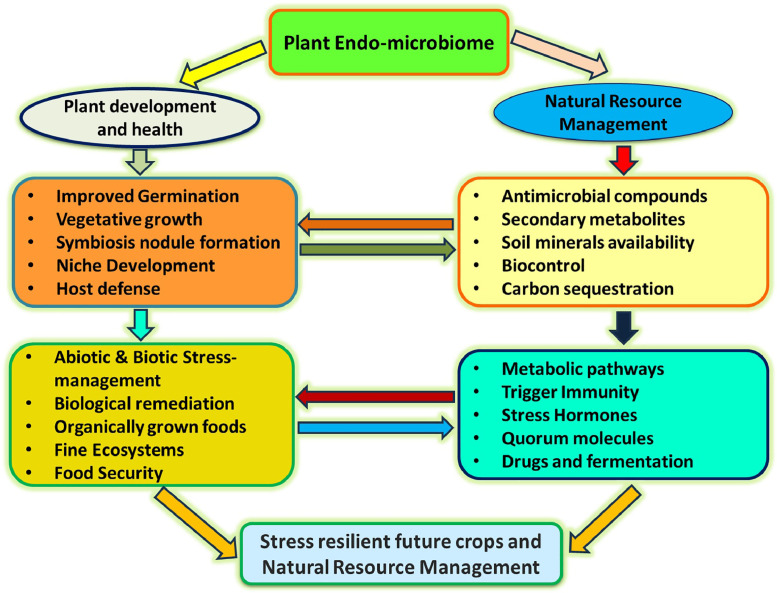
Plants have a microbiome, a diverse community of microorganisms, including bacteria, fungi, and viruses, living inside and on their tissues. Versatile endophytic microorganisms inhabited in every plant part without causing disease and develop endophytic microbiome or endo-microbiome. Plant endo-microbiome are drawn by the nutrient rich micro-environment, and in turn some microbes mutualistically endorse and protect plant from adverse environmental stresses. Plant endo-microbiome interact within well-designed host equilibrium containing xylem, phloem, nutrients, phytohormones, metabolites and shift according to environmental and nutritional change. Plant endo-microbiome regulate and respond to environmental variations, pathogens, herbivores by producing stress regulators, organic acids, secondary metabolites, stress hormones as well as unknown substances and signalling molecules. Endomicrobiome efficiently synthesizes multiple bioactive compounds, stress phytohormones with high competence. The technological innovation as next generation genomics biology and high-throughput multiomics techniques stepping stones on the illumination of critical endo-microbiome communities and functional characterization that aid in improving plant physiology, biochemistry and immunity interplay for best crop productivity. This review article contains deeper insight in endomicrobiome related research work in last years, recruitment, niche development, nutrient dynamics, stress removal mechanisms, bioactive services in plant health development, community architecture and communication, and immunity interplay in producing stress resilient future crop.
植物拥有微生物群,即一个由细菌、真菌和病毒等多种微生物组成的多样化群落,它们生活在植物组织内部和表面。多功能内生微生物存在于植物的各个部位,不会引发疾病,并形成内生微生物群或内微生物群。植物内微生物群被营养丰富的微环境所吸引,反过来,一些微生物会互利地支持和保护植物免受不利环境压力的影响。植物内微生物群在精心设计的宿主平衡中相互作用,这种平衡包含木质部、韧皮部、营养物质、植物激素、代谢产物,并会根据环境和营养变化而改变。植物内微生物群通过产生应激调节剂、有机酸、次生代谢产物、应激激素以及未知物质和信号分子来调节并响应环境变化、病原体和食草动物。内微生物群能够高效地合成多种生物活性化合物和应激植物激素。作为下一代基因组生物学和高通量多组学技术的技术创新,为阐明关键的内微生物群落及其功能特性提供了助力,有助于改善植物生理学、生物化学以及免疫相互作用,以实现最佳作物产量。这篇综述文章深入探讨了近年来与内微生物群相关的研究工作,包括其募集、生态位发育、养分动态、应激消除机制、在植物健康发育中的生物活性服务、群落结构与通讯,以及在培育抗逆未来作物中免疫相互作用。