Liu Junli, Liu Mingming, Shi Shengnan, Jiang Fei, Zhang Ye, Guo Jing, Gong Xingrui
Department of Anesthesiology, Xiangyang Central Hospital, Institution of Neuroscience and Brain Disease, Affiliated Hospital of Hubei University of Arts and Science, Xiangyang, China.
Pain Rep. 2024 May 15;9(3):e1163. doi: 10.1097/PR9.0000000000001163. eCollection 2024 Jun.
Postoperative rebound pain after peripheral nerve block increases patient suffering and delays recovery after surgery.
We tested whether the 5HT-3 receptor antagonist and α7nAChR agonist tropisetron could prevent postoperative rebound pain.
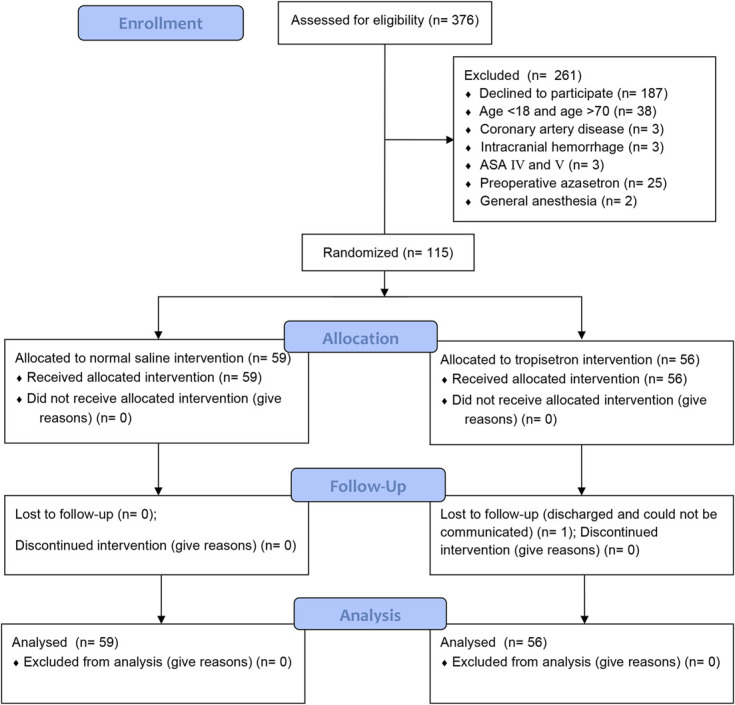
A total of 115 patients were randomized to receive 5-mg/5-mL tropisetron or the same volume of normal saline. Pain intensity was measured with the numerical rating scale of pain (NRS). Rebound pain was defined as a change from mild pain (NRS ≤ 3) measured in the postanesthesia care unit to severe pain (NRS ≥ 7) within 24 hours after peripheral nerve blockade. Logistic regression was used to identify relevant factors associated with postoperative rebound pain.
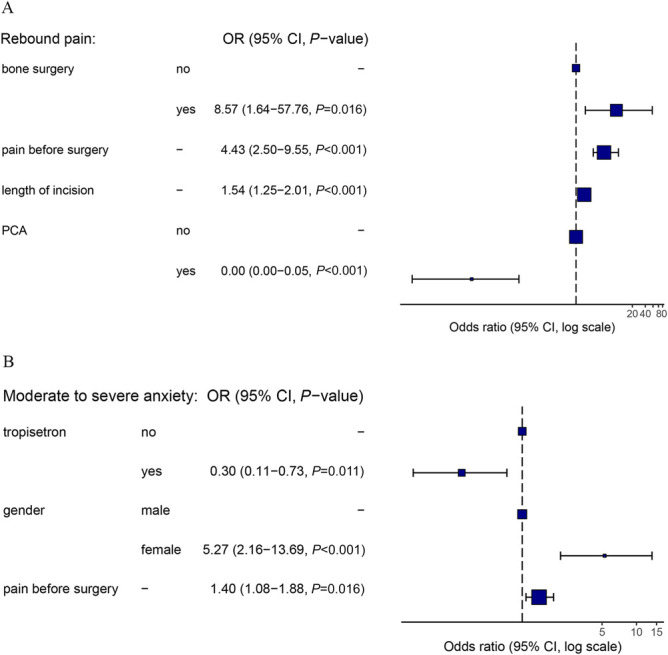
Tropisetron did not affect the NRS score or the incidence of rebound pain after peripheral nerve block. Logistic regression revealed that preoperative pain, bone surgery, and length of incision were risk factors for postoperative rebound pain, and patient-controlled analgesia was protective against postoperative rebound pain.
Tropisetron does not affect the incidence of rebound pain after peripheral nerve block. Patients at high risk of postoperative rebound pain should be identified for appropriate management. Registration site: www.chictr.org.cn (ChiCTR2300069994).
周围神经阻滞后的术后反弹痛会增加患者痛苦并延迟术后恢复。
我们测试了5-羟色胺-3受体拮抗剂和α7烟碱型乙酰胆碱受体激动剂托烷司琼是否能预防术后反弹痛。
总共115例患者被随机分配接受5毫克/5毫升托烷司琼或相同体积的生理盐水。疼痛强度用疼痛数字评定量表(NRS)进行测量。反弹痛定义为在麻醉后护理单元测得的轻度疼痛(NRS≤3)在周围神经阻滞后24小时内转变为重度疼痛(NRS≥7)。采用逻辑回归分析来确定与术后反弹痛相关的因素。
托烷司琼对外周神经阻滞后的NRS评分或反弹痛发生率没有影响。逻辑回归分析显示,术前疼痛、骨科手术和切口长度是术后反弹痛的危险因素,而患者自控镇痛对术后反弹痛具有预防作用。
托烷司琼不影响周围神经阻滞后的反弹痛发生率。应识别出术后反弹痛高危患者以便进行适当管理。注册网址:www.chictr.org.cn(ChiCTR2300069994)。