Kaur Jasmine, Singh Harpreet, Sethi Tavpritesh
Center of Excellence in Healthcare, Indraprastha Institute of Information Technology Delhi, New Delhi, India.
Department of Computational Biology, Indraprastha Institute of Information Technology Delhi, New Delhi, India.
Lancet Reg Health Southeast Asia. 2024 May 9;26:100412. doi: 10.1016/j.lansea.2024.100412. eCollection 2024 Jul.
Antimicrobial resistance (AMR) has escalated to pandemic levels, posing a significant global health threat. This study examines the patterns and trends of AMR in Bloodstream Infections (BSIs) across India, aiming to inform better surveillance and intervention strategies.
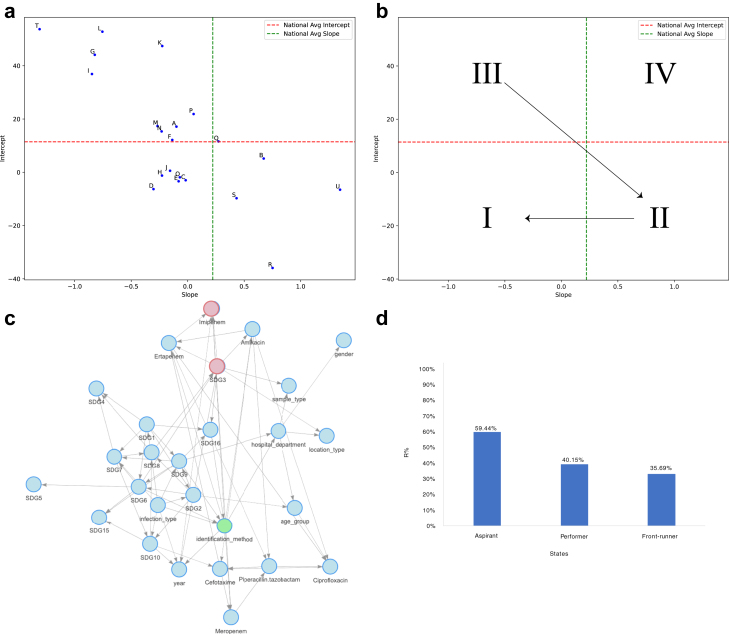
Six-year data from 21 tertiary care centers in the Indian Council of Medical Research's AMR Surveillance Network (IAMRSN) were retrospectively analyzed to estimate cluster-robust trends in resistance. Time-series analysis was used to discern lead/lag relationships between antibiotic pairs and the directional influence of resistance in community and hospital-acquired BSIs(CA/HA BSIs). A data-driven Bayesian network ensemble averaged over 301 bootstrap samples was modelled to uncover systemic associations between AMR and Sustainable Development Goals (SDGs).
Our findings indicate significant (p < 0.001) monthly increases in Imipenem and Meropenem resistance for , , and BSIs. Importantly, Carbapenem resistance in HA-BSIs preceded that in CA-BSIs for and (p < 0.05). At a national level, Cefotaxime resistance emerged as a potential early indicator for emerging Carbapenem resistance, proposing a novel surveillance marker. In BSIs, states with higher achievement of SDG3 goals showed lower Imipenem resistance. A model-based AMR scorecard is introduced for focused interventions and continuous monitoring.
The identified spatiotemporal trends and drug resistance associations offer critical insights for AMR surveillance aligning with WHO GLASS standards.The escalation of carbapenem resistance in BSIs demands vigilant monitoring and may be crucial for achieving SDGs by 2030. Implementing the proposed framework for data-driven evidence can help nations achieve proactive AMR surveillance.
No specific funding was received for this analysis.
抗菌药物耐药性(AMR)已升级到全球流行水平,对全球健康构成重大威胁。本研究调查了印度血流感染(BSIs)中AMR的模式和趋势,旨在为更好的监测和干预策略提供依据。
对印度医学研究理事会抗菌药物耐药性监测网络(IAMRSN)中21个三级医疗中心的六年数据进行回顾性分析,以估计耐药性的聚类稳健趋势。采用时间序列分析来识别抗生素对之间的超前/滞后关系,以及社区获得性和医院获得性血流感染(CA/HA-BSIs)中耐药性的方向性影响。对301个自抽样样本进行平均的数据驱动贝叶斯网络集成模型,以揭示AMR与可持续发展目标(SDGs)之间的系统关联。
我们的研究结果表明,在[具体情况未提及]、[具体情况未提及]和[具体情况未提及]血流感染中,亚胺培南和美罗培南耐药性每月有显著(p < 0.001)增加。重要的是,在[具体情况未提及]和[具体情况未提及]中,医院获得性血流感染中的碳青霉烯耐药性先于社区获得性血流感染(p < 0.05)。在国家层面,头孢噻肟耐药性成为新出现的碳青霉烯耐药性的潜在早期指标,提出了一种新的监测标志物。在[具体情况未提及]血流感染中,可持续发展目标3目标实现程度较高的邦亚胺培南耐药性较低。引入了基于模型的AMR记分卡,用于重点干预和持续监测。
所确定的时空趋势和耐药性关联为符合世界卫生组织全球抗菌药物耐药和使用监测系统(GLASS)标准的AMR监测提供了关键见解。血流感染中碳青霉烯耐药性的升级需要警惕监测,这对于到2030年实现可持续发展目标可能至关重要。实施所提议的数据驱动证据框架可以帮助各国实现主动的AMR监测。
本分析未获得特定资金。