Santella Biagio, Folliero Veronica, Pirofalo Gerarda Maria, Serretiello Enrica, Zannella Carla, Moccia Giuseppina, Santoro Emanuela, Sanna Giuseppina, Motta Oriana, De Caro Francesco, Pagliano Pasquale, Capunzo Mario, Galdiero Massimiliano, Boccia Giovanni, Franci Gianluigi
Section of Microbiology and Virology, University Hospital "Luigi Vanvitelli", 80138 Naples, Italy.
Department of Experimental Medicine, University of Campania "Luigi Vanvitelli", 80138 Naples, Italy.
Antibiotics (Basel). 2020 Nov 28;9(12):851. doi: 10.3390/antibiotics9120851.
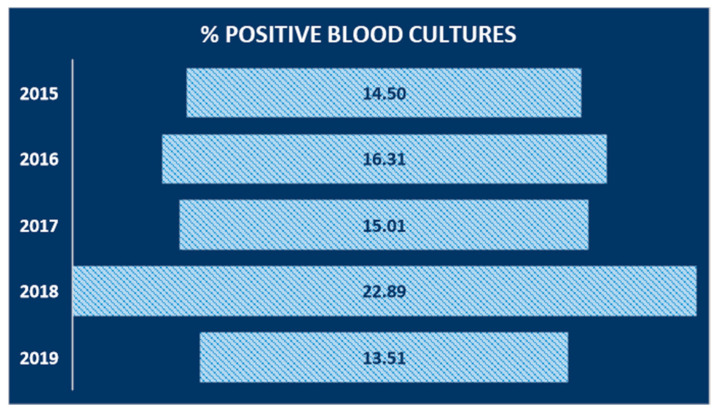
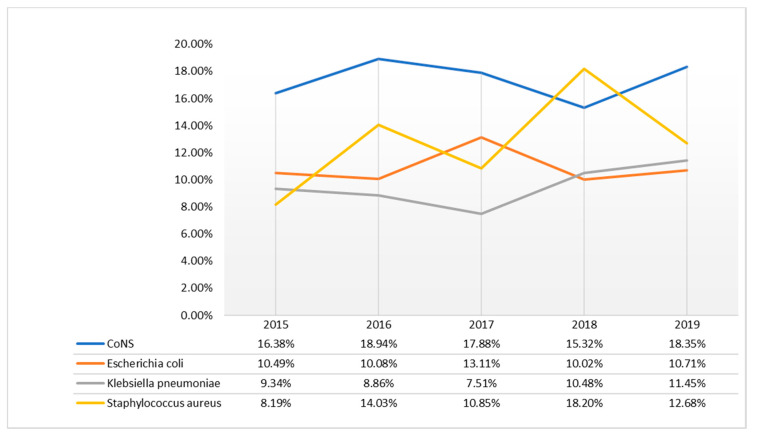
Bloodstream infections (BSIs) are among the leading causes of morbidity and mortality worldwide, among infectious diseases. Local knowledge of the main bacteria involved in BSIs and their associated antibiotic susceptibility patterns is essential to rationalize the empiric antimicrobial therapy. The aim of this study was to define the incidence of infection and evaluate the antimicrobial resistance profile of the main pathogens involved in BSIs. This study enrolled patients of all ages and both sexes admitted to the University Hospital "San Giovanni di Dio e Ruggi d'Aragona", Salerno, Italy between January 2015 to December 2019. Bacterial identification and antibiotic susceptibility testing were performed with Vitek 2. A number of 3.949 positive blood cultures were included out of 24,694 total blood cultures from 2015 to 2019. Coagulase-negative staphylococci (CoNS) were identified as the main bacteria that caused BSI (17.4%), followed by (12.3%), (10.9%), and (9.4%). Gram-positive bacteria were highly resistant to Penicillin G and Oxacillin, while Gram-negative strains to Ciprofloxacin, Cefotaxime, Ceftazidime, and Amoxicillin-clavulanate. High susceptibility to Vancomycin, Linezolid, and Daptomycin was observed among Gram-positive strains. Fosfomycin showed the best performance to treatment Gram-negative BSIs. Our study found an increase in resistance to the latest generation of antibiotics over the years. This suggests an urgent need to improve antimicrobial management programs to optimize empirical therapy in BSI.
血流感染(BSIs)是全球范围内传染病中导致发病和死亡的主要原因之一。了解当地血流感染中主要涉及的细菌及其相关的抗生素敏感性模式对于合理使用经验性抗菌治疗至关重要。本研究的目的是确定感染发生率,并评估血流感染中主要病原体的抗菌耐药性特征。本研究纳入了2015年1月至2019年12月期间入住意大利萨勒诺“圣乔瓦尼迪奥鲁吉达拉戈纳大学医院”的所有年龄和性别的患者。使用Vitek 2进行细菌鉴定和抗生素敏感性测试。在2015年至2019年的24694份总血培养物中,有3949份血培养呈阳性。凝固酶阴性葡萄球菌(CoNS)被确定为导致血流感染的主要细菌(17.4%),其次是[此处原文缺失部分内容](12.3%)、[此处原文缺失部分内容](10.9%)和[此处原文缺失部分内容](9.4%)。革兰氏阳性菌对青霉素G和苯唑西林高度耐药,而革兰氏阴性菌对环丙沙星、头孢噻肟、头孢他啶和阿莫西林-克拉维酸耐药。在革兰氏阳性菌株中观察到对万古霉素、利奈唑胺和达托霉素的高敏感性。磷霉素对革兰氏阴性血流感染的治疗效果最佳。我们的研究发现,多年来对最新一代抗生素的耐药性有所增加。这表明迫切需要改进抗菌管理方案,以优化血流感染的经验性治疗。