Ajkunic Azra, Sayar Erolcan, Roudier Martine P, Patel Radhika A, Coleman Ilsa M, De Sarkar Navonil, Hanratty Brian, Adil Mohamed, Zhao Jimmy, Zaidi Samir, True Lawrence D, Sperger Jamie M, Cheng Heather H, Yu Evan Y, Montgomery Robert B, Hawley Jessica E, Ha Gavin, Persse Thomas, Galipeau Patricia, Lee John K, Harmon Stephanie A, Corey Eva, Lang Joshua M, Sawyers Charles L, Morrissey Colm, Schweizer Michael T, Gulati Roman, Nelson Peter S, Haffner Michael C
Division of Human Biology, Fred Hutchinson Cancer Center, Seattle, WA, USA.
Department of Urology, University of Washington, Seattle, WA, USA.
NPJ Precis Oncol. 2024 May 17;8(1):104. doi: 10.1038/s41698-024-00599-6.
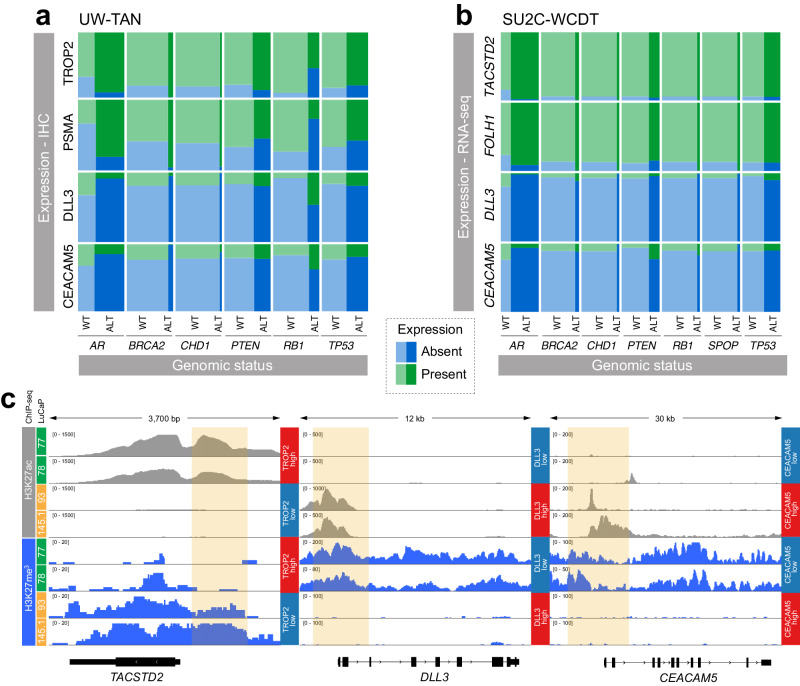
Therapeutic approaches targeting proteins on the surface of cancer cells have emerged as an important strategy for precision oncology. To capitalize on the potential impact of drugs targeting surface proteins, detailed knowledge about the expression patterns of the target proteins in tumor tissues is required. In castration-resistant prostate cancer (CRPC), agents targeting prostate-specific membrane antigen (PSMA) have demonstrated clinical activity. However, PSMA expression is lost in a significant number of CRPC tumors. The identification of additional cell surface targets is necessary to develop new therapeutic approaches. Here, we performed a comprehensive analysis of the expression heterogeneity and co-expression patterns of trophoblast cell-surface antigen 2 (TROP2), delta-like ligand 3 (DLL3), and carcinoembryonic antigen-related cell adhesion molecule 5 (CEACAM5) in CRPC samples from a rapid autopsy cohort. We show that DLL3 and CEACAM5 exhibit the highest expression in neuroendocrine prostate cancer (NEPC), while TROP2 is expressed across different CRPC molecular subtypes, except for NEPC. We further demonstrated that AR alterations were associated with higher expression of PSMA and TROP2. Conversely, PSMA and TROP2 expression was lower in RB1-altered tumors. In addition to genomic alterations, we show a tight correlation between epigenetic states, particularly histone H3 lysine 27 methylation (H3K27me3) at the transcriptional start site and gene body of TACSTD2 (encoding TROP2), DLL3, and CEACAM5, and their respective protein expression in CRPC patient-derived xenografts. Collectively, these findings provide insights into patterns and determinants of expression of TROP2, DLL3, and CEACAM5 with implications for the clinical development of cell surface targeting agents in CRPC.
靶向癌细胞表面蛋白的治疗方法已成为精准肿瘤学的一项重要策略。为了充分利用靶向表面蛋白药物的潜在影响,需要详细了解肿瘤组织中靶蛋白的表达模式。在去势抵抗性前列腺癌(CRPC)中,靶向前列腺特异性膜抗原(PSMA)的药物已显示出临床活性。然而,大量CRPC肿瘤中PSMA表达缺失。识别额外的细胞表面靶点对于开发新的治疗方法很有必要。在此,我们对来自快速尸检队列的CRPC样本中的滋养层细胞表面抗原2(TROP2)、δ样配体3(DLL3)和癌胚抗原相关细胞粘附分子5(CEACAM5)的表达异质性和共表达模式进行了全面分析。我们发现,DLL3和CEACAM5在神经内分泌前列腺癌(NEPC)中表达最高,而TROP2在除NEPC外的不同CRPC分子亚型中均有表达。我们进一步证明,AR改变与PSMA和TROP2的高表达相关。相反,在RB1改变的肿瘤中,PSMA和TROP2表达较低。除了基因组改变,我们还发现表观遗传状态之间存在紧密关联,特别是在TACSTD2(编码TROP2)、DLL3和CEACAM5的转录起始位点和基因体处的组蛋白H3赖氨酸27甲基化(H3K27me3),以及它们在CRPC患者来源异种移植中的各自蛋白表达。总的来说,这些发现为TROP2、DLL3和CEACAM5的表达模式和决定因素提供了见解,对CRPC中细胞表面靶向药物的临床开发具有重要意义。