Department of Biochemistry, Microbiology and Immunology, Faculty of Medicine, Centre for Infection, Immunity and Inflammation, Ottawa Institute of Systems Biology, University of Ottawa, Ottawa, ON, Canada.
Université Paris cité, CNRS, Inserm, Institut Cochin, Paris, France.
J Lipid Res. 2024 Jun;65(6):100564. doi: 10.1016/j.jlr.2024.100564. Epub 2024 May 17.
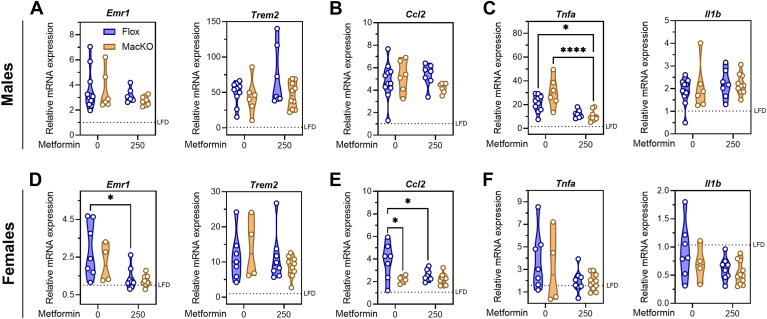
Metabolic programming underpins inflammation and liver macrophage activation in the setting of chronic liver disease. Here, we sought to identify the role of an important metabolic regulator, AMP-activated protein kinase (AMPK), specifically within myeloid cells during the progression of non-alcoholic steatohepatitis (NASH) and whether treatment with metformin, a firstline therapy for diabetes and activator of AMPK could stem disease progression. Male and female Prkaa1/Prkaa2 (Flox) control and Flox-LysM-Cre (MacKO) mice were fed a low-fat control or a choline-deficient, amino acid defined 45% Kcal high-fat diet (CDAHFD) for 8 weeks, where metformin was introduced in the drinking water (50 or 250 mg/kg/day) for the last 4 weeks. Hepatic steatosis and fibrosis were dramatically increased in response to CDAHFD-feeding compared to low-fat control. While myeloid AMPK signaling had no effect on markers of hepatic steatosis or circulating markers, fibrosis as measured by total liver collagen was significantly elevated in livers from MacKO mice, independent of sex. Although treatment with 50 mg/kg/day metformin had no effect on any parameter, intervention with 250 mg/kg/day metformin completely ameliorated hepatic steatosis and fibrosis in both male and female mice. While the protective effect of metformin was associated with lower final body weight, and decreased expression of lipogenic and Col1a1 transcripts, it was independent of myeloid AMPK signaling. These results suggest that endogenous AMPK signaling in myeloid cells, both liver-resident and infiltrating, acts to restrict fibrogenesis during CDAHFD-induced NASH progression but is not the mechanism by which metformin improves markers of NASH.
代谢编程为慢性肝病中的炎症和肝巨噬细胞激活提供了基础。在这里,我们试图确定一种重要的代谢调节剂 AMP 激活的蛋白激酶 (AMPK) 的作用,特别是在非酒精性脂肪性肝炎 (NASH) 进展过程中,髓样细胞内的作用,以及二甲双胍作为糖尿病一线治疗药物和 AMPK 激活剂是否可以阻止疾病进展。雄性和雌性 Prkaa1/Prkaa2 (Flox) 对照和 Flox-LysM-Cre (MacKO) 小鼠分别喂食低脂对照或胆碱缺乏、氨基酸定义的 45%热量高脂肪饮食 (CDAHFD)8 周,最后 4 周在饮用水中添加二甲双胍 (50 或 250mg/kg/天)。与低脂对照相比,CDAHFD 喂养导致肝脂肪变性和纤维化显著增加。髓样细胞 AMPK 信号对肝脂肪变性或循环标志物没有影响,但 MacKO 小鼠肝脏中的总肝胶原纤维化标志物显著升高,与性别无关。虽然 50mg/kg/天的二甲双胍治疗对任何参数都没有影响,但 250mg/kg/天的二甲双胍干预完全改善了雌雄小鼠的肝脂肪变性和纤维化。尽管二甲双胍的保护作用与较低的最终体重和脂生成和 Col1a1 转录物的表达降低有关,但它与髓样细胞 AMPK 信号无关。这些结果表明,CDAHFD 诱导的 NASH 进展过程中,肝固有和浸润的髓样细胞内的内源性 AMPK 信号会限制纤维化,但不是二甲双胍改善 NASH 标志物的机制。