Department of Biological Sciences, Faculty of Science, National University of Singapore, Singapore, 117543, Singapore.
Allergy and Molecular Immunology Laboratory, Lee Hiok Kwee Functional Genomics Laboratories, Block S2, Level 5, 14 Science Drive 4, Lower Kent Ridge Road, Singapore, 117543, Singapore.
J Physiol Anthropol. 2024 May 18;43(1):14. doi: 10.1186/s40101-024-00361-8.
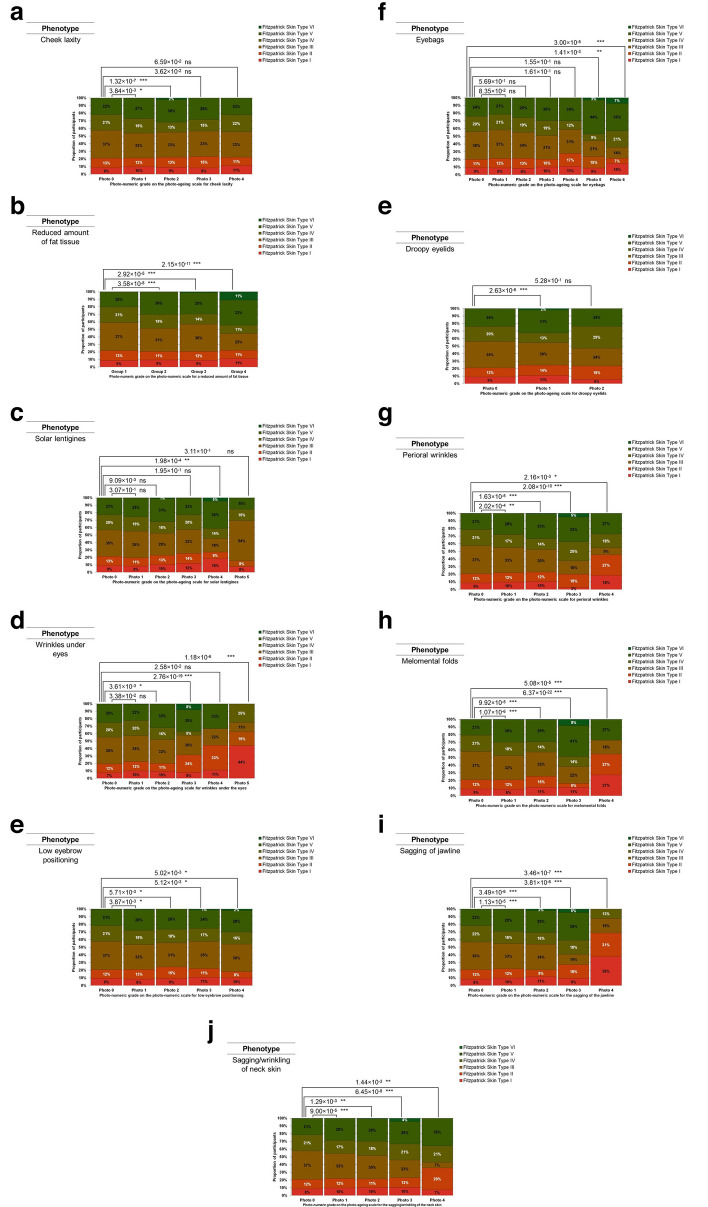
Changes develop on the facial skin as a person ages. Other than chronological time, it has been discovered that gender, ethnicity, air pollution, smoking, nutrition, and sun exposure are notable risk factors that influence the development of skin ageing phenotypes such as wrinkles and photo-ageing. These risk factors can be quantified through epidemiological collection methods. We previously studied wrinkles and photo-ageing in detail using photo-numeric scales. The analysis was performed on the ethnic Chinese skin by three trained assessors. Recent studies have shown that it is possible to use self-reported data to identify skin-related changes including skin colour and skin cancer. In order to investigate the association between risk factors and skin ageing phenotypic outcomes in large-scale epidemiological studies, it would be useful to evaluate whether it is also possible for participants to self-report signs of ageing on their skin.
We have previously identified several validated photo-numeric scales for wrinkling and photo-ageing to use on ethnic Chinese skin. Using these scales, our trained assessors grade wrinkling and photo-ageing with moderately high inter-assessor concordance and agreement. The main objective of this study involves letting participants grade self-reported wrinkling and photo-ageing using these same scales. We aim to compare the concordance and agreement between signs of skin ageing by the participant and signs of ageing identified by our assessors.
Three trained assessors studied facial photo-ageing on 1081 ethnic Chinese young adults from the Singapore/Malaysia Cross-sectional Genetics Epidemiology Study (SMCGES) cohort. Self-reported facial photo-ageing data by the same 1081 participants were also collated and the two sets of data are compared.
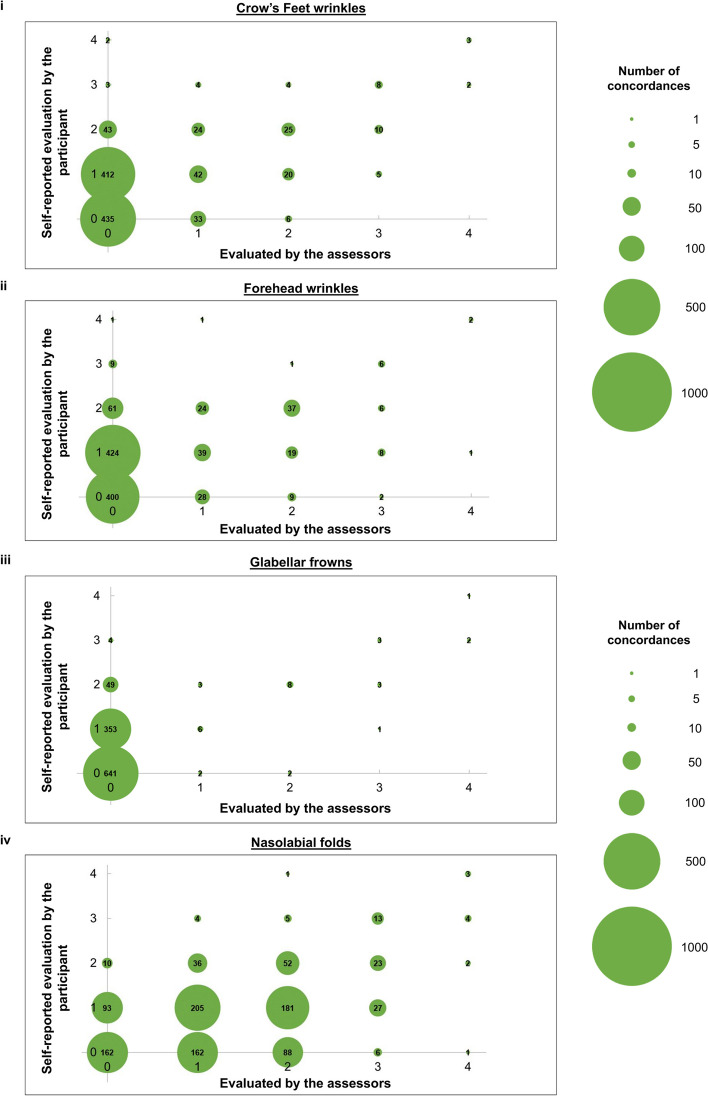
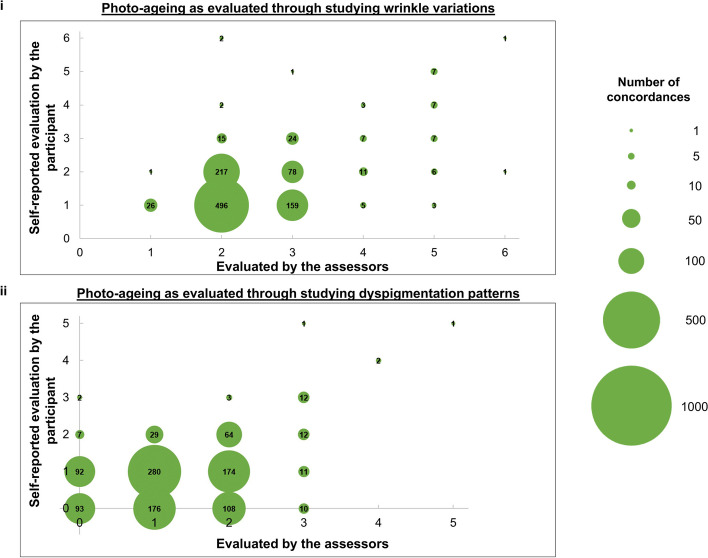
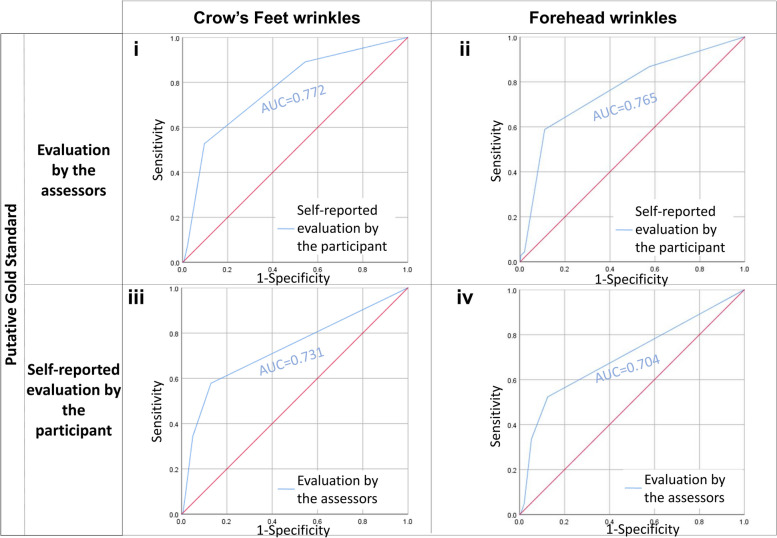
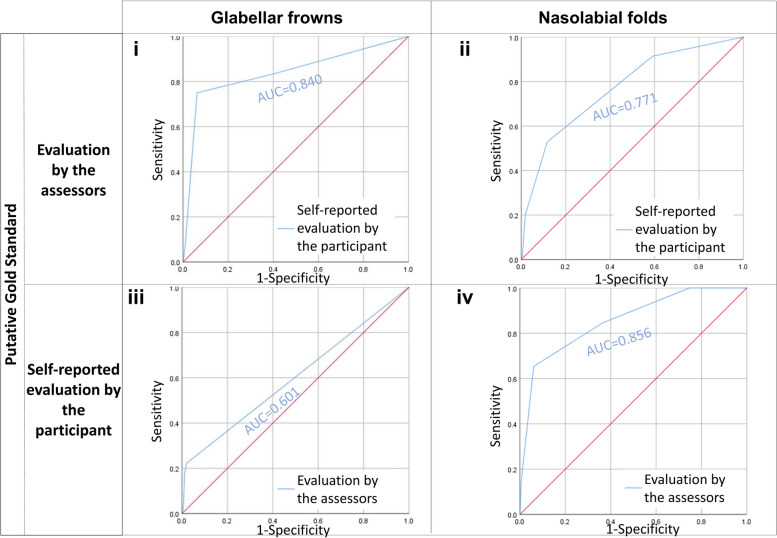
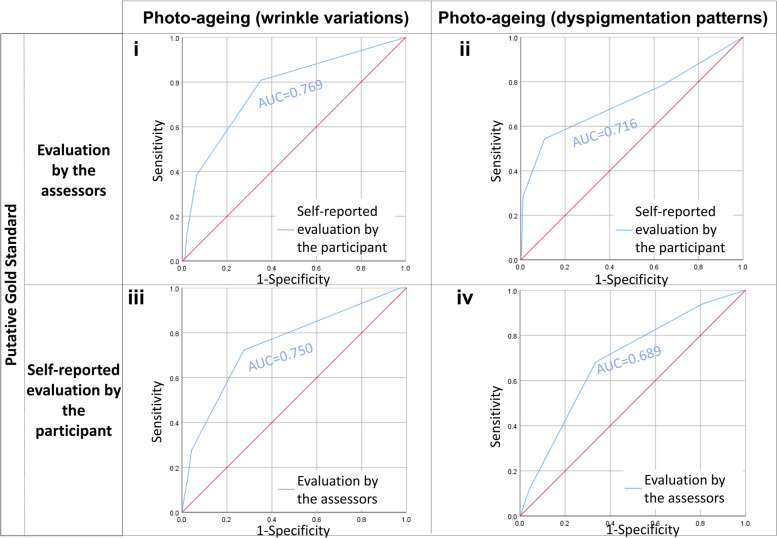
Here, we found that self-reported signs of photo-ageing are concordant with photo-ageing detected by our assessors. This finding is consistent whether photo-ageing is evaluated through studying wrinkle variations (Spearman's rank correlation (ρ) value: 0.246-0.329) or through studying dyspigmentation patterns (Spearman's rank correlation (ρ) value 0.203-0.278). When studying individual wrinkles, both participants and assessors often detect the presence of the same wrinkle (Spearman's rank correlation (ρ) value 0.249-0.366). A weak-to-fair level of agreement between both participants and assessors (Cohen's kappa (κ) values: 0.041-0.233) persists and is statistically significant after accounting for agreements due to chance. Both the participant and the assessor are largely consistent in evaluating the extent of photo-ageing (area under curve (AUC) values 0.689-0.769) and in discerning between the presence or absence of a given facial wrinkle (area under curve (AUC) values 0.601-0.856).
When we analyse the overall appearance of the face, our results show that signs of photo-ageing identified by the participant are concordant with signs of photo-ageing identified by our assessors. When we focused our analysis on specific areas of the face, we found that participants were more likely to identify and self-report the same wrinkles that our assessors have also detected. Here, we found that self-reported signs of skin ageing provide a satisfactory approximation to the signs of skin ageing identified by our assessors. The ability to use self-reported signs of skin ageing should also be evaluated on scales beyond the ones discussed in this study. Currently, there are not as many photo-numeric scales for quantifying dyspigmentation patterns as there are for quantifying wrinkle variations. As Chinese skin is known to become dyspigmented more easily with age, more photo-numeric scales need to be developed and properly validated.
随着人的年龄增长,面部皮肤会发生变化。除了时间因素外,已经发现性别、种族、空气污染、吸烟、营养和阳光照射等都是影响皱纹和光老化等皮肤老化表型发展的显著风险因素。这些风险因素可以通过流行病学收集方法进行量化。我们之前使用照片数字量表详细研究了皱纹和光老化。分析是由三名经过培训的评估员对汉族皮肤进行的。最近的研究表明,使用自我报告的数据来识别皮肤相关变化(包括肤色和皮肤癌)是可能的。为了在大规模的流行病学研究中研究风险因素与皮肤老化表型结果之间的关系,评估参与者是否也能够自我报告他们皮肤上的老化迹象将是有用的。
我们之前已经确定了几种经过验证的皱纹和光老化照片数字量表,可用于汉族皮肤。使用这些量表,我们经过培训的评估员对皱纹和光老化进行分级,具有中等程度的评估员间一致性和一致性。本研究的主要目的是让参与者使用相同的量表对自我报告的皱纹和光老化进行分级。我们旨在比较参与者自我报告的皮肤老化迹象与我们评估员识别的老化迹象之间的一致性和一致性。
三名经过培训的评估员对来自新加坡/马来西亚横断面遗传学流行病学研究(SMCGES)队列的 1081 名汉族年轻成年人的面部光老化进行了研究。还收集了同一 1081 名参与者的自我报告面部光老化数据,并对这两组数据进行了比较。
在这里,我们发现自我报告的光老化迹象与评估员检测到的光老化迹象一致。无论是通过研究皱纹变化(Spearman 秩相关系数(ρ)值:0.246-0.329)还是通过研究色素沉着变化模式(Spearman 秩相关系数(ρ)值 0.203-0.278)来评估光老化,都可以得出这一发现。当研究个体皱纹时,参与者和评估员通常会发现相同的皱纹(Spearman 秩相关系数(ρ)值 0.249-0.366)。参与者和评估员之间存在弱到中度的一致性(Cohen's kappa(κ)值:0.041-0.233),并且在考虑由于机会而产生的一致性后仍然具有统计学意义。参与者和评估员在评估光老化的程度(曲线下面积(AUC)值 0.689-0.769)和辨别给定面部皱纹的存在或不存在方面基本一致(AUC 值 0.601-0.856)。
当我们分析面部的整体外观时,我们的结果表明,参与者识别的光老化迹象与我们的评估员识别的光老化迹象是一致的。当我们将分析重点放在面部的特定区域时,我们发现参与者更有可能识别和自我报告评估员也已检测到的相同皱纹。在这里,我们发现自我报告的皮肤老化迹象与评估员识别的皮肤老化迹象大致相符。应该在本研究中讨论的量表之外,还评估使用自我报告的皮肤老化迹象的能力。目前,用于量化色素沉着变化模式的照片数字量表不如用于量化皱纹变化的量表多。由于中国人的皮肤随着年龄的增长更容易出现色素沉着不均,因此需要开发和正确验证更多的照片数字量表。