Wang Chengli, Lin Liling, Wu Jiayao, Fu Ganglan, Liu Zhongqi, Cao Minghui
Department of Anesthesiology, Sun Yat-sen Memorial Hospital, Sun Yat-sen University, Guangzhou, China.
Guangdong Provincial Key Laboratory of Malignant Tumor Epigenetics and Gene, Regulation, Sun Yat-sen Memorial Hospital, Sun Yat-sen University, Guangzhou, China.
Front Oncol. 2024 May 2;14:1345766. doi: 10.3389/fonc.2024.1345766. eCollection 2024.
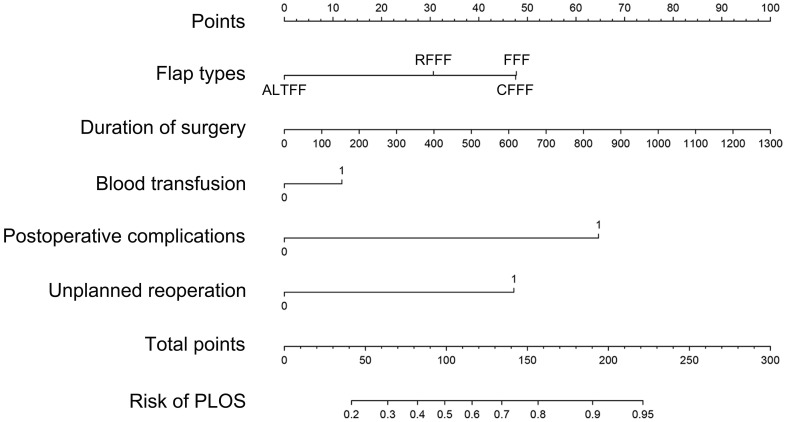
The aim of the present study was to build and internally validate a nomogram model for predicting prolonged length of stay (PLOS) among patients receiving free vascularized flap reconstruction of head and neck cancer (HNC).
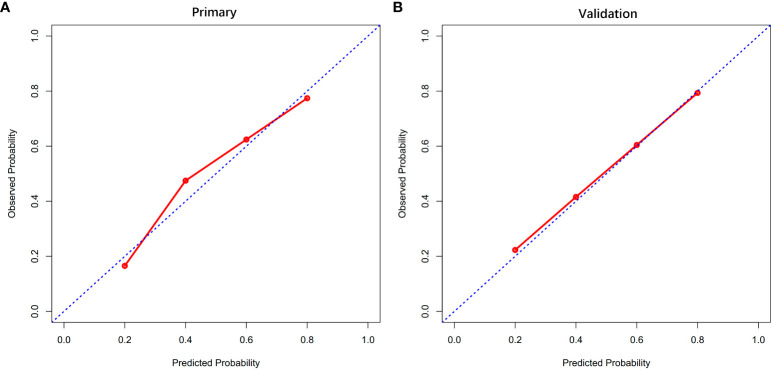
A retrospective clinical study was performed at a single center, examining patients receiving free vascularized flap reconstruction of HNC from January 2011 to January 2019. The variables were obtained from the electronic information system. The primary outcome measure was PLOS. Univariate and multivariate analyses were used to find risk factors for predicting PLOS. A model was then built according to multivariate results. Internal validation was implemented via 1000 bootstrap samples.
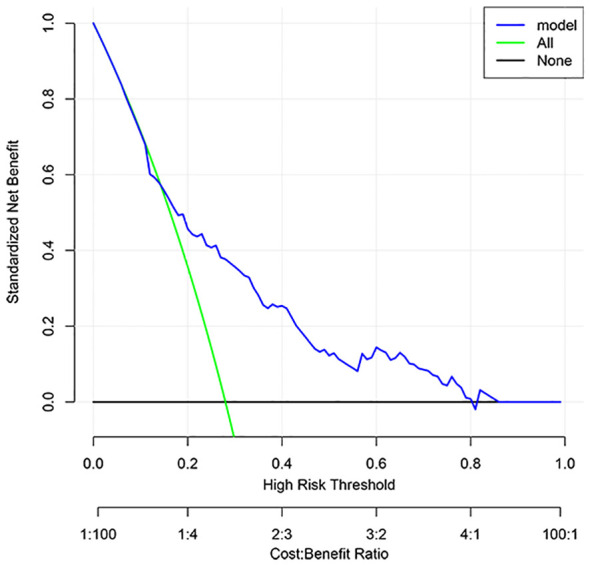
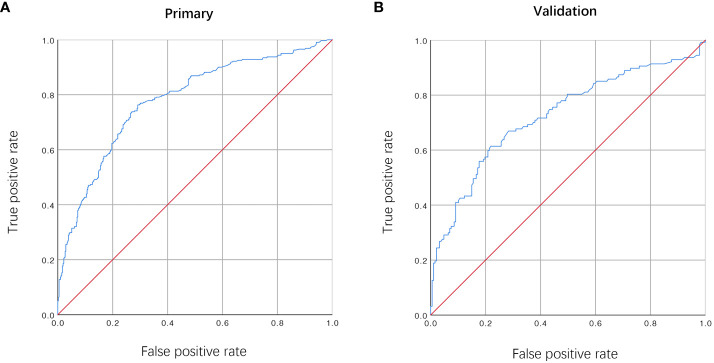
The study included 1047 patients, and the median length of stay (LOS) was 13.00 (11.00, 16.00) days. Multivariate analysis showed that flap types ((radial forearm free flap (odds ratio [OR] = 2.238; 95% CI, 1.403-3.569; P = 0.001), free fibula flap (OR = 3.319; 95% CI, 2.019-4.882; P < 0.001)), duration of surgery (OR = 1.002; 95% CI, 1.001-1.003; P = 0.004), postoperative complications (OR = 0.205; 95% CI, 0.129-0.325; P = P < 0.001) and unplanned reoperation (OR = 0.303; 95% CI, 0.140-0.653; P = 0.002) were associated with PLOS. In addition to these variables, blood transfusion was comprised in the model. The AUC of the model was 0.78 (95% CI, 0.711-0.849) and 0.725 (95% CI, 0.605-0.845) in the primary and internal validation cohorts, respectively. The DCA revealed the clinical utility of the current model when making intervention decisions within the PLOS possibility threshold range of 0.2-0.8.
Our study developed a nomogram that exhibits a commendable level of accuracy, thereby aiding clinicians in assessing the risk of PLOS among patients receiving free vascularized flap reconstruction for HNC.
本研究的目的是构建并在内部验证一个列线图模型,用于预测接受头颈癌(HNC)游离血管化皮瓣重建术患者的住院时间延长(PLOS)情况。
在单一中心进行了一项回顾性临床研究,研究对象为2011年1月至2019年1月期间接受HNC游离血管化皮瓣重建术的患者。变量从电子信息系统中获取。主要结局指标是PLOS。采用单因素和多因素分析来寻找预测PLOS的危险因素。然后根据多因素分析结果构建模型。通过1000次自抽样进行内部验证。
该研究纳入了1047例患者,中位住院时间(LOS)为13.00(11.00,16.00)天。多因素分析显示,皮瓣类型(桡侧前臂游离皮瓣(比值比[OR]=2.238;95%CI,1.403 - 3.569;P = 0.001)、游离腓骨皮瓣(OR = 3.319;95%CI,2.019 - 4.882;P < 0.001))、手术时长(OR = 1.002;95%CI,1.001 - 1.003;P = 0.004)、术后并发症(OR = 0.205;95%CI,0.129 - 0.325;P < 0.001)和计划外再次手术(OR = 0.303;95%CI,0.140 - 0.653;P = 0.002)与PLOS相关。除这些变量外,模型中还纳入了输血情况。该模型在主要验证队列和内部验证队列中的曲线下面积(AUC)分别为0.78(95%CI,0.711 - 0.849)和0.725(95%CI,0.605 - 0.845)。决策曲线分析(DCA)显示,在PLOS可能性阈值范围为0.2 - 0.8时做出干预决策,当前模型具有临床实用性。
我们的研究开发了一个列线图,其准确性水平值得称赞,有助于临床医生评估接受HNC游离血管化皮瓣重建术患者发生PLOS的风险。