Department of Family Medicine, Faculty of Medicine, Imam Mohammad Ibn Saud Islamic University, Riyadh, Saudi Arabia.
J Obes. 2024 May 10;2024:8056440. doi: 10.1155/2024/8056440. eCollection 2024.
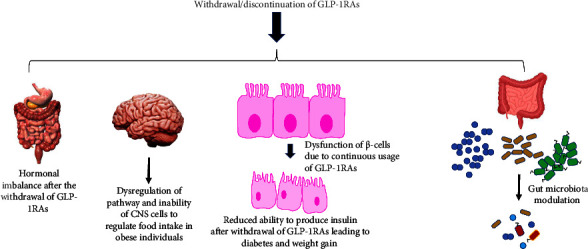
Obesity is considered the leading public health problem in the medical sector. The phenotype includes overweight conditions that lead to several other comorbidities that drastically decrease health. Glucagon-like receptor agonists (GLP-1RAs) initially designed for treating type 2 diabetes mellitus (T2DM) had demonstrated weight loss benefits in several clinical trials studies showed that GLP-1RA encourages reduced food consumption and consequent weight reduction by stimulating brown fat and enhancing energy outlay through the action of the sympathetic nervous system (SNS) pathways. Additionally, GLP-1RAs were found to regulate food intake through stimulation of sensory neurons in the vagus, interaction with the hypothalamus and hindbrain, and through inflammation and intestinal microbiota. However, the main concern with the use of GLP-1RA treatment was weight gain after withdrawal or discontinuation. We could identify three different ways that could lead to weight gain. Potential factors might include temporary hormonal adjustment in response to weight reduction, the central nervous system's (CNS) incompetence in regulating weight augmentation owing to the lack of GLP-1RA, and -cell malfunction due to sustained exposure to GLP-1RA. Here, we also review the data from clinical studies that reported withdrawal symptoms. Although the use of GLP-1RA could be beneficial in multiple ways, withdrawal after years has the symptoms reversed. Clinical studies should emphasize the downside of these views we highlighted, and mechanistic studies must be carried out for a better outcome with GLP-1RA from the laboratory to the bedside.
肥胖被认为是医疗领域的首要公共卫生问题。表型包括超重,导致多种其他合并症,严重降低健康水平。最初设计用于治疗 2 型糖尿病 (T2DM) 的胰高血糖素样肽受体激动剂 (GLP-1RAs) 在几项临床试验中显示出减肥益处,研究表明 GLP-1RA 通过刺激棕色脂肪和通过交感神经系统 (SNS) 途径增强能量支出来鼓励减少食物消耗和随之而来的体重减轻。此外,GLP-1RAs 被发现通过刺激迷走神经中的感觉神经元、与下丘脑和后脑的相互作用以及通过炎症和肠道微生物群来调节食物摄入。然而,使用 GLP-1RA 治疗的主要关注点是停药或停药后体重增加。我们可以确定导致体重增加的三种不同方式。潜在因素可能包括对体重减轻的暂时激素调整、由于缺乏 GLP-1RA,中枢神经系统 (CNS) 无法调节体重增加以及由于持续暴露于 GLP-1RA 而导致的 -细胞功能障碍。在这里,我们还回顾了报告停药症状的临床研究数据。尽管 GLP-1RA 的使用在多个方面可能是有益的,但多年后停药会使症状逆转。临床研究应强调我们强调的这些观点的缺点,并且必须进行机制研究,以便从实验室到床边更好地利用 GLP-1RA 获得更好的结果。