Nuffield Department of Orthopaedics, Rheumatology and Musculoskeletal Sciences, University of Oxford, Oxford, UNITED KINGDOM.
SwissRe Institute, UNITED KINGDOM.
Med Sci Sports Exerc. 2024 Oct 1;56(10):1945-1953. doi: 10.1249/MSS.0000000000003478. Epub 2024 May 15.
Step count is an intuitive measure of physical activity frequently quantified in health-related studies; however, accurate step counting is difficult in the free-living environment, with error routinely above 20% in wrist-worn devices against camera-annotated ground truth. This study aimed to describe the development and validation of step count derived from a wrist-worn accelerometer and assess its association with cardiovascular and all-cause mortality in a large prospective cohort.
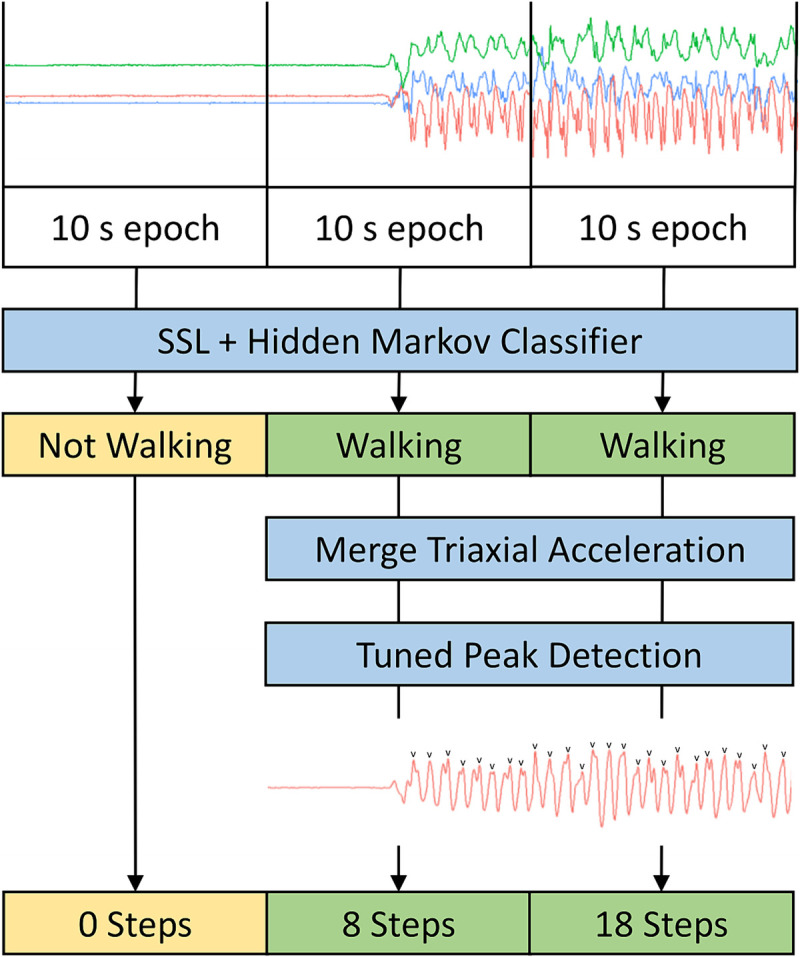
We developed and externally validated a self-supervised machine learning step detection model, trained on an open-source and step-annotated free-living dataset. Thirty-nine individuals will free-living ground-truth annotated step counts were used for model development. An open-source dataset with 30 individuals was used for external validation. Epidemiological analysis was performed using 75,263 UK Biobank participants without prevalent cardiovascular disease (CVD) or cancer. Cox regression was used to test the association of daily step count with fatal CVD and all-cause mortality after adjustment for potential confounders.
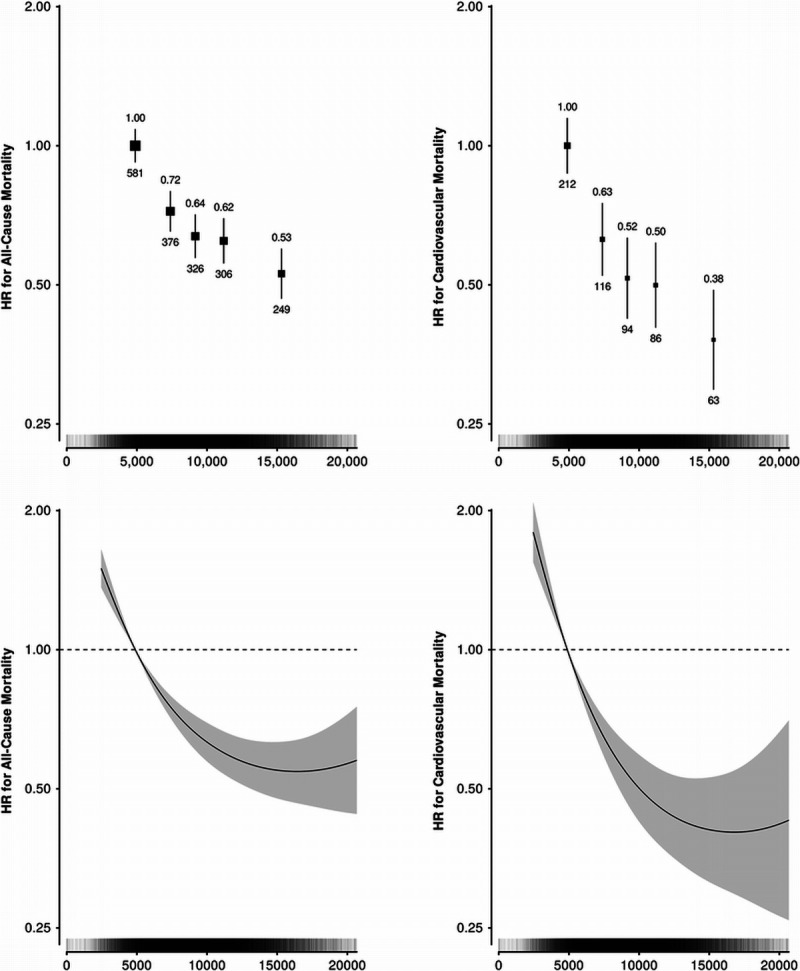
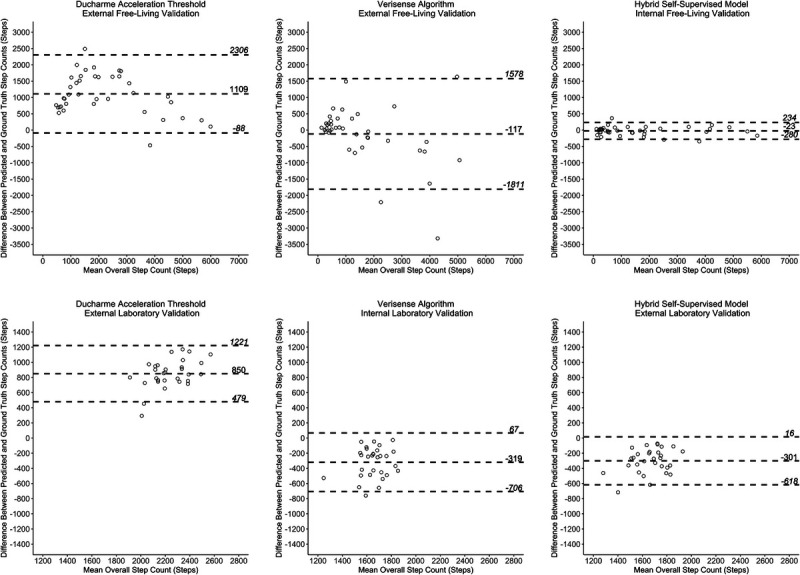
The algorithm substantially outperformed reference models (free-living mean absolute percent error of 12.5% vs 65%-231%). Our data indicate an inverse dose-response association, where taking 6430-8277 daily steps was associated with 37% (25%-48%) and 28% (20%-35%) lower risk of fatal CVD and all-cause mortality up to 7 yr later, compared with those taking fewer steps each day.
We have developed an open and transparent method that markedly improves the measurement of steps in large-scale wrist-worn accelerometer datasets. The application of this method demonstrated expected associations with CVD and all-cause mortality, indicating excellent face validity. This reinforces public health messaging for increasing physical activity and can help lay the groundwork for the inclusion of target step counts in future public health guidelines.
步数是衡量身体活动的直观指标,在与健康相关的研究中经常被量化;然而,在自由生活环境中,准确的计步非常困难,腕戴设备的误差通常比摄像机标记的地面真实值高出 20%以上。本研究旨在描述一种腕戴加速度计计步的开发和验证,并评估其与心血管疾病和全因死亡率的相关性,该研究基于一个大型前瞻性队列。
我们开发并外部验证了一种基于机器学习的自我监督步频检测模型,该模型是在一个开源的、带步频注释的自由生活数据集上训练的。使用 39 名个体的自由生活地面真实注释步数来开发模型。使用一个包含 30 名个体的开源数据集进行外部验证。使用没有患心血管疾病(CVD)或癌症的 75263 名英国生物库参与者进行流行病学分析。使用 Cox 回归来测试每天步数与致命 CVD 和全因死亡率之间的关联,调整了潜在的混杂因素。
该算法大大优于参考模型(自由生活的平均绝对百分比误差为 12.5%,而 65%-231%)。我们的数据表明存在一种剂量反应反比关系,每天走 6430-8277 步与致命 CVD 和全因死亡率的风险降低 37%(25%-48%)和 28%(20%-35%)相关,与每天走较少步数的人相比,这一风险在 7 年以后仍然存在。
我们开发了一种开放和透明的方法,极大地提高了大规模腕戴加速度计数据集的步数测量精度。该方法的应用显示了与 CVD 和全因死亡率的预期关联,表明其具有极好的表面有效性。这强化了增加身体活动的公共卫生信息,并为未来公共卫生指南中包含目标步数奠定了基础。