Harper Charlie, Sturge Adam D, Chan Shing, Maylor Ben, Shreves Alaina, Meier Daniel, Patkee Prachi, Schoonbee John, Strange Adam, Nabholz Christoph, Bennett Derrick, Doherty Aiden
Nuffield Department of Population Health, University of Oxford, UK.
Big Data Institute, Li Ka Shing Centre for Health Information and Discovery, University of Oxford, UK.
medRxiv. 2025 Apr 4:2025.04.03.25325101. doi: 10.1101/2025.04.03.25325101.
Many adults in high-income countries carry a device capable of measuring physical-activity behaviour. Thus, there is public health need to understand whether such data can enhance prediction of future health outcomes. We aimed to investigate whether device-measured daily-step count and walking cadence improve the prediction of mortality beyond traditional risk-factors.
Risk models were developed to predict five-year all-cause mortality using data from the UK Biobank accelerometer sub-study, with external validation in the US 2011-2014 National Health and Nutrition Examination Survey (NHANES). Median daily-step count and peak one-minute walking cadence were derived using self-supervised machine learning models from seven-day wrist-worn accelerometer data. Cox models were used to develop a baseline model incorporating traditional risk-factors, and a baseline model plus accelerometer data (i.e. daily-steps and walking cadence). Changes in model performance were assessed using Harrell's C-index, net reclassification index (NRI; 10% threshold), and the Nam-D'Agostino calibration test.
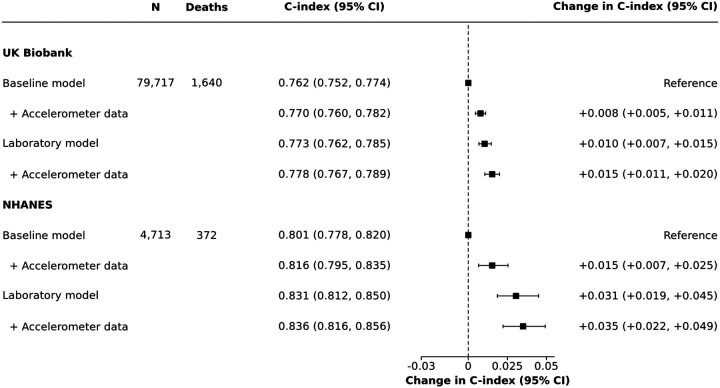
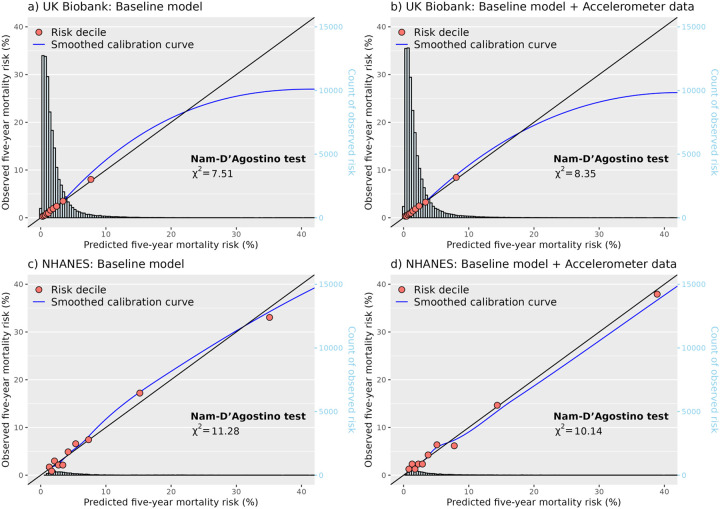
Among 79,717 UK Biobank participants, 1,640 died within 5-years. Adding accelerometer data to the baseline model modestly improved risk discrimination and classification with a change in c-index of 0.008 (95% confidence interval [CI] 0.005-0.011) and 3.3% NRI (95%CI 2.1%-4.5%). Greatest improvements in prediction were observed in participants with prior disease at baseline, showing a change in c-index of 0.028 (95%CI 0.019-0.039) and 5.9% NRI (95%CI 3.1%-8.6%). In the NHANES external validation cohort (n=4,713; deaths=378), similar improvements in prediction were observed (change in c-index: 0.015, 95%CI 0.007-0.025; NRI: 4.0%, 95%CI 0.7%-7.4%). All models were well calibrated (Nam-D'Agostino χ range: 6.8-13.2).
Device-measured daily-step count and walking cadence consistently demonstrated modest improvements in predicting mortality risk beyond traditional risk-factors, with the most significant enhancements seen in individuals with prior disease. These findings suggest that incorporating information from wearables does provide important new ways to improve risk stratification for targeted intervention in high-risk individuals.
高收入国家的许多成年人都携带能够测量身体活动行为的设备。因此,从公共卫生角度出发,有必要了解此类数据是否能提高对未来健康结果的预测能力。我们旨在研究通过设备测量的每日步数和步行节奏能否在传统风险因素之外改善对死亡率的预测。
利用英国生物银行加速度计子研究的数据建立风险模型,以预测五年全因死亡率,并在美国2011 - 2014年国家健康与营养检查调查(NHANES)中进行外部验证。使用自监督机器学习模型从七天佩戴在手腕上的加速度计数据中得出每日步数中位数和一分钟步行节奏峰值。使用Cox模型建立一个纳入传统风险因素的基线模型,以及一个包含加速度计数据(即每日步数和步行节奏)的基线模型。使用Harrell氏C指数、净重新分类指数(NRI;10%阈值)和Nam - D'Agostino校准测试评估模型性能的变化。
在79,717名英国生物银行参与者中,1,640人在5年内死亡。将加速度计数据添加到基线模型中适度改善了风险辨别和分类能力,C指数变化为0.008(95%置信区间[CI] 0.005 - 0.011),NRI为3.3%(95%CI 2.1% - 4.5%)。在基线时有既往疾病的参与者中观察到预测方面的最大改善,C指数变化为0.028(95%CI 0.019 - 0.039),NRI为5.9%(95%CI 3.1% - 8.6%)。在美国国家健康与营养检查调查(NHANES)外部验证队列(n = 4,713;死亡人数 = 378)中,也观察到了类似的预测改善(C指数变化:0.015,95%CI 0.007 - 0.025;NRI:4.0%,95%CI 0.7% - 7.4%)。所有模型校准良好(Nam - D'Agostino χ范围:6.8 - 13.2)。
通过设备测量的每日步数和步行节奏始终显示出在传统风险因素之外预测死亡风险方面有适度改善,在有既往疾病的个体中改善最为显著。这些发现表明,纳入可穿戴设备的信息确实为改善高风险个体的风险分层以进行有针对性的干预提供了重要的新方法。