Ewnetu Yalemwork, Badu Kingsley, Carlier Lise, Vera-Arias Claudia A, Troth Emma V, Mutala Abdul-Hakim, Afriyie Stephen Opoku, Addison Thomas Kwame, Berhane Nega, Lemma Wossenseged, Koepfli Cristian
Department of Medical Biotechnology, Institute of Biotechnology, University of Gondar, Gondar, Ethiopia.
University of Gondar Comprehensive Specialized Hospital, Gondar, Ethiopia.
PLOS Glob Public Health. 2024 May 20;4(5):e0003091. doi: 10.1371/journal.pgph.0003091. eCollection 2024.
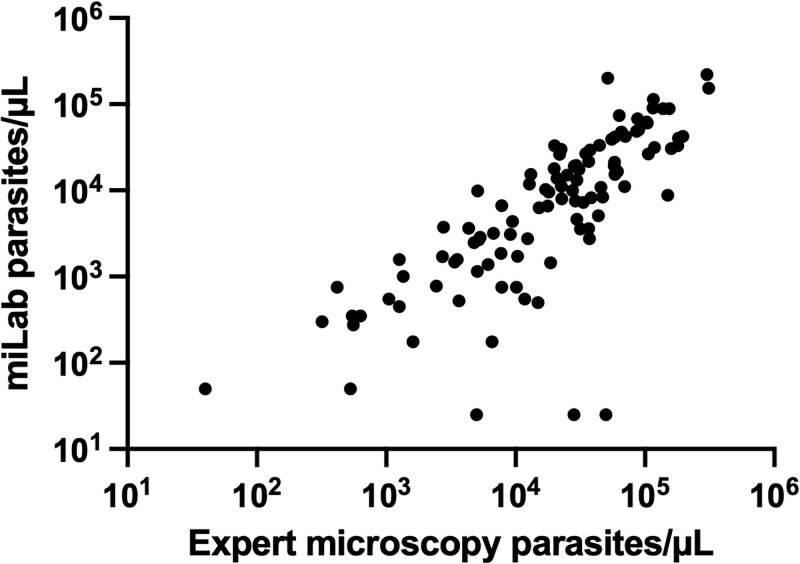
Sensitive and accurate malaria diagnosis is required for case management to accelerate control efforts. Diagnosis is particularly challenging where multiple Plasmodium species are endemic, and where P. falciparum hrp2/3 deletions are frequent. The Noul miLab is a fully automated portable digital microscope that prepares a blood film from a droplet of blood, followed by staining and detection of parasites by an algorithm. Infected red blood cells are displayed on the screen of the instrument. Time-to-result is approximately 20 minutes, with less than two minutes hands-on time. We evaluated the miLab among 659 suspected malaria patients in Gondar, Ethiopia, where P. falciparum and P. vivax are endemic, and the frequency of hrp2/3 deletions is high, and 991 patients in Ghana, where P. falciparum transmission is intense. Across both countries combined, the sensitivity of the miLab for P. falciparum was 94.3% at densities >200 parasites/μL by qPCR, and 83% at densities >20 parasites/μL. The miLab was more sensitive than local microscopy, and comparable to RDT. In Ethiopia, the miLab diagnosed 51/52 (98.1%) of P. falciparum infections with hrp2 deletion at densities >20 parasites/μL. Specificity of the miLab was 94.0%. For P. vivax diagnosis in Ethiopia, the sensitivity of the miLab was 97.0% at densities >200 parasites/μL (RDT: 76.8%, microscopy: 67.0%), 93.9% at densities >20 parasites/μL, and specificity was 97.6%. In Ethiopia, where P. falciparum and P. vivax were frequent, the miLab assigned the wrong species to 15/195 mono-infections at densities >20 parasites/μL by qPCR, and identified only 5/18 mixed-species infections correctly. In conclusion, the miLab was more sensitive than microscopy and thus is a valuable addition to the toolkit for malaria diagnosis, particularly for areas with high frequencies of hrp2/3 deletions.
病例管理需要敏感且准确的疟疾诊断,以加速防控工作。在多种疟原虫为地方流行、恶性疟原虫hrp2/3缺失频繁的地区,诊断工作尤其具有挑战性。Noul miLab是一款全自动便携式数字显微镜,它能从一滴血制备血涂片,随后进行染色,并通过算法检测寄生虫。受感染的红细胞会显示在仪器屏幕上。出结果时间约为20分钟,实际操作时间不到两分钟。我们在埃塞俄比亚的贡德尔对659名疑似疟疾患者进行了miLab评估,当地恶性疟原虫和间日疟原虫为地方流行,hrp2/3缺失频率较高;同时在加纳对991名患者进行了评估,当地恶性疟原虫传播强度高。在这两个国家的所有患者中,通过定量聚合酶链反应(qPCR)检测,当疟原虫密度>200个/微升时,miLab对恶性疟原虫的敏感性为94.3%,当密度>20个/微升时,敏感性为83%。miLab比当地显微镜检查更敏感,与快速诊断试验(RDT)相当。在埃塞俄比亚,miLab诊断出51/52(98.1%)例密度>20个/微升且存在hrp2缺失的恶性疟原虫感染。miLab的特异性为94.0%。对于埃塞俄比亚间日疟原虫的诊断,当密度>200个/微升时,miLab的敏感性为97.0%(RDT为76.8%,显微镜检查为67.0%),当密度>20个/微升时,敏感性为93.9%,特异性为97.6%。在埃塞俄比亚,恶性疟原虫和间日疟原虫感染较为常见,通过qPCR检测,在密度>20个/微升的195例单一感染中,miLab将15例的疟原虫种类判断错误,在18例混合感染中仅正确识别出5例。总之,miLab比显微镜检查更敏感,因此是疟疾诊断工具包中的一项有价值补充,特别是在hrp2/3缺失频率高的地区。