Department of Infectious Disease, Faculty of Medicine, Imperial College London, London, United Kingdom.
Department of Electrical and Electronic Engineering, Faculty of Engineering, Imperial College London, London, United Kingdom.
Microbiol Spectr. 2023 Jun 15;11(3):e0522222. doi: 10.1128/spectrum.05222-22. Epub 2023 May 9.
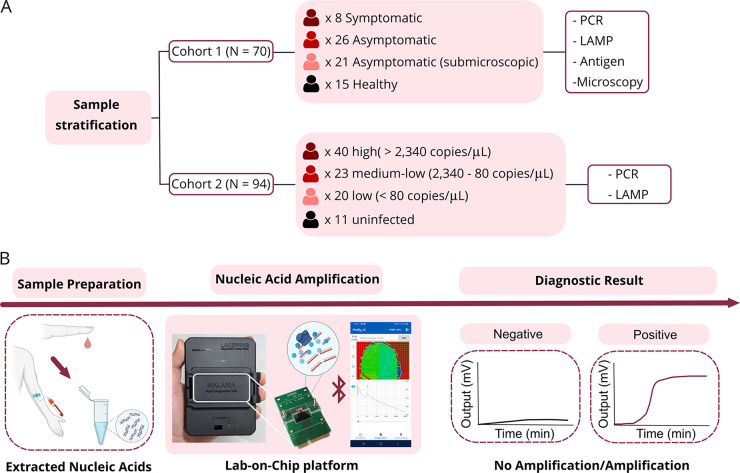
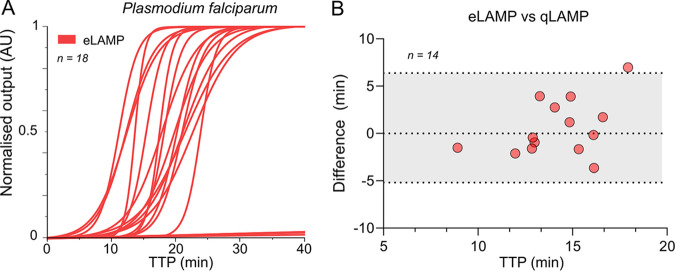
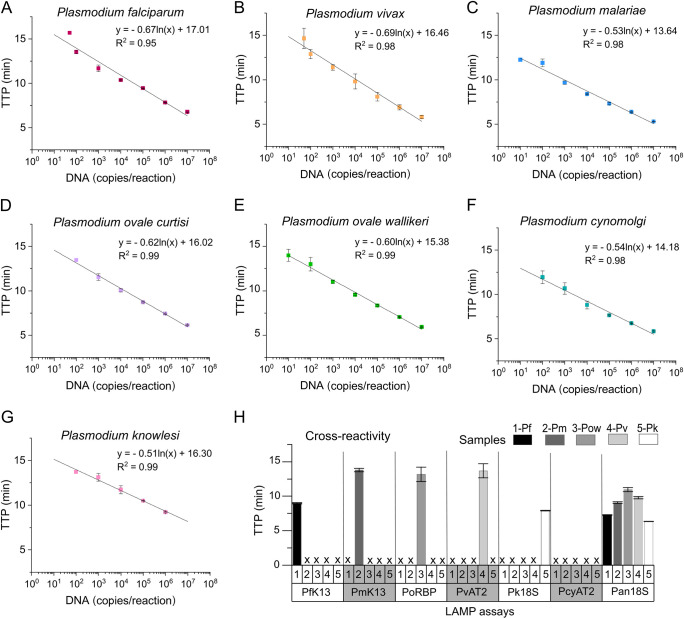
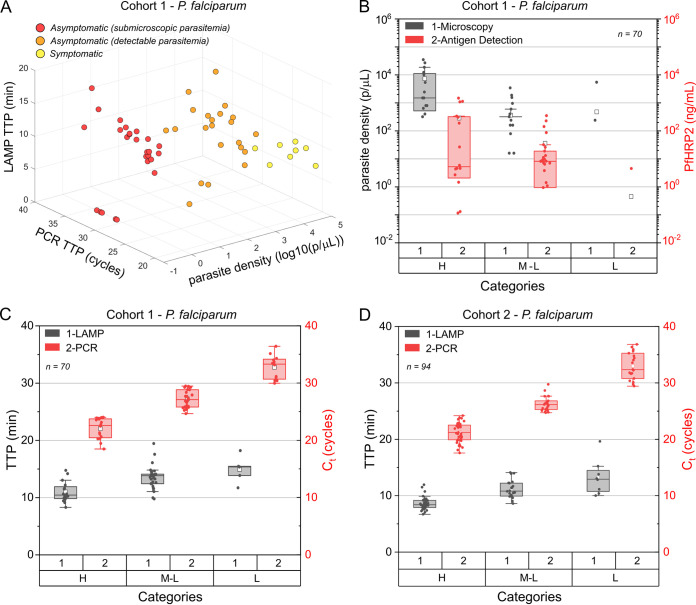
Human malaria is a life-threatening parasitic disease with high impact in the sub-Saharan Africa region, where 95% of global cases occurred in 2021. While most malaria diagnostic tools are focused on Plasmodium falciparum, there is a current lack of testing non-P. falciparum cases, which may be underreported and, if undiagnosed or untreated, may lead to severe consequences. In this work, seven species-specific loop-mediated isothermal amplification (LAMP) assays were designed and evaluated against TaqMan quantitative PCR (qPCR), microscopy, and enzyme-linked immunosorbent assays (ELISAs). Their clinical performance was assessed with a cohort of 164 samples of symptomatic and asymptomatic patients from Ghana. All asymptomatic samples with a parasite load above 80 genomic DNA (gDNA) copies per μL of extracted sample were detected with the Plasmodium falciparum LAMP assay, reporting 95.6% (95% confidence interval [95% CI] of 89.9 to 98.5) sensitivity and 100% (95% CI of 87.2 to 100) specificity. This assay showed higher sensitivity than microscopy and ELISA, which were 52.7% (95% CI of 39.7 to 67%) and 67.3% (95% CI of 53.3 to 79.3%), respectively. Nine samples were positive for , indicating coinfections with P. falciparum, which represented 5.5% of the tested population. No samples were detected as positive for P. vivax, , P. knowlesi, or P. cynomolgi by any method. Furthermore, translation to the point-of-care was demonstrated with a subcohort of 18 samples tested locally in Ghana using our handheld lab-on-chip platform, Lacewing, showing comparable results to a conventional fluorescence-based instrument. The developed molecular diagnostic test could detect asymptomatic malaria cases, including submicroscopic parasitemia, and it has the potential to be used for point-of-care applications. The spread of Plasmodium falciparum parasites with / gene deletions presents a major threat to reliable point-of-care diagnosis with current rapid diagnostic tests (RDTs). Novel molecular diagnostics based on nucleic acid amplification are needed to address this liability. In this work, we overcome this challenge by developing sensitive tools for the detection of Plasmodium falciparum and non-P. falciparum species. Furthermore, we evaluate these tools with a cohort of symptomatic and asymptomatic malaria patients and test a subcohort locally in Ghana. The findings of this work could lead to the implementation of DNA-based diagnostics to fight against the spread of malaria and provide reliable, sensitive, and specific diagnostics at the point of care.
人类疟疾是一种危及生命的寄生虫病,在撒哈拉以南非洲地区影响很大,2021 年全球 95%的疟疾病例发生在该地区。虽然大多数疟疾诊断工具都集中在恶性疟原虫上,但目前缺乏对非恶性疟原虫病例的检测,这些病例可能报告不足,如果未经诊断或治疗,可能会导致严重后果。在这项工作中,我们设计了七种针对特定物种的环介导等温扩增(LAMP)检测方法,并与 TaqMan 定量 PCR(qPCR)、显微镜和酶联免疫吸附测定(ELISA)进行了比较。我们使用加纳的一组 164 名有症状和无症状患者的样本评估了它们的临床性能。所有无症状样本中,寄生虫载量高于 80 个基因组 DNA(gDNA)拷贝/μL 提取样本的,都可以通过恶性疟原虫 LAMP 检测方法检测到,其灵敏度为 95.6%(95%置信区间 [95%CI]为 89.9%至 98.5%),特异性为 100%(95%CI 为 87.2%至 100%)。与灵敏度分别为 52.7%(95%CI 为 39.7%至 67%)和 67.3%(95%CI 为 53.3%至 79.3%)的显微镜和 ELISA 相比,该检测方法的灵敏度更高。有 9 个样本为 阳性,表明与恶性疟原虫混合感染,占检测人群的 5.5%。没有样本通过任何方法检测出间日疟原虫、卵形疟原虫、诺氏疟原虫或猕猴疟原虫阳性。此外,我们使用当地的 Lacewing 手持式芯片实验室平台对 18 个样本进行了亚组测试,展示了在当地进行即时检测的潜力,结果与传统的荧光仪器相当。开发的分子诊断检测方法可以检测无症状疟疾病例,包括亚微观寄生虫血症,并且有可能用于即时护理应用。目前的快速诊断检测(RDTs)中,恶性疟原虫寄生虫与 / 基因缺失的传播对可靠的即时护理诊断构成了重大威胁。需要基于核酸扩增的新型分子诊断来解决这一问题。在这项工作中,我们通过开发针对恶性疟原虫和非恶性疟原虫物种的敏感工具来克服这一挑战。此外,我们还使用一组有症状和无症状疟疾患者的样本对这些工具进行了评估,并在加纳当地对一个亚组进行了测试。这项工作的结果可能会导致采用基于 DNA 的诊断方法来对抗疟疾的传播,并在即时护理点提供可靠、敏感和特异性的诊断。