Department of General Practice, Univ Rennes, 2, Avenue du Pr Léon Bernard, RENNES Cedex, 35043, France.
CHU Rennes, Inserm CIC 1414 (Centre d'Investigation Clinique), Rennes, 35000, France.
BMC Endocr Disord. 2024 May 20;24(1):72. doi: 10.1186/s12902-024-01601-9.
Diabetes self-management (DSM) helps people with diabetes to become actors in their disease. Deprived populations are particularly affected by diabetes and are less likely to have access to these programmes. DSM implementation in primary care, particularly in a multi-professional primary care practice (MPCP), is a valuable strategy to promote care access for these populations. In Rennes (Western France), a DSM programme was designed by a MPCP in a socio-economically deprived area. The study objective was to compare diabetes control in people who followed or not this DSM programme.
The historical cohort of patients who participated in the DSM programme at the MPCP between 2017 and 2019 (n = 69) was compared with patients who did not participate in the programme, matched on sex, age, diabetes type and place of the general practitioner's practice (n = 138). The primary outcome was glycated haemoglobin (HbA1c) change between 12 months before and 12 months after the DSM programme. Secondary outcomes included modifications in diabetes treatment, body mass index, blood pressure, dyslipidaemia, presence of microalbuminuria, and diabetes retinopathy screening participation.
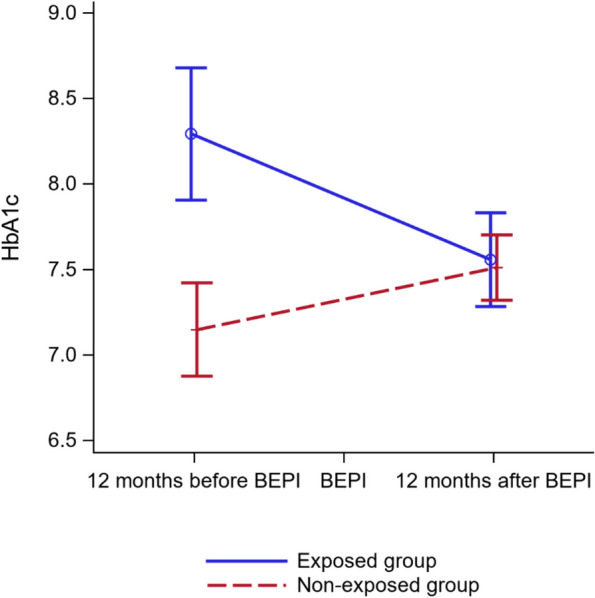
HbA1c was significantly improved in the exposed group after the programme (p < 0.01). The analysis did not find any significant between-group difference in socio-demographic data, medical history, comorbidities, and treatment adaptation.
These results, consistent with the international literature, promote the development of DSM programmes in primary care settings in deprived areas. The results of this real-life study need to be confirmed on the long-term and in different contexts (rural area, healthcare organisation).
糖尿病自我管理(DSM)帮助糖尿病患者成为疾病的积极参与者。贫困人群尤其受到糖尿病的影响,获得这些项目的机会较少。在初级保健中实施 DSM,特别是在多专业初级保健实践(MPCP)中,是促进这些人群获得护理的有价值策略。在法国西部的雷恩,一个 MPCP 在一个社会经济贫困地区设计了一个 DSM 项目。该研究的目的是比较参与和不参与该 DSM 项目的患者的糖尿病控制情况。
将在 MPCP 参加 DSM 项目的患者(n=69)的历史队列与未参加该项目的患者(n=138)进行比较,这些患者按照性别、年龄、糖尿病类型和全科医生实践地点进行匹配。主要结局是在 DSM 项目前 12 个月和后 12 个月之间糖化血红蛋白(HbA1c)的变化。次要结局包括糖尿病治疗、体重指数、血压、血脂异常、微量白蛋白尿的改变以及糖尿病视网膜病变筛查的参与情况。
在项目后,暴露组的 HbA1c 显著改善(p<0.01)。分析未发现两组间在社会人口统计学数据、病史、合并症和治疗适应方面有任何显著差异。
这些结果与国际文献一致,促进了在贫困地区初级保健环境中开展 DSM 项目。这项真实世界研究的结果需要在长期和不同背景(农村地区、医疗保健组织)中得到证实。