Okada Natsuo, Nozaki Hiromasa, Nakamura Shinichiro, Manjate Elsa Pansilvania Andre, Gebretsadik Angesom, Ohtomo Yoko, Arima Takahiko, Kawamura Youhei
Division of Sustainable Resources Engineering, Graduate School of Engineering, Hokkaido University, Kita-13, Nishi-8, Sapporo, 060-8628, Japan.
Division of Engineering, Instituto Superior Politécnico de Tete, Tete, Mozambique.
Sci Rep. 2024 May 21;14(1):11544. doi: 10.1038/s41598-024-62166-0.
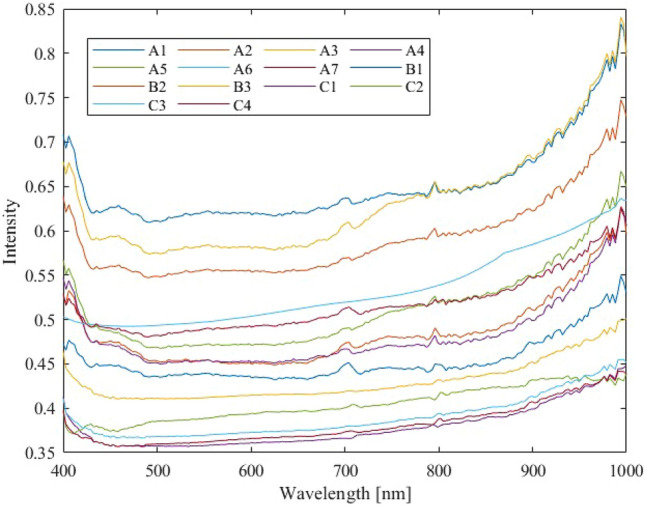
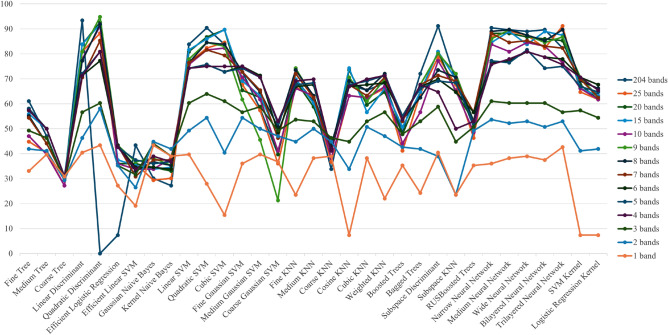
Arsenic contamination not only complicates mineral processing but also poses environmental and health risks. To address these challenges, this research investigates the feasibility of utilizing Hyperspectral imaging combined with machine learning techniques for the identification of arsenic-containing minerals in copper ore samples, with a focus on practical application in sorting and processing operations. Through experimentation with various copper sulfide ores, Neighborhood Component Analysis (NCA) was employed to select essential wavelength bands from Hyperspectral data, subsequently used as inputs for machine learning algorithms to identify arsenic concentrations. Results demonstrate that by selecting a subset of informative bands using NCA, accurate mineral identification can be achieved with a significantly reduced the size of dataset, enabling efficient processing and analysis. Comparison with other wavelength selection methods highlights the superiority of NCA in optimizing classification accuracy. Specifically, the identification accuracy showed 91.9% or more when utilizing 8 or more bands selected by NCA and was comparable to hyperspectral data analysis with 204 bands. The findings suggest potential for cost-effective implementation of multispectral cameras in mineral processing operations. Future research directions include refining machine learning algorithms, exploring broader applications across diverse ore types, and integrating hyperspectral imaging with emerging sensor technologies for enhanced mineral processing capabilities.
砷污染不仅使矿物加工变得复杂,还带来环境和健康风险。为应对这些挑战,本研究调查了利用高光谱成像结合机器学习技术识别铜矿样品中含砷矿物的可行性,重点在于其在分选和加工操作中的实际应用。通过对各种硫化铜矿石进行实验,采用邻域成分分析(NCA)从高光谱数据中选择关键波长带,随后将其用作机器学习算法的输入以识别砷浓度。结果表明,通过使用NCA选择信息波段子集,可以在显著减小数据集规模的情况下实现准确的矿物识别,从而实现高效处理和分析。与其他波长选择方法的比较突出了NCA在优化分类精度方面的优越性。具体而言,当使用由NCA选择的8个或更多波段时,识别准确率达到91.9%或更高,与使用204个波段的高光谱数据分析相当。研究结果表明在矿物加工操作中经济高效地应用多光谱相机具有潜力。未来的研究方向包括改进机器学习算法、探索在各种不同矿石类型上的更广泛应用,以及将高光谱成像与新兴传感器技术集成以增强矿物加工能力。