Department of Kinesiology, Faculty of Science, McMaster University, Hamilton, Ontario, Canada.
Department of Physical Medicine and Rehabilitation, Schulich School of Medicine and Dentistry, Western University, London, Ontario, Canada.
PLoS One. 2024 May 22;19(5):e0303785. doi: 10.1371/journal.pone.0303785. eCollection 2024.
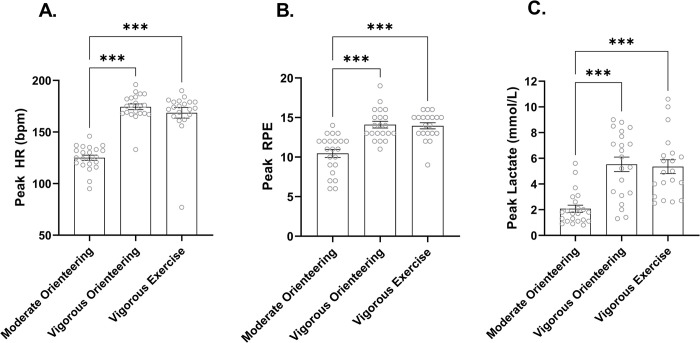
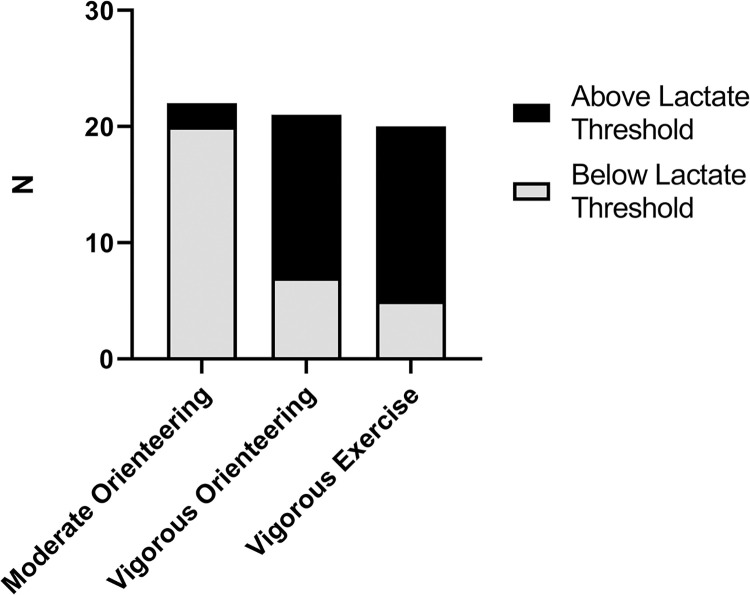
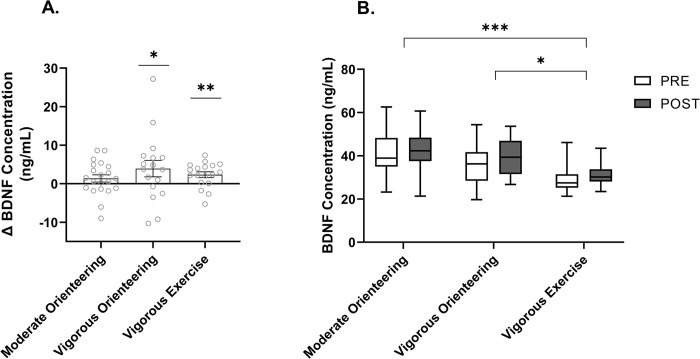
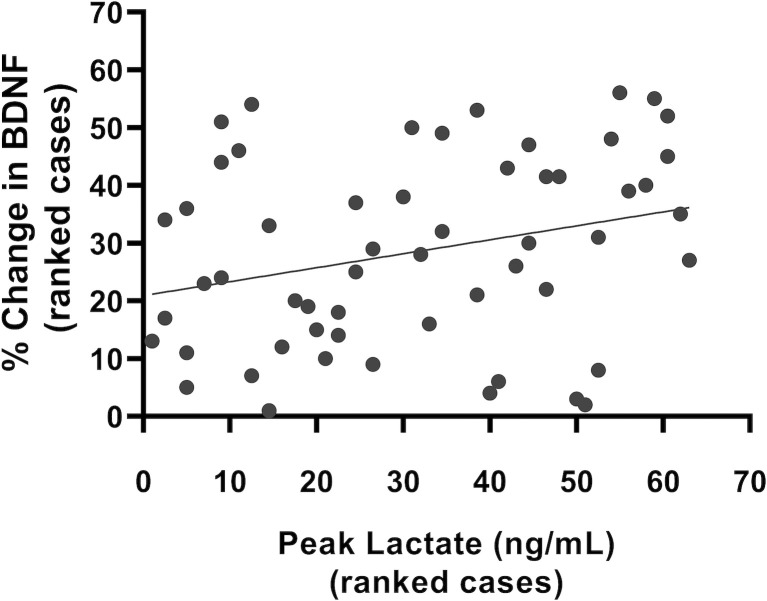
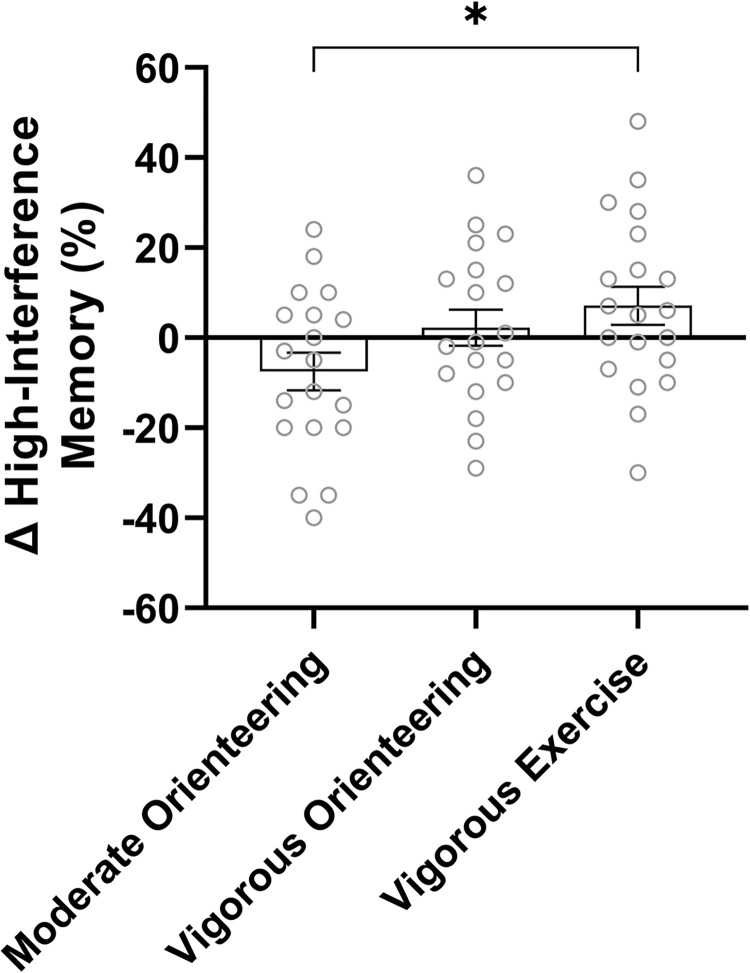
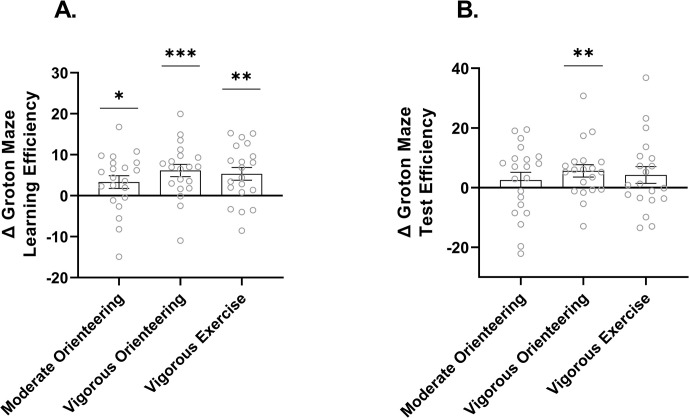
Exercise enhances aspects of human cognition, but its intensity may matter. Recent animal research suggests that vigorous exercise, which releases greater amounts of lactate, activates more brain-derived neurotrophic factor (BDNF) in the hippocampus and, thus, may be optimal for supporting cognitive function. The cognitive benefits of exercise may be further augmented when combined with cognitive training. The sport of orienteering simultaneously combines exercise with spatial navigation and, therefore, may result in greater cognitive benefits than exercising only, especially at vigorous intensities. The present study aimed to examine the effects of an acute bout of orienteering at different intensities on cognition and BDNF compared to exercising only. We hypothesized that vigorous-intensity orienteering would increase lactate and BDNF and improve cognition more than moderate-intensity orienteering or vigorous exercise alone. Sixty-three recreationally active, healthy young adults (Mage = 21.10±2.75 years) with no orienteering experience completed a 1.3 km intervention course by navigating and exercising at a vigorous (80-85% of heart rate reserve) or moderate (40-50% of heart rate reserve) intensity or exercising vigorously without navigation. Exercise intensity was monitored using peak lactate, heart rate and rating of perceived exertion. Serum BDNF was extracted immediately before and after the intervention. Memory was assessed using the Mnemonic Similarity Task (high-interference memory) and the Groton Maze Learning Test (spatial memory). Both exercising and orienteering at a vigorous intensity elicited greater peak lactate and increases in BDNF than moderate-intensity orienteering, and individuals with higher peak lactate also had greater increases in BDNF. High-interference memory improved after both vigorous-intensity interventions but did not improve after the moderate-intensity intervention. Spatial memory only increased after vigorous-intensity orienteering, suggesting that orienteering at a vigorous intensity may particularly benefit spatial cognition. Overall, the results demonstrate the benefits of vigorous exercise on human cognition and BDNF.
运动可以增强人类认知的各个方面,但运动强度可能很重要。最近的动物研究表明,剧烈运动(会释放更多的乳酸)会使海马体中更多的脑源性神经营养因子(BDNF)活跃起来,因此可能是支持认知功能的最佳选择。将运动与认知训练相结合,可能会进一步提高运动的认知益处。定向运动是一项同时结合运动和空间导航的运动,因此可能比单纯运动更能带来更大的认知益处,尤其是在剧烈运动强度下。本研究旨在比较不同强度的急性定向运动与单纯运动对认知和 BDNF 的影响,我们假设高强度的定向运动比中强度的定向运动或单纯剧烈运动更能增加乳酸和 BDNF,从而改善认知。63 名有定向运动经验的健康年轻人(平均年龄 21.10±2.75 岁)完成了 1.3 公里的干预课程,他们以剧烈(80-85%心率储备)或中强度(40-50%心率储备)导航和运动或单纯剧烈运动而不导航的方式运动。运动强度通过峰值乳酸、心率和主观用力程度来监测。干预前后立即提取血清 BDNF。使用记忆相似任务(高干扰记忆)和格罗顿迷宫学习测试(空间记忆)评估记忆。与中强度定向运动相比,剧烈运动和定向运动都会引起更高的峰值乳酸和 BDNF 增加,峰值乳酸较高的个体的 BDNF 也会有更大的增加。两种剧烈强度的干预措施后高干扰记忆都有所改善,但中强度干预后则没有改善。只有在剧烈强度的定向运动后,空间记忆才会增加,这表明高强度的定向运动可能特别有益于空间认知。总的来说,这些结果表明剧烈运动对人类认知和 BDNF 的有益作用。