MEDCIDS, Department of Community Medicine, Information and Health Decision Sciences, Faculty of Medicine, University of Porto, Porto, Portugal.
CINTESIS@RISE, Faculty of Medicine of the University of Porto, 4200-450, Porto, Portugal.
BMC Public Health. 2024 May 22;24(1):1374. doi: 10.1186/s12889-024-18529-3.
The European Union (EU) faces many health-related challenges. Burden of diseases information and the resulting trends over time are essential for health planning. This paper reports estimates of disease burden in the EU and individual 27 EU countries in 2019, and compares them with those in 2010.
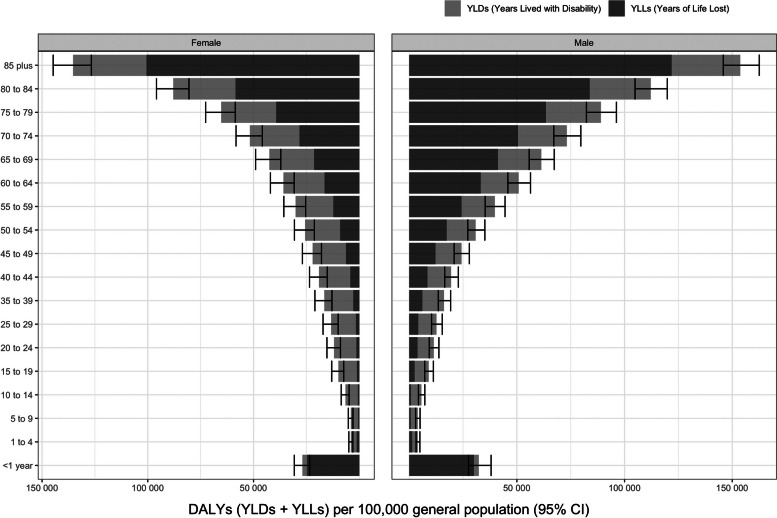
We used the Global Burden of Disease 2019 study estimates and 95% uncertainty intervals for the whole EU and each country to evaluate age-standardised death, years of life lost (YLLs), years lived with disability (YLDs) and disability-adjusted life years (DALYs) rates for Level 2 causes, as well as life expectancy and healthy life expectancy (HALE).
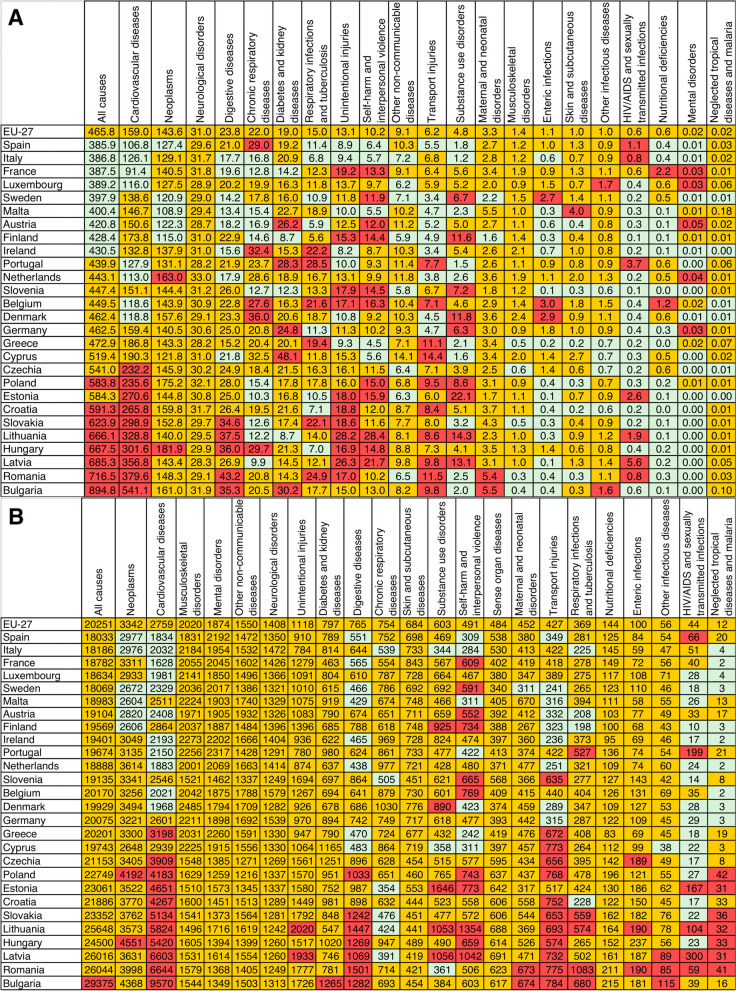
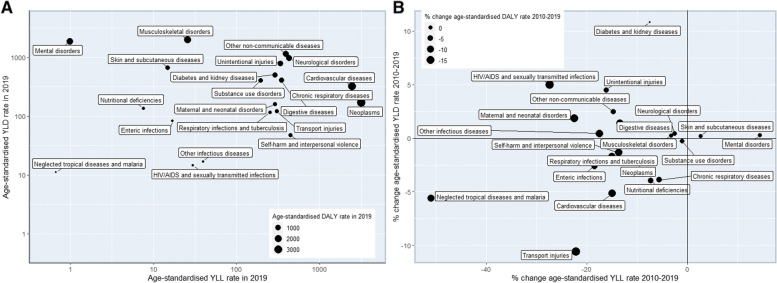
In 2019, the age-standardised death and DALY rates in the EU were 465.8 deaths and 20,251.0 DALYs per 100,000 inhabitants, respectively. Between 2010 and 2019, there were significant decreases in age-standardised death and YLL rates across EU countries. However, YLD rates remained mainly unchanged. The largest decreases in age-standardised DALY rates were observed for "HIV/AIDS and sexually transmitted diseases" and "transport injuries" (each -19%). "Diabetes and kidney diseases" showed a significant increase for age-standardised DALY rates across the EU (3.5%). In addition, "mental disorders" showed an increasing age-standardised YLL rate (14.5%).
There was a clear trend towards improvement in the overall health status of the EU but with differences between countries. EU health policymakers need to address the burden of diseases, paying specific attention to causes such as mental disorders. There are many opportunities for mutual learning among otherwise similar countries with different patterns of disease.
欧盟面临着许多与健康相关的挑战。疾病负担信息及其随时间变化的趋势对于健康规划至关重要。本文报告了欧盟和 27 个欧盟国家 2019 年的疾病负担估计值,并将其与 2010 年的估计值进行了比较。
我们使用 2019 年全球疾病负担研究的估计值和 95%的不确定性区间,对整个欧盟和每个国家进行评估,以评估二级病因的标准化死亡率、生命损失年(YLLs)、残疾生活年(YLDs)和残疾调整生命年(DALYs)率,以及预期寿命和健康期望寿命(HALE)。
2019 年,欧盟的标准化死亡率和 DALY 率分别为每 10 万人 465.8 人死亡和 20251.0 DALY。2010 年至 2019 年期间,欧盟各国的标准化死亡率和 YLL 率均显著下降。然而,YLD 率基本保持不变。标准化 DALY 率下降最大的是“艾滋病毒/艾滋病和性传播疾病”和“交通伤害”(各下降 19%)。“糖尿病和肾脏疾病”在整个欧盟的标准化 DALY 率显著上升(3.5%)。此外,“精神障碍”的标准化 YLL 率呈上升趋势(14.5%)。
欧盟的整体健康状况明显呈改善趋势,但各国之间存在差异。欧盟卫生政策制定者需要解决疾病负担问题,特别关注精神障碍等疾病。对于疾病模式不同的相似国家,有许多相互学习的机会。