Huang Qiuliang, Liu Haoyang, Li Changshun, Zhu Xiaoru, Yuan Zongsheng, Lai Jialiang, Cao Minghui, Huang Zhenbei, Yang Yushan, Zhuo Shenglan, Lü Zengwei, Zhang Guofang
College of Forestry, Fujian Agriculture and Forestry University, Fuzhou, Fujian, China.
Service Center, Fujian Meteorological Bureau, Fuzhou, Fujian, China.
Front Plant Sci. 2024 May 8;15:1360190. doi: 10.3389/fpls.2024.1360190. eCollection 2024.
Arid and semi-arid regions are climate-sensitive areas, which account for about 40% of the world's land surface area. Future environment change will impact the environment of these area, resulting in a sharp expansion of arid and semi-arid regions. is a multi-functional tree species with extreme cold, drought and barren resistance, as well as ornamental and medicinal functions. It was found to be one of the most important tree species for ecological restoration in arid and semi-arid areas. However, bioclimatic factors play an important role in the growth, development and distribution of plants. Therefore, exploring the response pattern and ecological adaptability of to future climate change is important for the long-term ecological restoration of in arid and semi-arid areas.
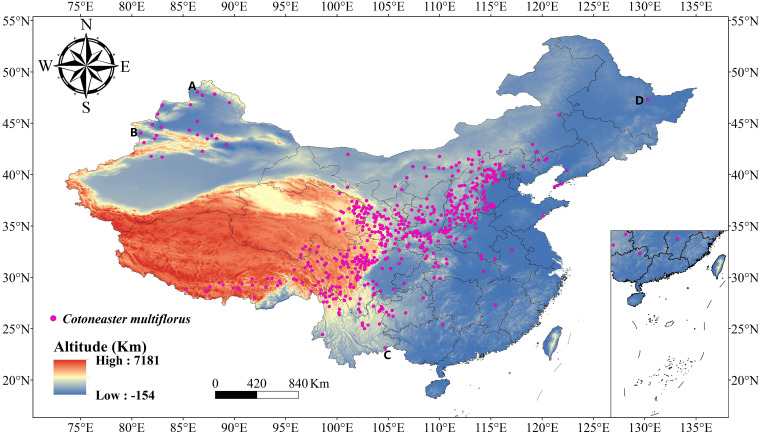
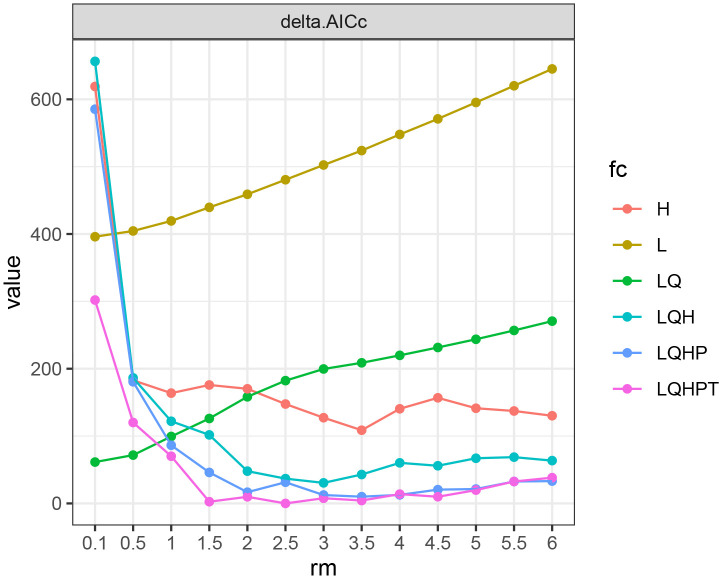
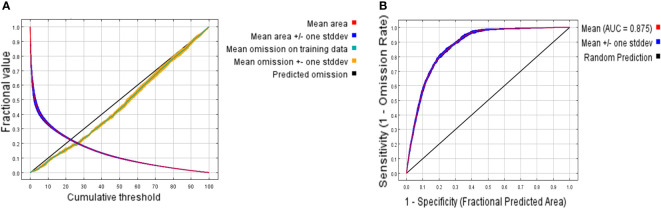
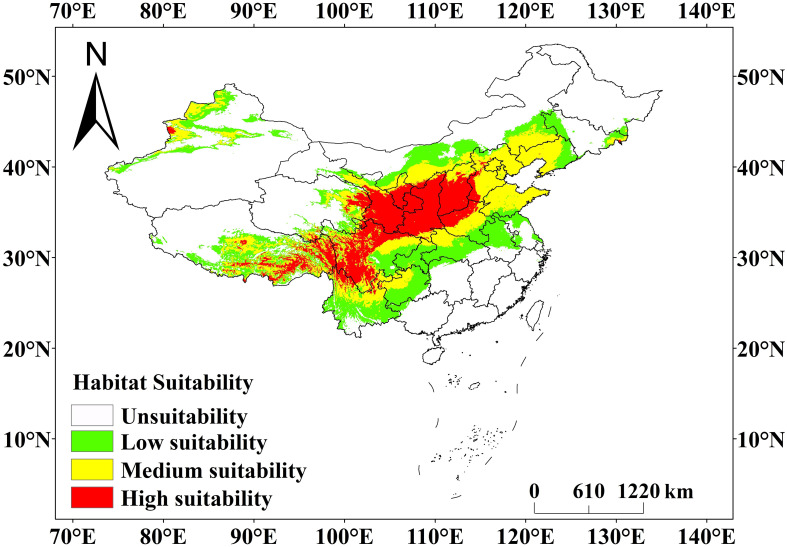
In this study, we predicted the potential distribution of in China under different climate scenarios based on the MaxEnt 2.0 model, and discussed its adaptability and the major factors affecting its geographical distribution.
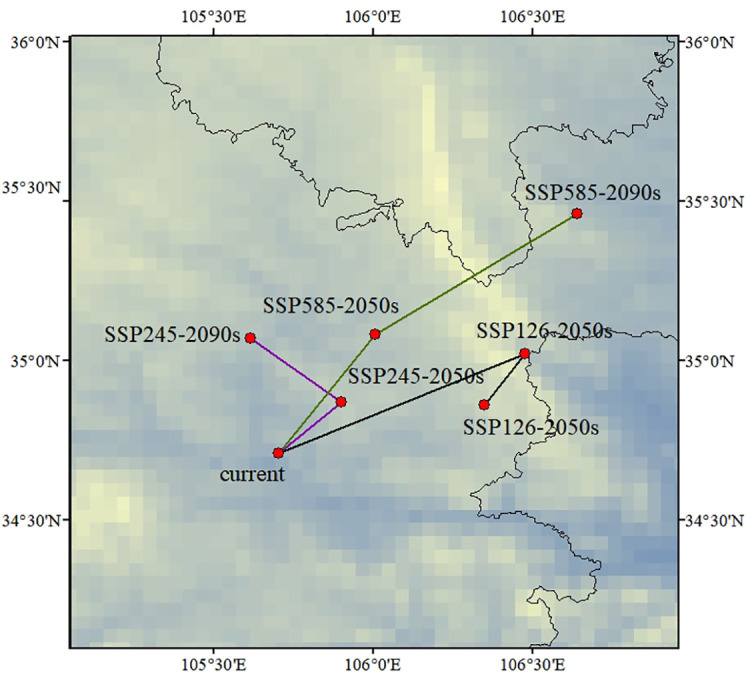
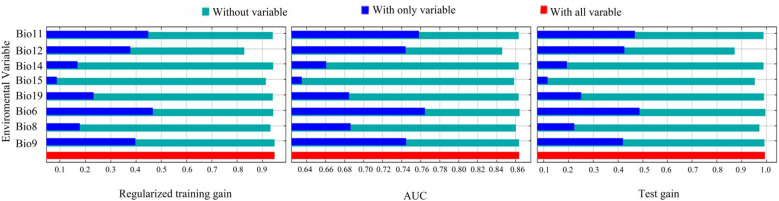
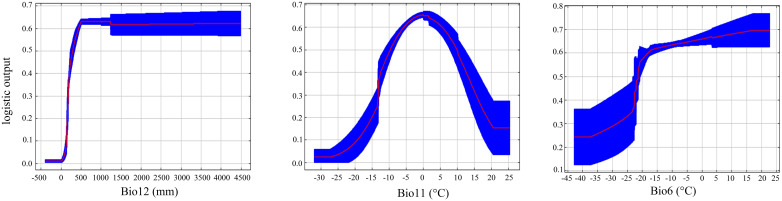
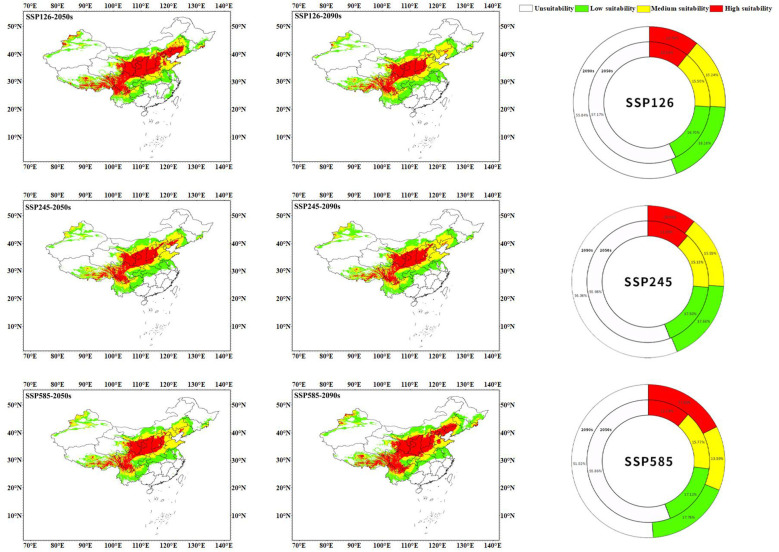
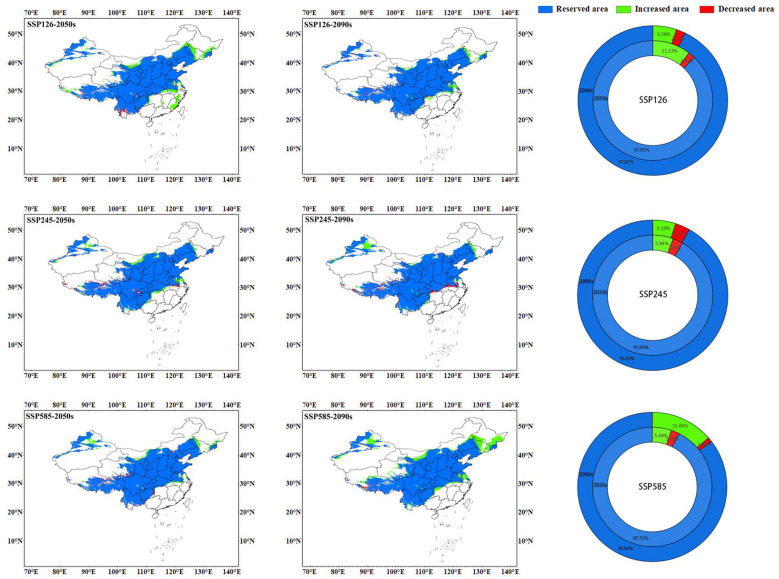
The major factors that explained the geographical distribution of were Annual precipitation (Bio12), Min air temperature of the coldest month (Bio6), and Mean air temperature of the coldest quarter (Bio11). However, could thrive in environments where Annual precipitation (Bio12) >150 mm, Min air temperature of the coldest month (Bio6) > -42.5°C, and Mean air temperature of the coldest quarter (Bio11) > -20°C, showcasing its characteristics of cold and drought tolerance. Under different future climate scenarios, the total suitable area for ranged from 411.199×10 km² to 470.191×10 km², which was 0.8~6.14 percentage points higher than the current total suitable area. Additionally, it would further shift towards higher latitude.
The MaxEnt 2.0 model predicted the potential distribution pattern of in the context of future climate change, and identified its ecological adaptability and the main climatic factors affecting its distribution. This study provides an important theoretical basis for natural vegetation restoration in arid and semi-arid areas.
干旱和半干旱地区是气候敏感区,约占全球陆地面积的40%。未来的环境变化将影响这些地区的环境,导致干旱和半干旱地区急剧扩张。[具体树种名称]是一种具有极耐寒、耐旱和耐贫瘠特性的多功能树种,同时还具有观赏和药用功能。它被发现是干旱和半干旱地区生态恢复的最重要树种之一。然而,生物气候因素对植物的生长、发育和分布起着重要作用。因此,探索[具体树种名称]对未来气候变化的响应模式和生态适应性,对于干旱和半干旱地区[具体树种名称]的长期生态恢复具有重要意义。
在本研究中,我们基于MaxEnt 2.0模型预测了[具体树种名称]在中国不同气候情景下的潜在分布,并讨论了其适应性以及影响其地理分布的主要因素。
解释[具体树种名称]地理分布的主要因素是年降水量(Bio12)、最冷月最低气温(Bio6)和最冷月平均气温(Bio11)。然而,[具体树种名称]能在年降水量(Bio12)>150毫米、最冷月最低气温(Bio6)>-42.5℃和最冷月平均气温(Bio11)>-20℃的环境中茁壮成长,展现出其耐寒耐旱的特性。在不同的未来气候情景下,[具体树种名称]的总适宜面积在411.199×10平方千米至470.191×10平方千米之间,比当前的总适宜面积高出0.8至6.14个百分点。此外,它将进一步向高纬度地区转移。
MaxEnt 2.0模型预测了未来气候变化背景下[具体树种名称]的潜在分布模式,并确定了其生态适应性以及影响其分布的主要气候因素。本研究为干旱和半干旱地区的自然植被恢复提供了重要的理论依据。