Wang Xinrui, Duan Caohui, Lyu Jinhao, Han Dongshan, Cheng Kun, Meng Zhihua, Wu Xiaoyan, Chen Wen, Wang Guohua, Niu Qingliang, Li Xin, Bian Yitong, Han Dan, Guo Weiting, Yang Shuai, Wang Ximing, Zhang Tijiang, Bi Junying, Wu Feiyun, Xia Shuang, Tong Dan, Duan Kai, Li Zhi, Wang Rongpin, Wang Jinan, Lou Xin
Department of Radiology, Chinese PLA General Hospital, Beijing 100853, China.
Department of Radiology, Yuebei People's Hospital, Shaoguan 512000, Guangdong Province, China.
J Transl Int Med. 2022 Nov 15;12(2):197-208. doi: 10.2478/jtim-2022-0057. eCollection 2024 Apr.
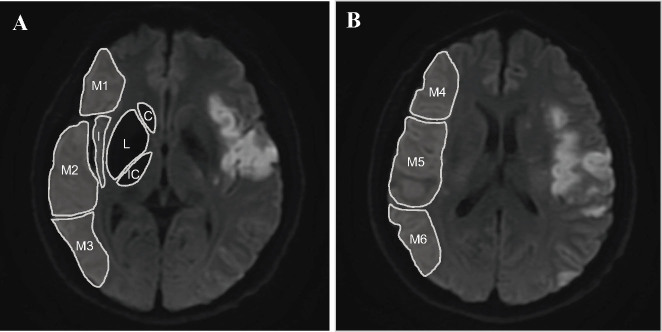
The Alberta Stroke Program CT Score (ASPECTS) is a widely used rating system for assessing infarct extent and location. We aimed to investigate the prognostic value of ASPECTS subregions' involvement in the long-term functional outcomes of acute ischemic stroke (AIS).
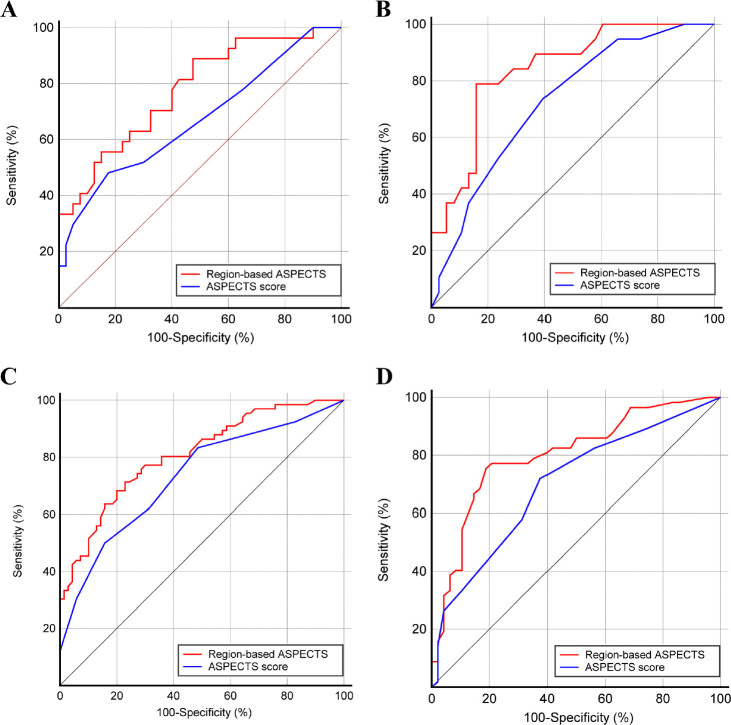
Consecutive patients with AIS and anterior circulation large-vessel stenosis and occlusion between January 2019 and December 2020 were included. The ASPECTS score and subregion involvement for each patient was assessed using posttreatment magnetic resonance diffusion-weighted imaging. Univariate and multivariable regression analyses were conducted to identify subregions related to 3-month poor functional outcome (modified Rankin Scale scores, 3-6) in the reperfusion and medical therapy cohorts, respectively. In addition, prognostic efficiency between the region-based ASPECTS and ASPECTS score methods were compared using receiver operating characteristic curves and DeLong's test.
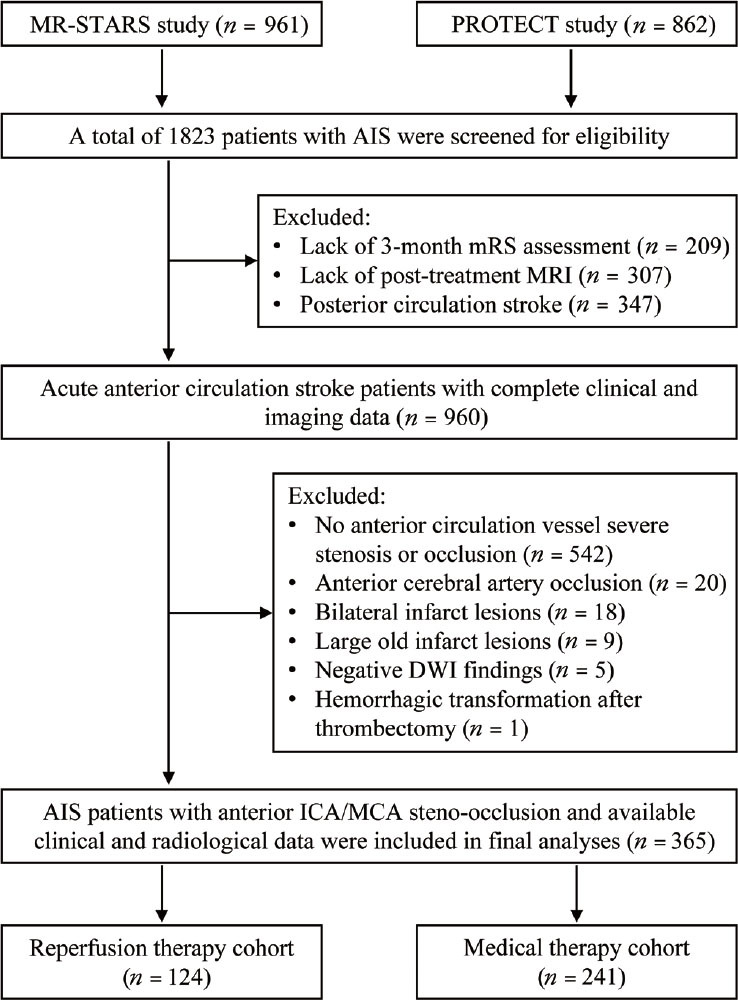
A total of 365 patients (median age, 64 years; 70% men) were included, of whom 169 had poor outcomes. In the reperfusion therapy cohort, multivariable regression analyses revealed that the involvement of the left M4 cortical region in left-hemisphere stroke (adjusted odds ratio [aOR] 5.39, 95% confidence interval [CI] 1.53-19.02) and the involvement of the right M3 cortical region in right-hemisphere stroke (aOR 4.21, 95% CI 1.05-16.78) were independently associated with poor functional outcomes. In the medical therapy cohort, left-hemisphere stroke with left M5 cortical region (aOR 2.87, 95% CI 1.08-7.59) and caudate nucleus (aOR 3.14, 95% CI 1.00-9.85) involved and right-hemisphere stroke with right M3 cortical region (aOR 4.15, 95% CI 1.29-8.18) and internal capsule (aOR 3.94, 95% CI 1.22-12.78) affected were related to the increased risks of poststroke disability. In addition, region-based ASPECTS significantly improved the prognostic efficiency compared with the conventional ASPECTS score method.
The involvement of specific ASPECTS subregions depending on the affected hemisphere was associated with worse functional outcomes 3 months after stroke, and the critical subregion distribution varied by clinical management. Therefore, region-based ASPECTS could provide additional value in guiding individual decision making and neurological recovery in patients with AIS.
阿尔伯塔卒中项目CT评分(ASPECTS)是一种广泛用于评估梗死范围和位置的评分系统。我们旨在研究ASPECTS各亚区受累情况对急性缺血性卒中(AIS)长期功能结局的预后价值。
纳入2019年1月至2020年12月期间连续的AIS患者,这些患者存在前循环大血管狭窄和闭塞。使用治疗后的磁共振扩散加权成像评估每位患者的ASPECTS评分和亚区受累情况。分别进行单因素和多因素回归分析,以确定再灌注治疗组和药物治疗组中与3个月时功能预后不良(改良Rankin量表评分,3 - 6分)相关的亚区。此外,使用受试者工作特征曲线和德龙检验比较基于区域的ASPECTS和ASPECTS评分方法的预后效能。
共纳入365例患者(中位年龄64岁;70%为男性),其中169例预后不良。在再灌注治疗组中,多因素回归分析显示,左侧半球卒中时左侧M4皮质区受累(调整优势比[aOR] 5.39,95%置信区间[CI] 1.53 - 19.02)以及右侧半球卒中时右侧M3皮质区受累(aOR 4.21,95% CI 1.05 - 16.78)与功能预后不良独立相关。在药物治疗组中,左侧半球卒中伴有左侧M5皮质区(aOR 2.87,95% CI 1.08 - 7.59)和尾状核(aOR 3.14,95% CI 1.00 - 9.85)受累以及右侧半球卒中伴有右侧M3皮质区(aOR 4.15,95% CI 1.29 - 8.18)和内囊(aOR 3.94,95% CI 1.22 - 12.78)受累与卒中后残疾风险增加相关。此外,与传统的ASPECTS评分方法相比,基于区域的ASPECTS显著提高了预后效能。
根据受累半球不同,特定ASPECTS亚区的受累情况与卒中后3个月时更差的功能结局相关,关键亚区分布因临床治疗方式而异。因此,基于区域的ASPECTS在指导AIS患者的个体化决策和神经功能恢复方面可能具有额外价值。