Zang Chenke, Chung Meng-Han Joseph, Neeman Teresa, Harrison Lauren, Vinogradov Ivan M, Jennions Michael D
Division of Ecology and Evolution, Research School of Biology, Australian National University, Canberra, Australian Capital Territory, 2601, Australia.
Biological Data Science Institute, Australian National University, Canberra Australian Capital Territory, 2601, Australia.
Behav Ecol. 2024 May 3;35(4):arae037. doi: 10.1093/beheco/arae037. eCollection 2024 Jul-Aug.
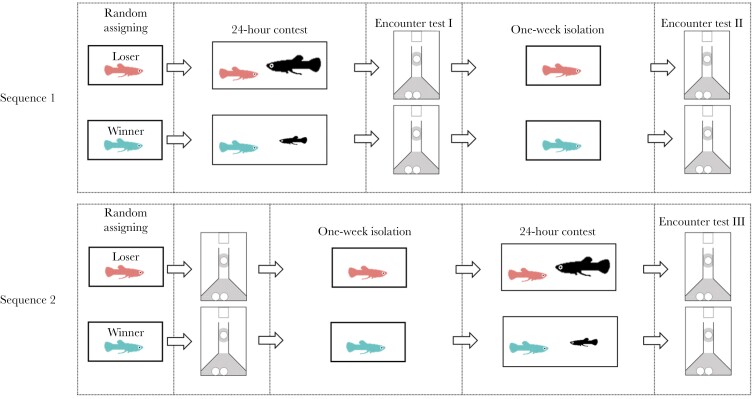
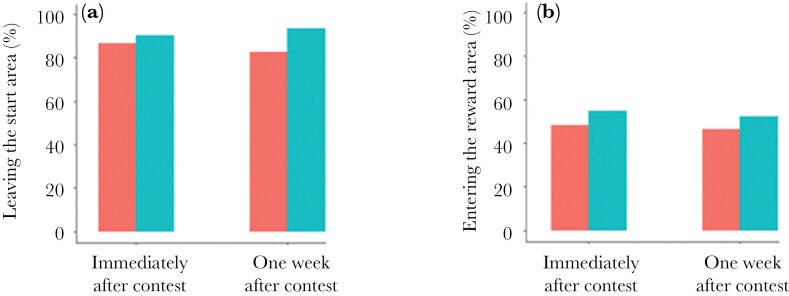
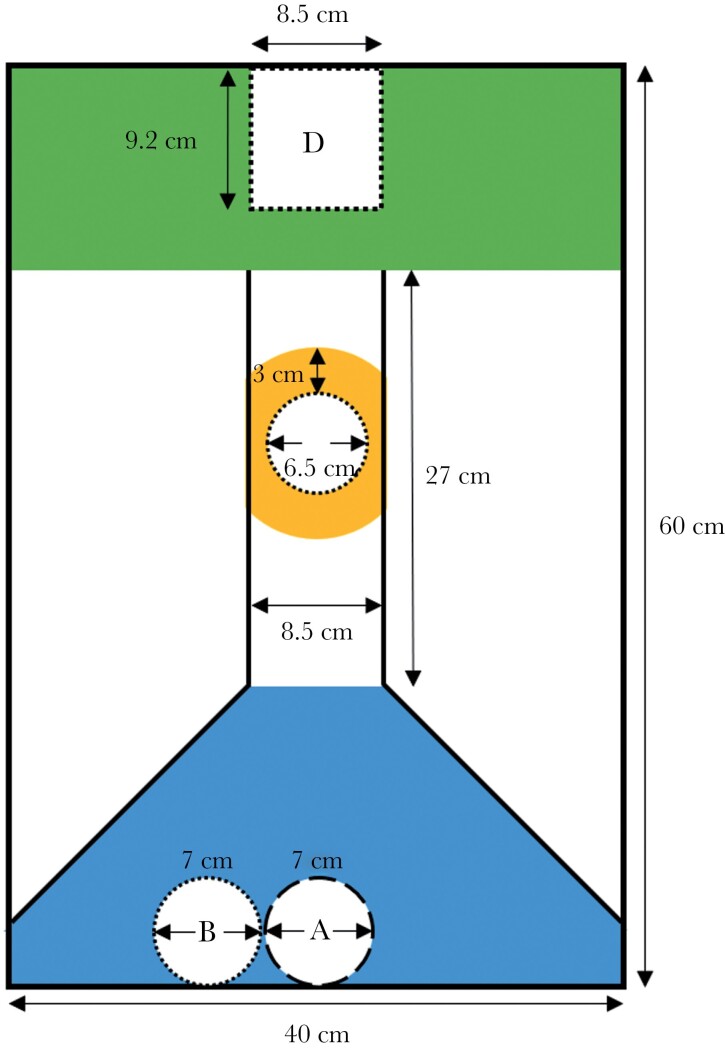
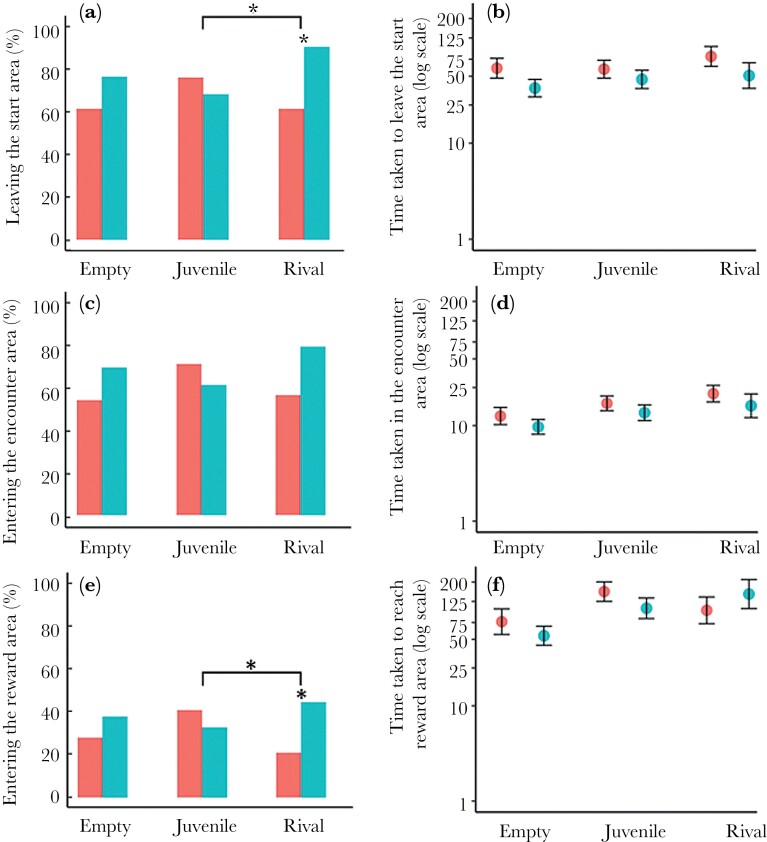
Male-male contests for access to females or breeding resources are critical in determining male reproductive success. Larger males and those with more effective weaponry are more likely to win fights. However, even after controlling for such predictors of fighting ability, studies have reported a winner-loser effect: previous winners are more likely to win subsequent contests, while losers often suffer repeated defeats. While the effect of winning-losing is well-documented for the outcome of future fights, its effect on other behaviors (e.g. mating) remains poorly investigated. Here, we test whether a winning versus losing experience influenced subsequent behaviors of male mosquitofish () toward rivals and potential mates. We housed focal males with either a smaller or larger opponent for 24 h to manipulate their fighting experience to become winners or losers, respectively. The focal males then underwent tests that required them to enter and swim through a narrow corridor to reach females, bypassing a cylinder that contained either a larger rival male (competitive scenario), a juvenile or was empty (non-competitive scenarios). The tests were repeated after 1 wk. Winners were more likely to leave the start area and to reach the females, but only when a larger rival was presented, indicating higher levels of risk-taking behavior in aggressive interactions. This winner-loser effect persisted for at least 1 wk. We suggest that male mosquitofish adjust their assessment of their own and/or their rival's fighting ability following contests in ways whose detection by researchers depends on the social context.
雄性之间为获得雌性或繁殖资源而进行的竞争对于决定雄性的繁殖成功率至关重要。体型较大的雄性以及拥有更有效武器的雄性更有可能赢得战斗。然而,即使在控制了这些战斗能力的预测因素之后,研究仍报告了一种输赢效应:先前的赢家更有可能赢得后续竞争,而输家往往会屡战屡败。虽然输赢对未来战斗结果的影响已有充分记录,但其对其他行为(如交配)的影响仍鲜有研究。在此,我们测试输赢经历是否会影响雄性食蚊鱼对竞争对手和潜在配偶的后续行为。我们将焦点雄性与体型较小或较大的对手饲养24小时,以分别操纵它们的战斗经历,使其成为赢家或输家。然后,焦点雄性接受测试,要求它们进入并游过一条狭窄的通道以接近雌性,绕过一个装有体型较大的竞争雄性(竞争场景)、幼鱼或为空(非竞争场景)的圆柱体。测试在1周后重复进行。赢家更有可能离开起始区域并接近雌性,但只有在出现体型较大的竞争对手时才会如此,这表明在攻击性互动中冒险行为水平更高。这种输赢效应至少持续1周。我们认为,雄性食蚊鱼在竞争后会根据竞争情况调整对自身和/或对手战斗能力的评估,而研究人员能否察觉这种调整取决于社会背景。