
工作年龄段的长新冠自主神经综合征与工作能力受损。
Long-COVID autonomic syndrome in working age and work ability impairment.
机构信息
Occupational Medicine, IRCCS Salvatore Maugeri, University of Pavia, Pavia, Italy.
Department of Biomedical Sciences, Humanitas University, Pieve Emanuele, Milan, Italy.
出版信息
Sci Rep. 2024 May 23;14(1):11835. doi: 10.1038/s41598-024-61455-y.
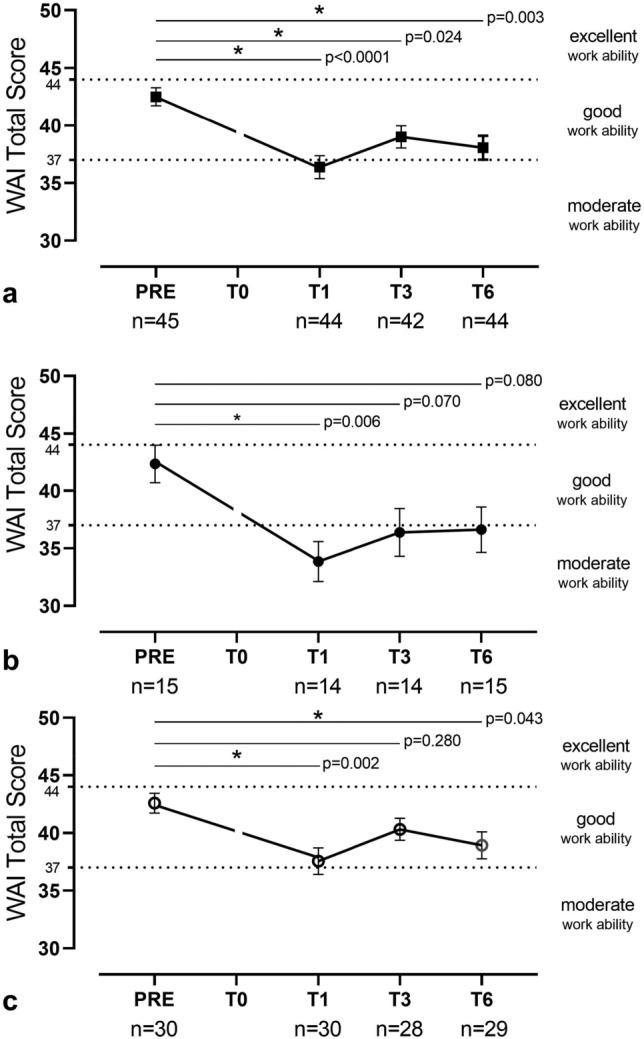
Long-COVID19 has been recently associated with long-sick leave and unemployment. The autonomic nervous system functioning may be also affected by SARS-CoV-2, leading to a chronic autonomic syndrome. This latter remains widely unrecognized in clinical practice. In the present study, we assessed the occurrence of Long-COVID19 Autonomic Syndrome in a group of active workers as well as the relationships between their autonomic dysfunction and work ability. This prospective observational study was conducted during the 2nd wave of the pandemic in Italy. Forty-five patients (53.6 ± 8.4 years; 32 M) hospitalized for COVID19, were consecutively enrolled at the time of their hospital discharge (T0) and followed-up for 6 months. Autonomic symptoms and work ability were assessed by COMPASS31 and Work Ability Index questionnaires at T0, one (T1), three and six (T6) months after hospital discharge and compared to those retrospectively collected for a period preceding SARS-CoV-2 infection. Clinical examination and standing test were also performed at T1 and T6. One in three working-age people developed a new autonomic syndrome that was still evident 6 months after the acute infection resolution. This was associated with a significant reduction in the work ability. Recognition of Long-COVID19 Autonomic Syndrome may promote early intervention to facilitate return to work and prevent unemployment.
长新冠与长期病假和失业有关。自主神经系统功能也可能受到 SARS-CoV-2 的影响,导致慢性自主神经综合征。这种综合征在临床实践中仍未得到广泛认识。在本研究中,我们评估了一组在职患者中长新冠自主神经综合征的发生情况,以及他们的自主神经功能障碍与工作能力之间的关系。这项前瞻性观察研究是在意大利第二波大流行期间进行的。45 名患者(53.6 ± 8.4 岁;32 名男性)因 COVID19 住院,在出院时(T0)连续入组,并在出院后 6 个月进行随访。自主症状和工作能力通过 COMPASS31 和工作能力指数问卷在 T0、1 个月(T1)、3 个月和 6 个月(T6)进行评估,并与 SARS-CoV-2 感染前的回顾性数据进行比较。临床检查和站立试验也在 T1 和 T6 进行。三分之一的工作年龄人群出现了新的自主神经综合征,这种综合征在急性感染消退 6 个月后仍很明显。这与工作能力的显著下降有关。识别长新冠自主神经综合征可能有助于早期干预,促进重返工作岗位,预防失业。



 Zotero 插件