Lee Jeonghoon, Song Hyunchan, Kim Kiyoung
Department of Medical Science of Meridian, College of Korean Medicine, Graduate School, Kyung Hee University, Kyungheedae-ro 6-gil, Dongdaemun-gu, Seoul 02447, Republic of Korea.
Graduate School of Biotechnology, Kyung Hee University, 1732, Deogyeong-daero, Giheung-gu, Yongin-si 17104, Republic of Korea.
Antibiotics (Basel). 2024 May 12;13(5):434. doi: 10.3390/antibiotics13050434.
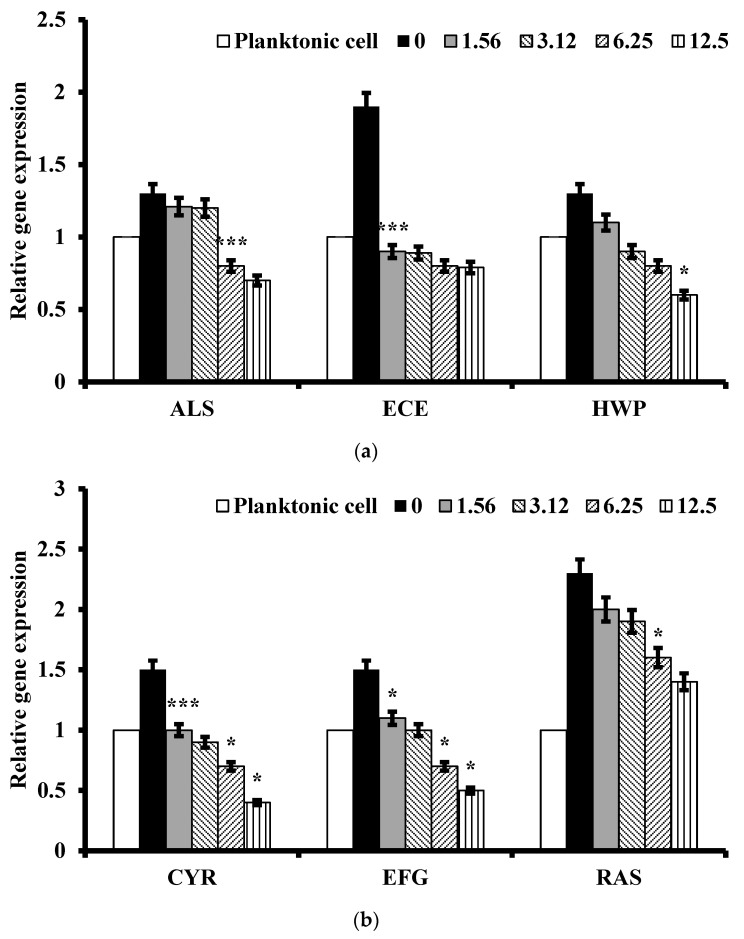
(1) Background: Although accounts for the majority of fungal infections, therapeutic options are limited and require alternative antifungal agents with new targets; (2) Methods: A biofilm formation assay with RPMI1640 medium was performed with extract. A combination antifungal assay, dimorphic transition assay, and adhesion assay were performed under the biofilm formation condition to determine the anti-biofilm formation effect. qRT-PCR analysis was accomplished to confirm changes in gene expression; (3) Results: extract significantly reduces biofilm formation by 51.65% at 1.56 μg/mL use and therefore increases susceptibility to miconazole. extract also inhibited the dimorphic transition of Candida; nearly 50% of the transition was inhibited when 1.56 μg/mL of the extract was treated. The extract of inhibited the expression of genes related to hyphal development and extracellular matrix of 34.4% and 36.0%, respectively, as well as genes within the Ras1-cAMP-PKA, Cph2-Tec1, and MAP kinase signaling pathways of 25.58%, 7.1% and 15.8%, respectively, at 1.56 μg/mL of extract treatment; (4) Conclusions: extract significantly reduced Candida biofilm formation, which lead to induced antifungal susceptibility to miconazole. It suggests that extract is a promising anti-biofilm candidate of since the biofilm formation of is an excellent target for candidiasis regulation.
(1) 背景:尽管[真菌名称]占真菌感染的大多数,但治疗选择有限,需要具有新靶点的替代抗真菌药物;(2) 方法:用[提取物名称]提取物在RPMI1640培养基中进行生物膜形成试验。在生物膜形成条件下进行联合抗真菌试验、双态转变试验和黏附试验,以确定抗生物膜形成效果。通过qRT-PCR分析来确认基因表达的变化;(3) 结果:[提取物名称]提取物在使用浓度为1.56μg/mL时显著降低生物膜形成达51.65%,因此增加了对咪康唑的敏感性。[提取物名称]提取物还抑制了念珠菌的双态转变;当用1.56μg/mL的提取物处理时,近50%的转变受到抑制。在1.56μg/mL的[提取物名称]提取物处理下,[提取物名称]提取物分别抑制了与菌丝发育和细胞外基质相关基因表达的34.4%和36.0%,以及Ras1-cAMP-PKA、Cph2-Tec1和MAP激酶信号通路中基因表达的25.58%、7.1%和15.8%;(4) 结论:[提取物名称]提取物显著减少念珠菌生物膜形成,从而诱导对咪康唑的抗真菌敏感性。这表明[提取物名称]提取物是一种有前景的抗生物膜候选药物,因为念珠菌的生物膜形成是念珠菌病调控的一个极佳靶点。