Ballatore Andrea, Gatti Marco, Mella Serena, Tore Davide, Xhakupi Henri, Giorgino Fabio, Saglietto Andrea, Carmagnola Ludovica, Roagna Edoardo, De Ferrari Gaetano Maria, Faletti Riccardo, Anselmino Matteo
Division of Cardiology, Cardiovascular and Thoracic Department, "Città della Salute e della Scienza" Hospital, 10126 Turin, Italy.
Department of Medical Sciences, University of Turin, 10126 Turin, Italy.
J Cardiovasc Dev Dis. 2024 Apr 28;11(5):137. doi: 10.3390/jcdd11050137.
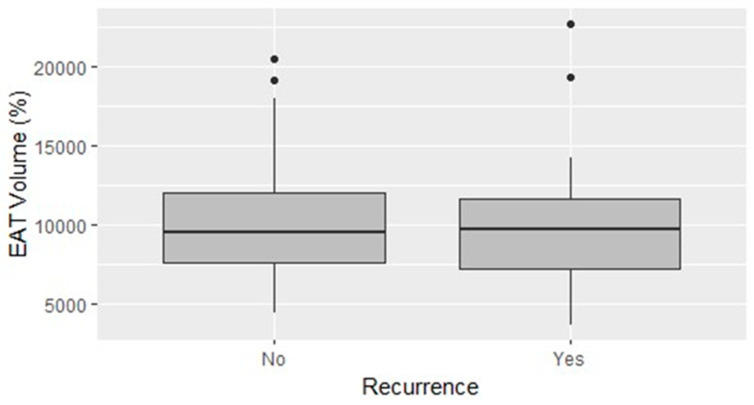
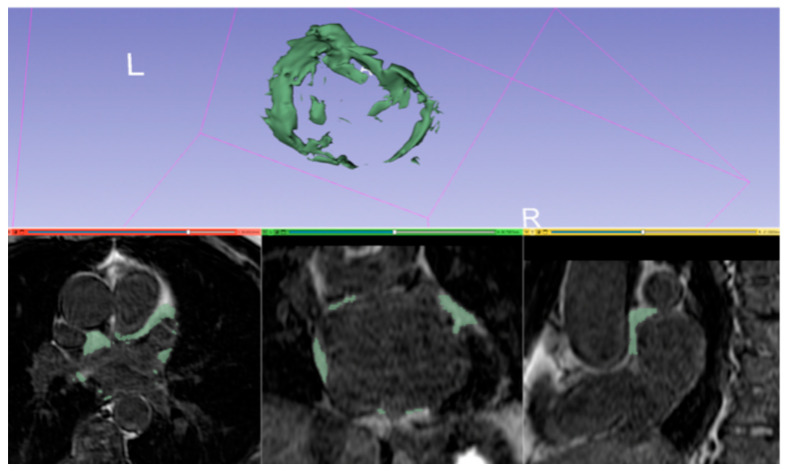
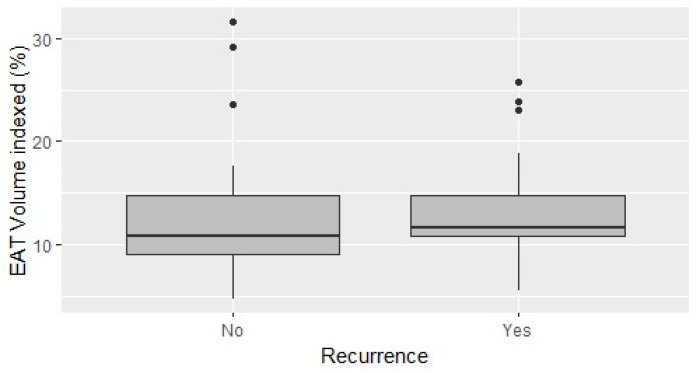
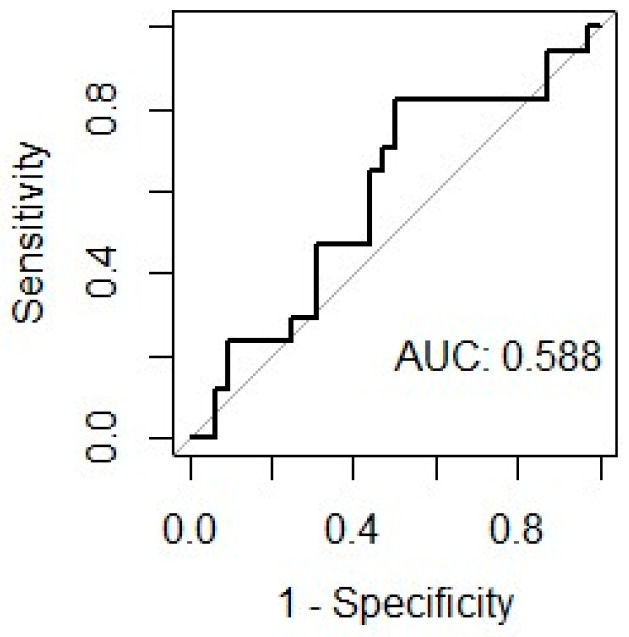
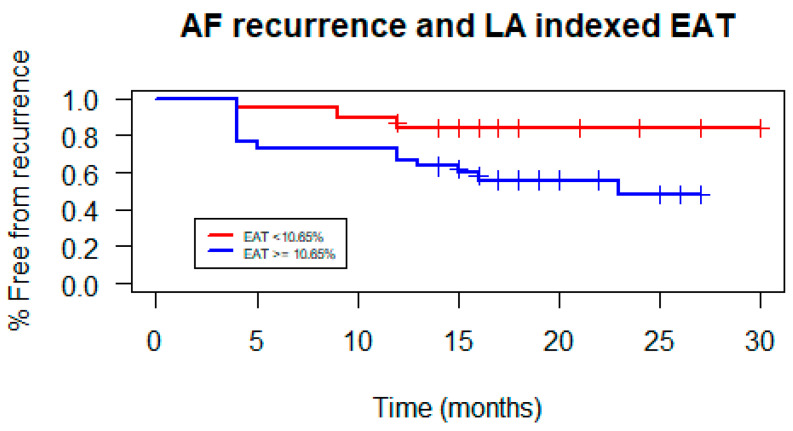
The relationship between epicardial adipose tissue (EAT) and atrial fibrillation (AF) has gained interest in recent years. The previous literature on the topic presents great heterogeneity, focusing especially on computed tomography imaging. The aim of the present study is to determine whether an increased volume of left atrial (LA) EAT evaluated at routine pre-procedural cardiac magnetic resonance imaging (MRI) relates to AF recurrences after catheter ablation. A total of 50 patients undergoing AF cryoballoon ablation and pre-procedural cardiac MRI allowing quantification of LA EAT were enrolled. In one patient, the segmentation of LA EAT could not be achieved. After a median follow-up of 16.0 months, AF recurrences occurred in 17 patients (34%). The absolute volume of EAT was not different in patients with and without AF recurrences (10.35 mL vs. 10.29 mL; -value = 0.963), whereas the volume of EAT indexed on the LA volume (EATi) was lower, albeit non-statistically significant, in patients free from arrhythmias (12.77% vs. 14.06%; -value = 0.467). The receiver operating characteristic curve testing the ability of LA EATi to predict AF recurrence after catheter ablation showed sub-optimal performance (AUC: 0.588). The finest identified cut-off of LA EATi was 10.65%, achieving a sensitivity of 0.5, a specificity of 0.82, a positive predictive value of 0.59 and a negative predictive value of 0.76. Patients with values of LA EATi lower than 10.65% showed greater survival, free from arrhythmias, than patients with values above this cut-off (84% vs. 48%; -value = 0.04). In conclusion, EAT volume indexed on the LA volume evaluated at cardiac MRI emerges as a possible independent predictor of arrhythmia recurrence after AF cryoballoon ablation. Nevertheless, prospective studies are needed to confirm this finding and eventually sustain routine EAT evaluation in the management of patients undergoing AF catheter ablation.
近年来,心外膜脂肪组织(EAT)与心房颤动(AF)之间的关系备受关注。以往关于该主题的文献存在很大的异质性,尤其侧重于计算机断层扫描成像。本研究的目的是确定在常规术前心脏磁共振成像(MRI)中评估的左心房(LA)EAT体积增加是否与导管消融术后AF复发有关。共有50例接受AF冷冻球囊消融术且术前心脏MRI可对LA EAT进行定量分析的患者入组。其中1例患者无法实现LA EAT的分割。在中位随访16.0个月后,17例患者(34%)出现AF复发。有和没有AF复发的患者之间EAT的绝对体积无差异(10.35 mL对10.29 mL;P值 = 0.963),而在无心律失常的患者中,以LA体积为指数的EAT体积(EATi)较低,尽管无统计学意义(12.77%对14.06%;P值 = 0.467)。测试LA EATi预测导管消融术后AF复发能力的受试者工作特征曲线显示性能欠佳(曲线下面积:0.588)。LA EATi最精确的确定截断值为10.65%,灵敏度为0.5,特异性为0.82,阳性预测值为0.59,阴性预测值为0.76。LA EATi值低于10.65%的患者与高于该截断值的患者相比,无心律失常的生存率更高(84%对48%;P值 = 0.04)。总之,在心脏MRI中评估的以LA体积为指数的EAT体积可能是AF冷冻球囊消融术后心律失常复发的一个独立预测指标。然而,需要前瞻性研究来证实这一发现,并最终支持在接受AF导管消融术的患者管理中进行常规EAT评估。