Izák Josef, Benč Marek, Kunčická Lenka, Opěla Petr, Kocich Radim
Faculty of Mechanical Engineering, Brno University of Technology, Technická 2896, 616 00 Brno, Czech Republic.
Department of Metallurgical Technologies, Faculty of Materials Science and Technology, VŠB Technical University of Ostrava, 17. Listopadu 2172-15, 708 00 Ostrava, Czech Republic.
Materials (Basel). 2024 May 14;17(10):2317. doi: 10.3390/ma17102317.
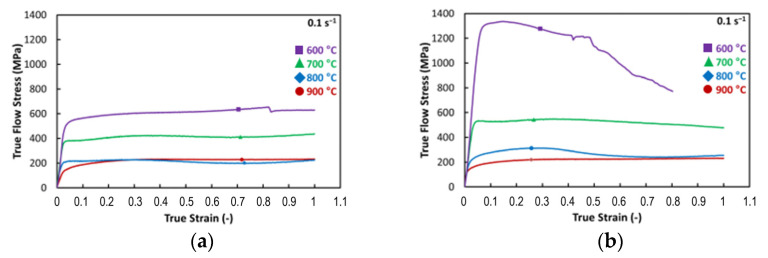
The presented work is focused on the influence of imposed strain on the weldability of Dievar alloy. Two mechanisms affecting the microstructure and thus imparting changes in the mechanical properties were applied-heat treatment (hardening and tempering), and rotary swaging. The processed workpieces were further subjected to welding with various welding currents. In order to characterize the effects of welding on the microstructure, especially in the heat-affected zone, and determine material stability under elevated temperatures, samples for uniaxial hot compression testing at temperatures from 600 to 900 °C, optical and scanning electron microscopy, and microhardness testing were taken. The testing revealed that, although the rotary swaged and heat-treated samples featured comparable microhardness, the strength of the swaged material was approximately twice as high as that of the heat-treated one-specifically 1350 MPa. Furthermore, it was found that the rotary swaged sample exhibited favorable welding behavior when compared to the heat-treated one, when the higher welding current was applied.
本文所呈现的工作聚焦于施加应变对迪瓦合金焊接性的影响。采用了两种影响微观结构并进而改变力学性能的机制——热处理(淬火和回火)以及旋转锻造。对加工后的工件施加不同的焊接电流进行焊接。为了表征焊接对微观结构的影响,尤其是热影响区的微观结构,并确定材料在高温下的稳定性,制备了用于在600至900℃温度下进行单轴热压缩试验的样品、进行光学和扫描电子显微镜观察以及显微硬度测试。测试结果表明,尽管旋转锻造和热处理后的样品具有相当的显微硬度,但锻造材料的强度约为热处理材料的两倍,具体为1350MPa。此外,研究发现,当施加较高的焊接电流时,与热处理后的样品相比,旋转锻造后的样品表现出良好的焊接性能。