Division of Infectious Diseases, Johns Hopkins University School of Medicine, Baltimore, MD 21205, USA.
Center for Biomedical Data Science, Yale University School of Medicine, New Haven, CT 06511, USA.
Viruses. 2024 May 2;16(5):723. doi: 10.3390/v16050723.
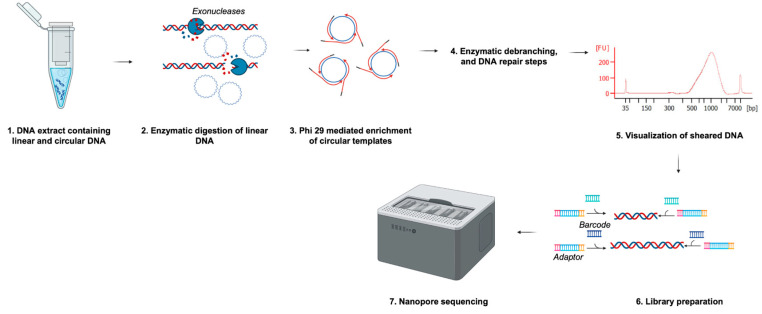
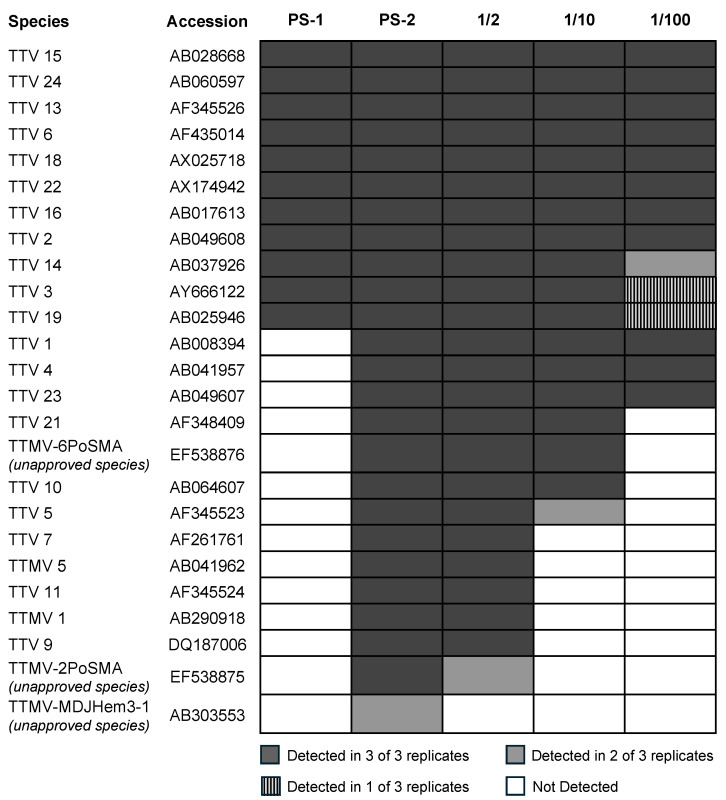
Routinely used metagenomic next-generation sequencing (mNGS) techniques often fail to detect low-level viremia (<10 copies/mL) and appear biased towards viruses with linear genomes. These limitations hinder the capacity to comprehensively characterize viral infections, such as those attributed to the family. These near ubiquitous non-pathogenic components of the human virome have circular single-stranded DNA genomes that vary in size from 2.0 to 3.9 kb and exhibit high genetic diversity. Hence, species identification using short reads can be challenging. Here, we introduce a rolling circle amplification (RCA)-based metagenomic sequencing protocol tailored for circular single-stranded DNA genomes, utilizing the long-read Oxford Nanopore platform. The approach was assessed by sequencing anelloviruses in plasma drawn from people who inject drugs (PWID) in two geographically distinct cohorts. We detail the methodological adjustments implemented to overcome difficulties inherent in sequencing circular genomes and describe a computational pipeline focused on anellovirus detection. We assessed our protocol across various sample dilutions and successfully differentiated anellovirus sequences in conditions simulating mixed infections. This method provides a robust framework for the comprehensive characterization of circular viruses within the human virome using the Oxford Nanopore.
常规使用的宏基因组下一代测序(mNGS)技术常常无法检测到低水平的病毒血症(<10 拷贝/mL),并且似乎偏向于具有线性基因组的病毒。这些局限性阻碍了全面描述病毒感染的能力,例如归因于 科的病毒感染。这些近普遍存在的人类病毒组中非致病性成分具有圆形单链 DNA 基因组,大小从 2.0 到 3.9 kb 不等,表现出高度的遗传多样性。因此,使用短读长进行物种鉴定可能具有挑战性。在这里,我们介绍了一种基于滚环扩增(RCA)的宏基因组测序方案,专门针对圆形单链 DNA 基因组,利用长读长 Oxford Nanopore 平台。该方法通过对来自两个地理位置不同的静脉注射吸毒者(PWID)人群的血浆中的微小病毒进行测序进行了评估。我们详细介绍了为克服测序圆形基因组固有的困难而实施的方法学调整,并描述了一个专注于微小病毒检测的计算管道。我们在各种样品稀释度下评估了我们的方案,并成功区分了模拟混合感染条件下的微小病毒序列。该方法为使用 Oxford Nanopore 全面描述人类病毒组中的圆形病毒提供了一个强大的框架。