Division of Chemical Biology, Department of Life Sciences, Chalmers University of Technology, Gothenburg 412 96, Sweden.
The Rheumatology Clinic, Sahlgrenska University Hospital, Gothenburg 413 45, Sweden.
ACS Appl Bio Mater. 2024 Jun 17;7(6):3810-3820. doi: 10.1021/acsabm.4c00182. Epub 2024 May 25.
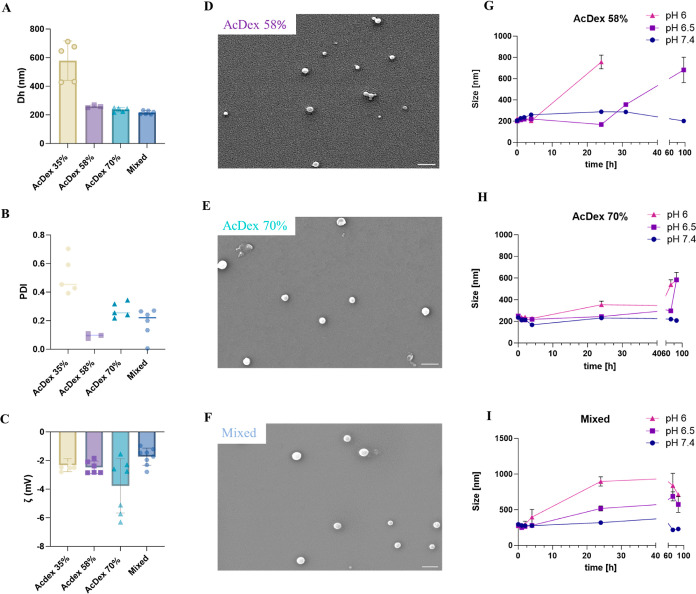
Polymer-based nanoparticles (NPs) that react to altered physiological characteristics have the potential to enhance the delivery of therapeutics to a specific area. These materials can utilize biochemical triggers, such as low pH, which is prone to happen locally in an inflammatory microenvironment due to increased cellular activity. This reduced pH is neutralized when inflammation subsides. For precise delivery of therapeutics to match this dynamic reaction, drug delivery systems (DDS) need to not only release the drug (ON) but also stop the release (OFF) autonomously. In this study, we use a systematic approach to optimize the composition of acetalated dextran (AcDex) NPs to start (ON) and stop (OFF) releasing model cargo, depending on local pH changes. By mixing ratios of AcDex polymers (mixed NPs), we achieved a highly sensitive material that was able to rapidly release cargo when going from pH 7.4 to pH 6.0. At the same time, the mix also offered a stable composition that enabled a rapid ON/OFF/ON/OFF switching within this narrow pH range in only 90 min. These mixed NPs were also sensitive to biological pH changes, with increased release in the presence of inflammatory cells compared to healthy cells. Such precise and controllable characteristics of a DDS position mixed NPs as a potential treatment platform to inhibit disease flare-ups, reducing both systemic and local side effects to offer a superior treatment option for inflammation compared to conventional systems.
基于聚合物的纳米颗粒(NPs)可以对改变的生理特征做出反应,从而有可能增强治疗剂向特定区域的输送。这些材料可以利用生化触发因素,例如低 pH 值,由于细胞活性增加,炎症微环境中局部容易发生这种情况。当炎症消退时,这种降低的 pH 值会被中和。为了精确输送与这种动态反应相匹配的治疗剂,药物输送系统(DDS)不仅需要释放药物(ON),还需要自主停止释放(OFF)。在这项研究中,我们使用系统的方法来优化乙酰化葡聚糖(AcDex) NPs 的组成,使其能够根据局部 pH 值的变化开始(ON)和停止(OFF)释放模型货物。通过混合 AcDex 聚合物(混合 NPs)的比例,我们获得了一种高度敏感的材料,当从 pH 值 7.4 降低到 pH 值 6.0 时,能够快速释放货物。同时,该混合物还具有稳定的组成,能够在仅 90 分钟内实现这种狭窄 pH 范围内的快速 ON/OFF/ON/OFF 切换。这些混合 NPs 还对生物 pH 值变化敏感,与健康细胞相比,在存在炎症细胞的情况下,释放量增加。这种 DDS 的精确和可控特性使混合 NPs 成为一种潜在的治疗平台,可以抑制疾病发作,减少全身和局部副作用,为炎症提供优于传统系统的治疗选择。