Department of Neurosurgery, Huashan Hospital, Shanghai Medical College, Fudan University, Shanghai, China; National Center for Neurological Disorders, Shanghai, China; Shanghai Key Laboratory of Brain Function and Restoration and Neural Regeneration, Shanghai, China; Immunology Laboratory, Neurosurgical Institute of Fudan University, Shanghai, China; Shanghai Clinical Medical Center of Neurosurgery, Shanghai, China.
Immunology Laboratory, Neurosurgical Institute of Fudan University, Shanghai, China.
Neoplasia. 2024 Aug;54:101007. doi: 10.1016/j.neo.2024.101007. Epub 2024 May 25.
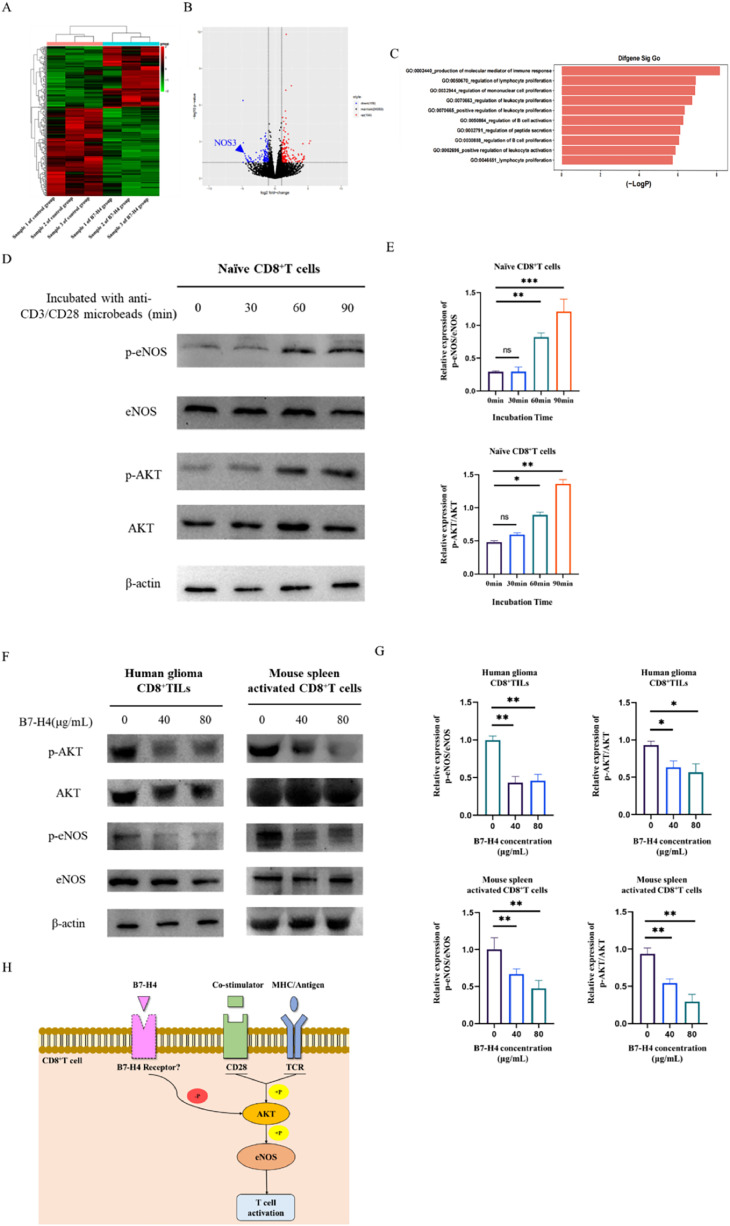
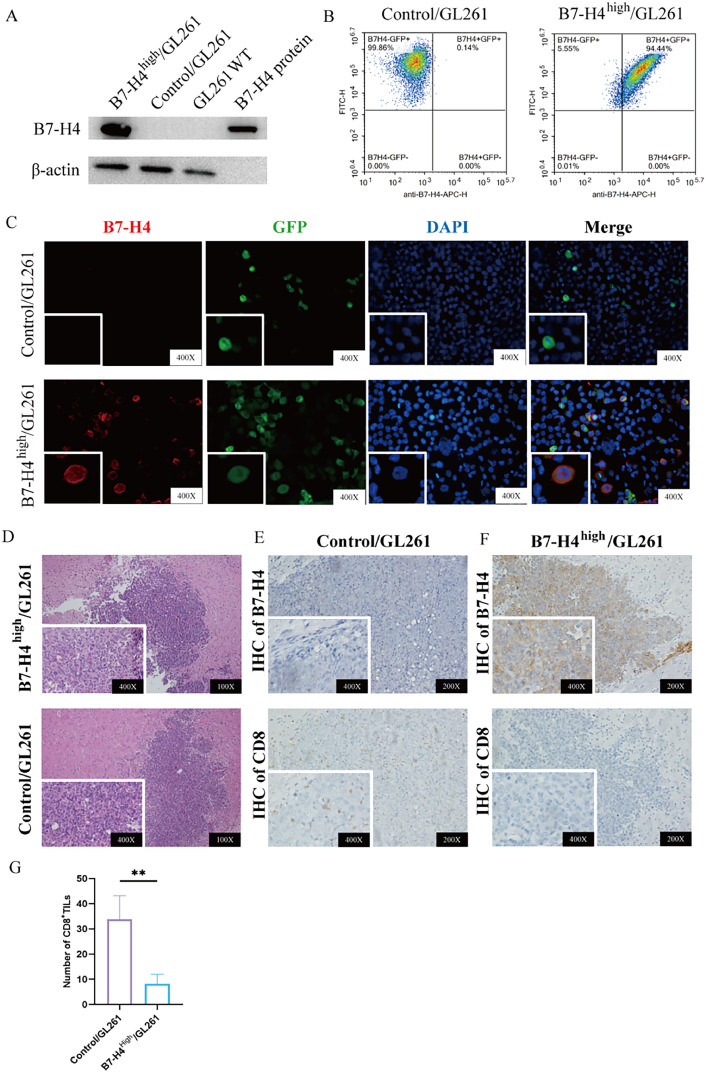
B7-H4 is a promising immune checkpoint molecule in tumor immunotherapy. Our previous study showed that high B7-H4 expression was strongly correlated with deficiency in tumor infiltrated lymphocytes (TILs) in glioma patients. On this basis, we investigated the impact of B7-H4 on CD8+TILs in gliomas and the associated molecular mechanism here. B7-H4-positive tumor samples (n=129) from our glioma cohort were used to assess B7-H4 expression and CD8+TIL quantification by immunohistochemistry. CD8+TILs from five glioma patients cultured with B7-H4 protein were used to evaluate anti-tumor dysfunction by flow cytometry and ELISpot. An orthotopic murine glioma model was used to investigate the role of B7-H4 in glioma CD8+TILs by immunohisto- chemistry and flow cytometry. CD8+TILs from glioma patients cultured with B7-H4 protein were used to explore the potential molecular mechanism by RNA sequencing and western blot. Our results showed that glioma CD8+TIL density was negatively correlated with B7-H4 expression both in glioma patient cohort (P < 0.05) and orthotopic glioma murine model (P < 0.01). B7-H4 also lowered the expression of CD137 and CD103 (P < 0.05 for both) in glioma CD8+TILs and reduced their secretion of the anti-tumor cytokines IFN-γ and TNF-α (P < 0.01 for both) in a dose-dependent manner. Furthermore, B7-H4 was found to induce early dysfunction of glioma CD8+TILs by downregulating the phosphorylation of AKT and eNOS (P < 0.05 for both). In conclusion, B7-H4 reduced the infiltration of glioma CD8+TILs and induced an anti-tumor dysfunction phenotype. B7-H4 may also impair the anti-tumor function of glioma CD8+TILs via the AKT-eNOS pathway. These results indicated that B7-H4 may serve as a potential target in future glioma immunotherapy.
B7-H4 是肿瘤免疫治疗中一种有前途的免疫检查点分子。我们之前的研究表明,B7-H4 的高表达与胶质瘤患者肿瘤浸润淋巴细胞(TILs)的缺乏密切相关。在此基础上,我们研究了 B7-H4 对胶质瘤中 CD8+TIL 的影响及其相关的分子机制。我们使用来自胶质瘤队列的 129 例 B7-H4 阳性肿瘤样本通过免疫组化评估 B7-H4 表达和 CD8+TIL 定量。我们使用 B7-H4 蛋白培养来自 5 例胶质瘤患者的 CD8+TIL,通过流式细胞术和 ELISpot 评估其抗肿瘤功能障碍。我们使用原位胶质瘤小鼠模型通过免疫组化和流式细胞术研究 B7-H4 在胶质瘤 CD8+TIL 中的作用。我们使用 B7-H4 蛋白培养的胶质瘤患者的 CD8+TIL 通过 RNA 测序和 Western blot 探索潜在的分子机制。我们的结果表明,在胶质瘤患者队列中(P < 0.05)和原位胶质瘤小鼠模型中(P < 0.01),胶质瘤 CD8+TIL 密度与 B7-H4 表达呈负相关。B7-H4 还降低了胶质瘤 CD8+TIL 中 CD137 和 CD103 的表达(两者均为 P < 0.05),并呈剂量依赖性降低其分泌的抗肿瘤细胞因子 IFN-γ 和 TNF-α(两者均为 P < 0.01)。此外,B7-H4 通过下调 AKT 和 eNOS 的磷酸化诱导胶质瘤 CD8+TIL 的早期功能障碍(两者均为 P < 0.05)。总之,B7-H4 减少了胶质瘤 CD8+TIL 的浸润,并诱导了抗肿瘤功能障碍表型。B7-H4 可能还通过 AKT-eNOS 通路损害胶质瘤 CD8+TIL 的抗肿瘤功能。这些结果表明,B7-H4 可能成为未来胶质瘤免疫治疗的潜在靶点。