Chen Di, Li Gaopeng, Ji Chunxia, Lu Qiqi, Qi Ying, Tang Chao, Xiong Ji, Hu Jian, Yasar Fatma Betul Aksoy, Zhang Yan, Hoon Dave S B, Yao Yu, Zhou Liangfu
Department of Neurosurgery, Huashan Hospital, Fudan University, Shanghai, China.
Shenzhen Key Laboratory of Marine Bioresources and Ecology, Brain Disease and Big Data Research Institute, College of Life Sciences & and Oceanography, Shenzhen University, Shenzhen, Guangdong, China.
J Immunother Cancer. 2020 May;8(1). doi: 10.1136/jitc-2019-000154.
Characterizing expression profiles of different immune checkpoint molecules are promising for personalized checkpoint inhibitory immunotherapy. Gliomas have been shown as potential targets for immune checkpoint inhibitors recently. Our study was performed to determine coexpression levels of two major B7 immune regulatory molecules programmed death ligand 1 (PD-L1) and B7-H4, both of which have been demonstrated to inhibit antitumor host immunity in gliomas.
We assessed tumor tissues from stage II-IV primary gliomas (n=505) by immunohistochemistry (IHC) for protein levels of both PD-L1 and B7-H4. Gene coexpression analysis assessing clusters based on extent of PD-L1/B7-H4 classifier genes expression were investigated in two transcriptome datasets (The Cancer Genome Atlas and Chinese Glioma Genome Atlas). In addition, levels of immune cell infiltrates were estimated with IHC and RNA-seq data for assessing the tumor immune microenvironment of PD-L1/B7-H4 subgroups.
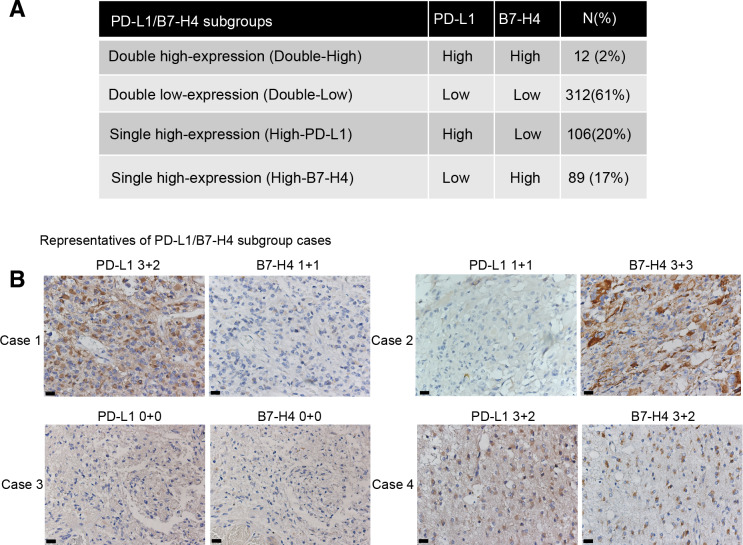
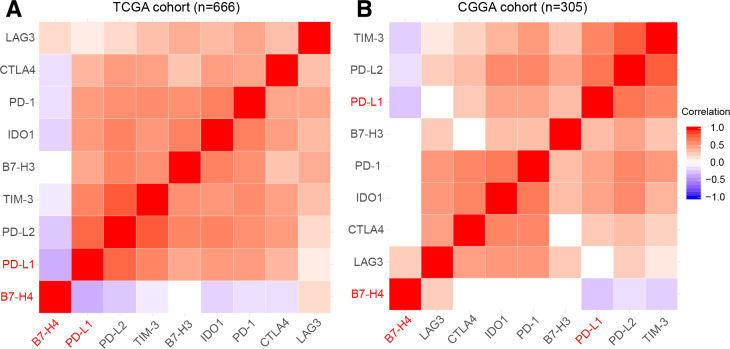
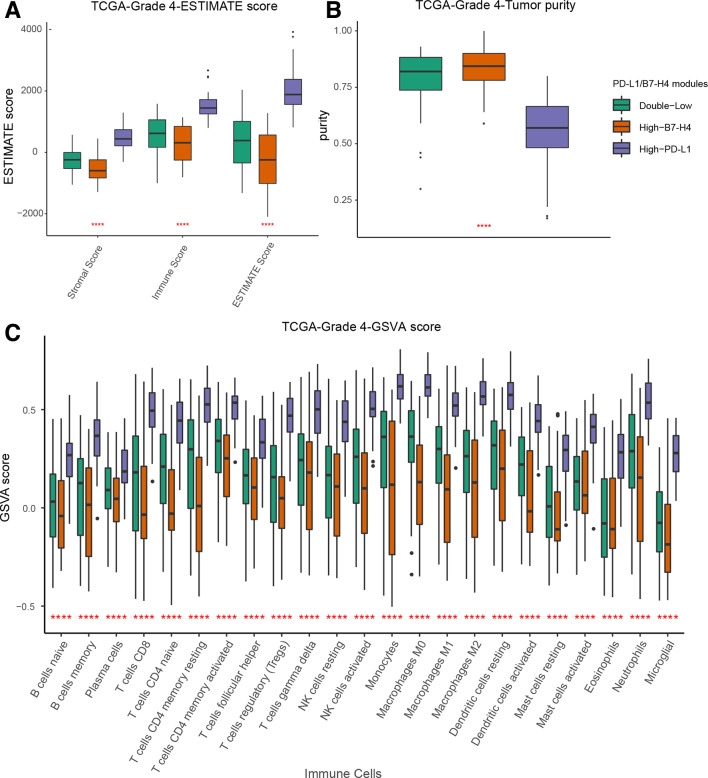
High expression of PD-L1 and B7-H4 in gliomas was 23% and 20%, respectively, whereas coexpression of two proteins at high levels was limited to 2% of the cases. Comparable results were seen in RNA-seq datasets where PD-L1 mRNA expression levels negatively correlated with that of B7-H4. Gene coexpression modules clustered within each grade of gliomas demonstrated lack of double-high modules (cluster with high expression of both PD-L1 and B7-H4 classifier genes). B7-H4 mRNA expression levels showed negative correlation with extent of immune cell infiltration and High-B7-H4 module gliomas (high B7-H4 but low PD-L1 classifier genes expression) had less tumor-infiltrating lymphocytes (TILs) and tumor-associated macrophages (TAMs). IHC assessment also showed few TILs and TAMs in High-B7-H4 subgroup gliomas.
The majority of gliomas express PD-L1 or B7-H4, however, coexpression of both at high levels is minimal. The high-B7-H4 patients could be considered as 'super-cold' gliomas with significantly deficient in TILs, suggesting that B7-H4 might inhibit T-cell trafficking into the central nervous system. This study demonstrated that PD-L1 and B7-H4 may serve as mutually compensatory immune checkpoint molecules in gliomas for immune targeted or active-specific immunotherapy. The distinct B7-H4 pathways modulating T-cell function and immune evasion in glioma patients deserved to be further explored in the future during immunotherapy.
描绘不同免疫检查点分子的表达谱对于个性化的检查点抑制免疫疗法很有前景。胶质瘤最近已被证明是免疫检查点抑制剂的潜在靶点。我们开展这项研究以确定两种主要的B7免疫调节分子程序性死亡配体1(PD-L1)和B7-H4的共表达水平,这两种分子均已被证明在胶质瘤中可抑制抗肿瘤宿主免疫。
我们通过免疫组织化学(IHC)评估了II-IV期原发性胶质瘤(n=505)的肿瘤组织中PD-L1和B7-H4的蛋白水平。在两个转录组数据集(癌症基因组图谱和中国胶质瘤基因组图谱)中进行了基于PD-L1/B7-H4分类基因表达程度评估聚类的基因共表达分析。此外,利用IHC和RNA测序数据估计免疫细胞浸润水平,以评估PD-L1/B7-H4亚组的肿瘤免疫微环境。
胶质瘤中PD-L1和B7-H4的高表达分别为23%和20%,而两种蛋白的高水平共表达仅限于2%的病例。在RNA测序数据集中也观察到了类似结果,其中PD-L1 mRNA表达水平与B7-H4的表达呈负相关。在各等级胶质瘤中聚类的基因共表达模块显示缺乏双高模块(同时高表达PD-L1和B7-H4分类基因的聚类)。B7-H4 mRNA表达水平与免疫细胞浸润程度呈负相关,高B7-H4模块的胶质瘤(高B7-H4但低PD-L1分类基因表达)中肿瘤浸润淋巴细胞(TILs)和肿瘤相关巨噬细胞(TAMs)较少。IHC评估也显示高B7-H4亚组胶质瘤中的TILs和TAMs较少。
大多数胶质瘤表达PD-L1或B7-H4,然而,两者的高水平共表达极少。高B7-H4患者可被视为TILs明显缺乏的“超冷”胶质瘤,这表明B7-H4可能抑制T细胞向中枢神经系统的迁移。本研究表明,在胶质瘤中,PD-L1和B7-H4可能作为相互补偿的免疫检查点分子用于免疫靶向或主动特异性免疫治疗。在未来免疫治疗期间,胶质瘤患者中调节T细胞功能和免疫逃逸的独特B7-H4途径值得进一步探索。