Romero-Carramiñana Inés, Dominguez-Zorita Sonia, Esparza-Moltó Pau B, Cuezva José M
Departamento de Biología Molecular, Centro de Biología Molecular Severo Ochoa, Consejo Superior de Investigaciones Científicas-Universidad Autónoma de Madrid (CSIC-UAM), 28049 Madrid, Spain.
Centro de Investigación Biomédica en Red de Enfermedades Raras (CIBERER) ISCIII, Madrid, Spain.
iScience. 2024 May 3;27(6):109863. doi: 10.1016/j.isci.2024.109863. eCollection 2024 Jun 21.
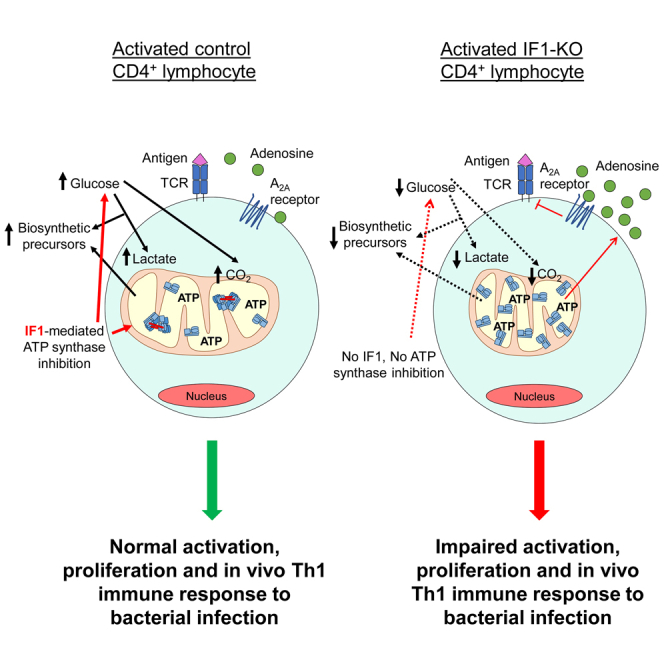
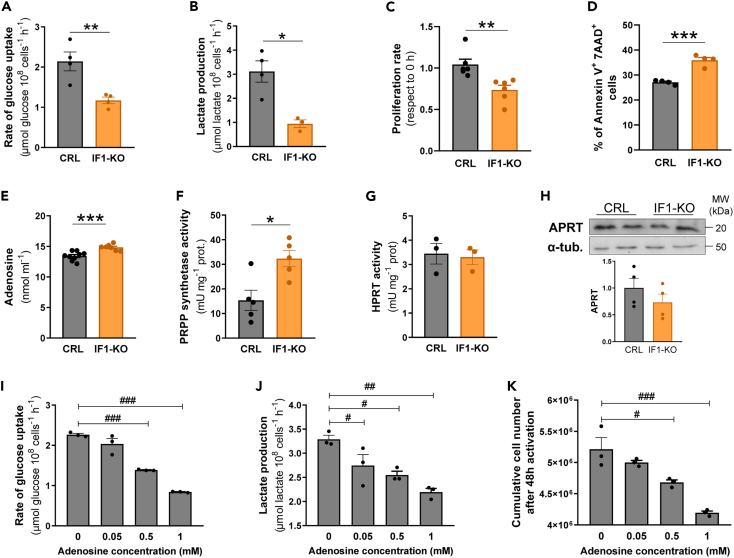
T cells experience metabolic reprogramming to an enhanced glycolysis upon activation. Herein, we have investigated whether ATPase Inhibitory Factor 1 (IF1), the physiological inhibitor of mitochondrial ATP synthase, participates in rewiring T cells to a particular metabolic phenotype. We show that the activation of naive CD4 T lymphocytes both and is accompanied by a sharp upregulation of IF1, which is expressed only in Th1 effector cells. T lymphocytes of conditional CD4-IF1-knockout mice display impaired glucose uptake and flux through glycolysis, reducing the biogenesis of mitochondria and cellular proliferation after activation. Consequently, mice devoid of IF1 in T lymphocytes cannot mount an effective Th1 response against bacterial infection compromising their survival. Overall, we show that the inhibition of a fraction of ATP synthase by IF1 regulates metabolic reprogramming and functionality of T cells, highlighting the essential role of IF1 in adaptive immune responses.
T细胞在激活后会经历代谢重编程,增强糖酵解。在此,我们研究了线粒体ATP合酶的生理抑制剂ATP酶抑制因子1(IF1)是否参与将T细胞重塑为特定的代谢表型。我们发现,初始CD4 T淋巴细胞的激活无论是在体内还是体外,都伴随着IF1的急剧上调,而IF1仅在Th1效应细胞中表达。条件性CD4-IF1基因敲除小鼠的T淋巴细胞在激活后显示出葡萄糖摄取和糖酵解通量受损,线粒体生物合成和细胞增殖减少。因此,T淋巴细胞中缺乏IF1的小鼠无法对细菌感染产生有效的Th1反应,从而影响其生存。总体而言,我们表明IF1对一部分ATP合酶的抑制作用调节了T细胞的代谢重编程和功能,突出了IF1在适应性免疫反应中的重要作用。