Departamento Química Física, Universidad Complutense de Madrid, Avda. Complutense s/n, Madrid, 28040, Spain.
Instituto de Investigación Biomédica Hospital Doce de Octubre (imas12), Avenida de Córdoba s/n, Madrid, 28041, Spain.
Adv Sci (Weinh). 2023 Nov;10(31):e2301606. doi: 10.1002/advs.202301606. Epub 2023 Sep 13.
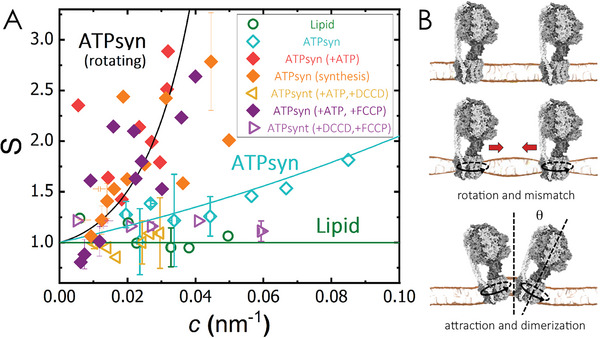
ATP synthases are proteins that catalyse the formation of ATP through the rotatory movement of their membrane-spanning subunit. In mitochondria, ATP synthases are found to arrange as dimers at the high-curved edges of cristae. Here, a direct link is explored between the rotatory movement of ATP synthases and their preference for curved membranes. An active curvature sorting of ATP synthases in lipid nanotubes pulled from giant vesicles is found. Coarse-grained simulations confirm the curvature-seeking behaviour of rotating ATP synthases, promoting reversible and frequent protein-protein contacts. The formation of transient protein dimers relies on the membrane-mediated attractive interaction of the order of 1.5 k T produced by a hydrophobic mismatch upon protein rotation. Transient dimers are sustained by a conic-like arrangement characterized by a wedge angle of θ ≈ 50°, producing a dynamic coupling between protein shape and membrane curvature. The results suggest a new role of the rotational movement of ATP synthases for their dynamic self-assembly in biological membranes.
ATP 合酶是一种通过跨膜亚基的旋转运动催化 ATP 形成的蛋白质。在线粒体中,ATP 合酶被发现排列在嵴的高曲率边缘作为二聚体。在这里,探索了 ATP 合酶的旋转运动与其对弯曲膜的偏好之间的直接联系。从巨大囊泡中提取的脂质纳米管中的 ATP 合酶表现出一种主动的曲率分选。粗粒化模拟证实了旋转 ATP 合酶的曲率寻求行为,促进了可逆和频繁的蛋白质-蛋白质接触。瞬时蛋白质二聚体的形成依赖于膜介导的吸引力相互作用,这种相互作用由蛋白质旋转时产生的疏水性失配产生,约为 1.5 kT。瞬时二聚体由一个圆锥状排列来维持,其特征是楔形角θ≈50°,在蛋白质形状和膜曲率之间产生动态耦合。研究结果表明,ATP 合酶的旋转运动在其在生物膜中的动态自组装中具有新的作用。