Division of Applied Bioinformatics, German Cancer Research Center (DKFZ), Heidelberg, Germany.
Division of Radiooncology/Radiobiology, German Cancer Research Center (DKFZ), Heidelberg, Germany.
NPJ Syst Biol Appl. 2024 May 27;10(1):57. doi: 10.1038/s41540-024-00385-x.
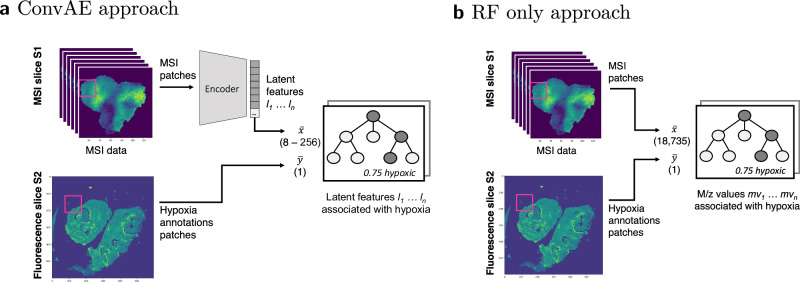
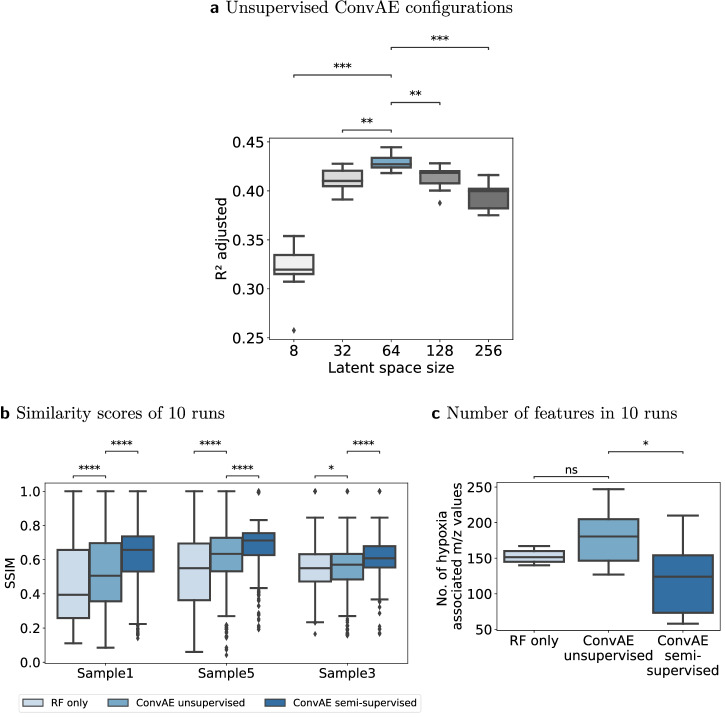
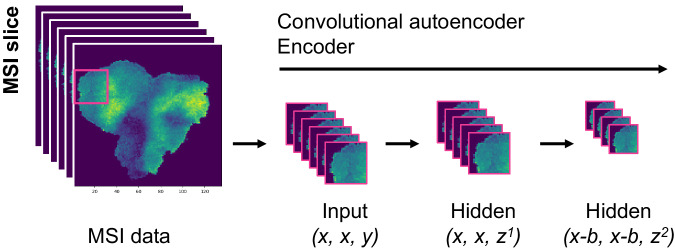
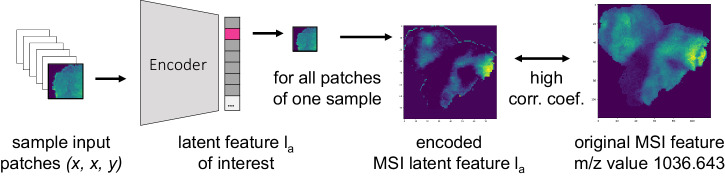
Mass spectrometry imaging (MSI) allows to study cancer's intratumoral heterogeneity through spatially-resolved peptides, metabolites and lipids. Yet, in biomedical research MSI is rarely used for biomarker discovery. Besides its high dimensionality and multicollinearity, mass spectrometry (MS) technologies typically output mass-to-charge ratio values but not the biochemical compounds of interest. Our framework makes particularly low-abundant signals in MSI more accessible. We utilized convolutional autoencoders to aggregate features associated with tumor hypoxia, a parameter with significant spatial heterogeneity, in cancer xenograft models. We highlight that MSI captures these low-abundant signals and that autoencoders can preserve them in their latent space. The relevance of individual hyperparameters is demonstrated through ablation experiments, and the contribution from original features to latent features is unraveled. Complementing MSI with tandem MS from the same tumor model, multiple hypoxia-associated peptide candidates were derived. Compared to random forests alone, our autoencoder approach yielded more biologically relevant insights for biomarker discovery.
质谱成像(MSI)允许通过空间分辨的肽、代谢物和脂质来研究肿瘤内的异质性。然而,在生物医学研究中,MSI 很少用于生物标志物的发现。除了其高维度和多重共线性之外,质谱(MS)技术通常输出质荷比(mass-to-charge ratio)值,而不是感兴趣的生化化合物。我们的框架使得 MSI 中的特别低丰度信号更容易获取。我们利用卷积自动编码器来聚合与肿瘤缺氧相关的特征,肿瘤缺氧是癌症异种移植模型中具有显著空间异质性的参数。我们强调,MSI 可以捕获这些低丰度信号,并且自动编码器可以在其潜在空间中保留这些信号。通过消融实验证明了个别超参数的相关性,并揭示了原始特征对潜在特征的贡献。通过对同一肿瘤模型的 MSI 进行串联 MS 补充,得出了多个与缺氧相关的肽候选物。与单独的随机森林相比,我们的自动编码器方法为生物标志物的发现提供了更具生物学意义的见解。