Interdisciplinary Centre for Palliative Medicine, Medical Faculty, University Hospital Düsseldorf, Heinrich-Heine-University Düsseldorf, Düsseldorf, Germany.
Center of Integrated Oncology Aachen, Bonn, Cologne (CIO ABCD), Heinrich-Heine-University, Düsseldorf, Germany.
Crit Care. 2024 May 28;28(1):181. doi: 10.1186/s13054-024-04969-1.
Triggers have been developed internationally to identify intensive care patients with palliative care needs. Due to their work, nurses are close to the patient and their perspective should therefore be included. In this study, potential triggers were first identified and then a questionnaire was developed to analyse their acceptance among German intensive care nurses.
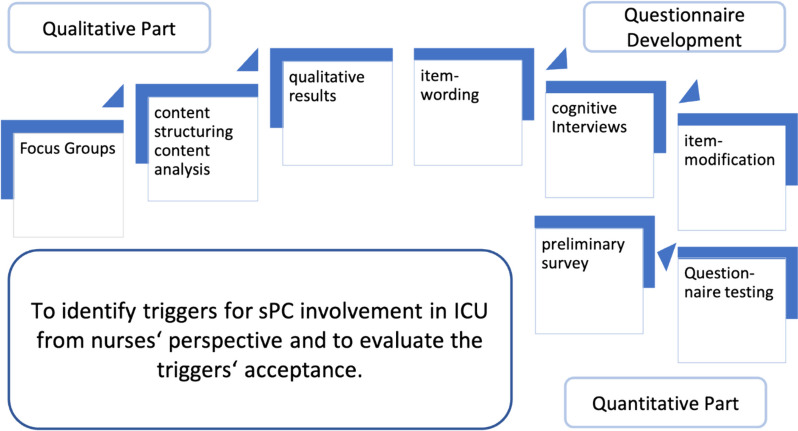
For the qualitative part of this mixed methods study, focus groups were conducted with intensive care nurses from different disciplines (surgery, neurosurgery, internal medicine), which were selected by convenience. Data were analysed using the "content-structuring content analysis" according to Kuckartz. For the quantitative study part, the thus identified triggers formed the basis for questionnaire items. The questionnaire was tested for comprehensibility in cognitive pretests and for feasibility in a pilot survey.
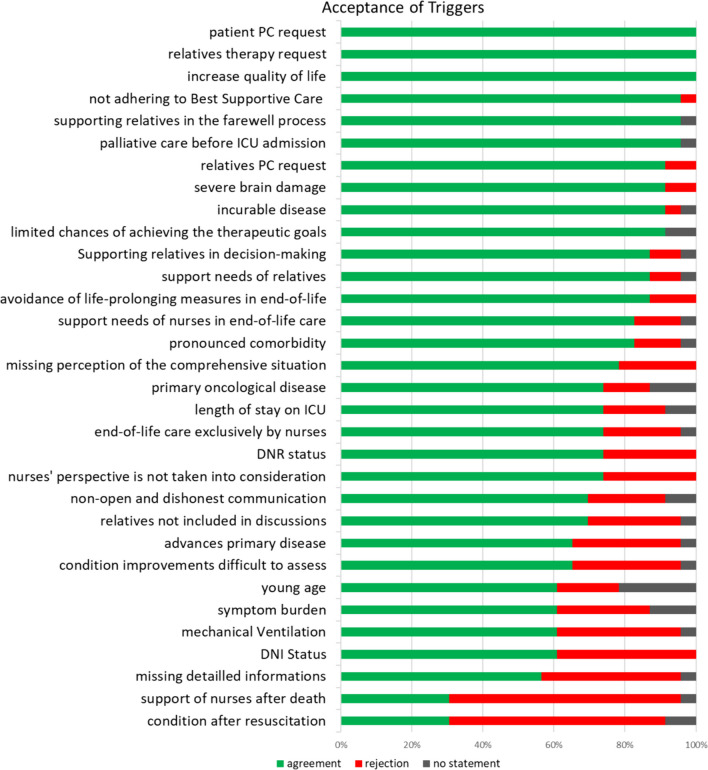
In the qualitative part six focus groups were conducted at four university hospitals. From the data four main categories (prognosis, interprofessional cooperation, relatives, patients) with three to 15 subcategories each could be identified. The nurses described situations requiring palliative care consults that related to the severity of the disease, the therapeutic course, communication within the team and between team and patient/relatives, and typical characteristics of patients and relatives. In addition, a professional conflict between nurses and physicians emerged. The questionnaire, which was developed after six cognitive interviews, consists of 32 items plus one open question. The pilot had a response rate of 76.7% (23/30), whereby 30 triggers were accepted with an agreement of ≥ 50%.
Intensive care nurses see various triggers, with interprofessional collaboration and the patient's prognosis playing a major role. The questionnaire can be used for further surveys, e.g. interprofessional triggers could be developed.
国际上已经开发出了一些触发因素来识别有姑息治疗需求的重症监护患者。由于他们的工作,护士与患者密切接触,因此应该包括他们的观点。在这项研究中,首先确定了潜在的触发因素,然后开发了一份问卷来分析德国重症监护护士对这些触发因素的接受程度。
这项混合方法研究的定性部分采用方便抽样选择了来自不同学科(外科、神经外科、内科)的重症监护护士进行焦点小组讨论。数据采用 Kuckartz 的“内容结构内容分析”进行分析。在定量研究部分,由此确定的触发因素构成了问卷项目的基础。该问卷在认知预测试中进行了可理解性测试,在试点调查中进行了可行性测试。
在定性部分,在四家大学医院进行了六次焦点小组讨论。从数据中可以确定四个主要类别(预后、跨专业合作、家属、患者),每个类别有三到十五个子类别。护士描述了需要姑息治疗咨询的情况,这些情况与疾病的严重程度、治疗过程、团队内部以及团队与患者/家属之间的沟通有关,以及患者和家属的典型特征。此外,护士和医生之间还出现了一种职业冲突。在六次认知访谈后开发的问卷由 32 个项目加一个开放问题组成。试点调查的回复率为 76.7%(23/30),其中 30 个触发因素的同意率≥50%。
重症监护护士看到了各种触发因素,其中跨专业合作和患者的预后起着重要作用。该问卷可用于进一步的调查,例如可以开发跨专业的触发因素。