Michalsen Andrej, Neitzke Gerald, Dutzmann Jochen, Rogge Annette, Seidlein Anna-Henrikje, Jöbges Susanne, Burchardi Hilmar, Hartog Christiane, Nauck Friedemann, Salomon Fred, Duttge Gunnar, Michels Guido, Knochel Kathrin, Meier Stefan, Gretenkort Peter, Janssens Uwe
Klinik für Anästhesiologie, Intensivmedizin, Notfallmedizin und Schmerztherapie, Klinikum Konstanz, Konstanz, Deutschland.
Institut für Geschichte, Ethik und Philosophie der Medizin, Medizinische Hochschule Hannover, Hannover, Deutschland.
Med Klin Intensivmed Notfmed. 2021 May;116(4):281-294. doi: 10.1007/s00063-021-00794-4. Epub 2021 Mar 1.
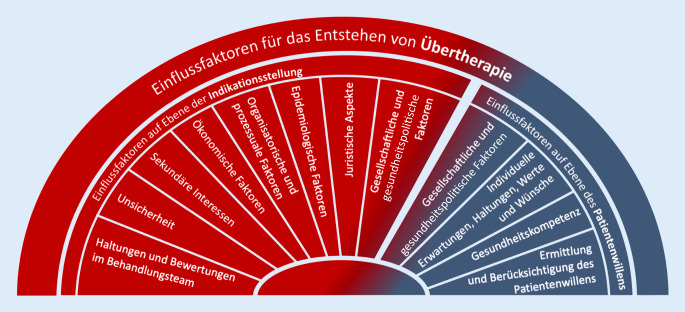
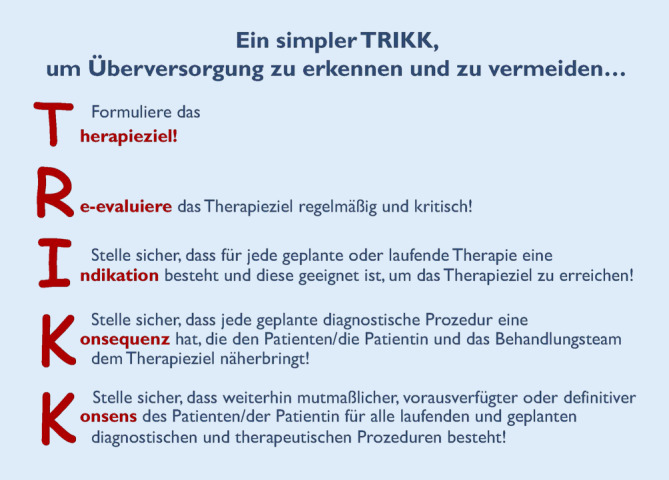
Despite social laws, overtreatment, undertreatment, and incorrect treatment are all present in the German health care system. Overtreatment denotes diagnostic and therapeutic measures that are not appropriate because they do not improve the patients' length or quality of life, cause more harm than benefit, and/or are not consented to by the patient. Overtreatment can result in considerable burden for patients, their families, the treating teams, and society. This position paper describes causes of overtreatment in intensive care medicine and makes specific recommendations to identify and prevent it. Recognition and avoidance of overtreatment in intensive care medicine requires measures on the micro-, meso- and macrolevels, especially the following: (1) frequent (re-)evaluation of the therapeutic goal within the treating team while taking the patient's will into consideration, while simultaneously attending to the patients and their families; (2) fostering a patient-centered corporate culture in the hospital, giving priority to high-quality patient care; (3) minimizing improper incentives in health care financing, supported by reform of the reimbursement system that is still based on diagnose-related groups; (4) strengthening of interprofessional co-operation via education and training; and (5) initiating and advancing a societal discourse on overtreatment.
尽管存在社会法律,但过度治疗、治疗不足和不当治疗在德国医疗保健系统中都存在。过度治疗是指那些不恰当的诊断和治疗措施,因为它们并不能改善患者的寿命或生活质量,造成的危害大于益处,和/或未得到患者的同意。过度治疗会给患者、其家人、治疗团队和社会带来相当大的负担。本立场文件描述了重症医学中过度治疗的原因,并提出了识别和预防过度治疗的具体建议。在重症医学中识别和避免过度治疗需要在微观、中观和宏观层面采取措施,特别是以下几点:(1)治疗团队在考虑患者意愿的同时,频繁(重新)评估治疗目标,同时关注患者及其家人;(2)在医院中培育以患者为中心的企业文化,优先提供高质量的患者护理;(3)通过改革仍基于诊断相关组的报销系统,尽量减少医疗保健融资中的不当激励措施;(4)通过教育和培训加强跨专业合作;(5)发起并推进关于过度治疗的社会讨论。