INGM, Istituto Nazionale di Genetica Molecolare "Romeo ed Enrica Invernizzi", Milan 20122, Italy.
IFOM-ETS, The AIRC Institute of Molecular Oncology, Milan 20139, Italy.
Nucleic Acids Res. 2024 Jul 8;52(12):e54. doi: 10.1093/nar/gkae454.
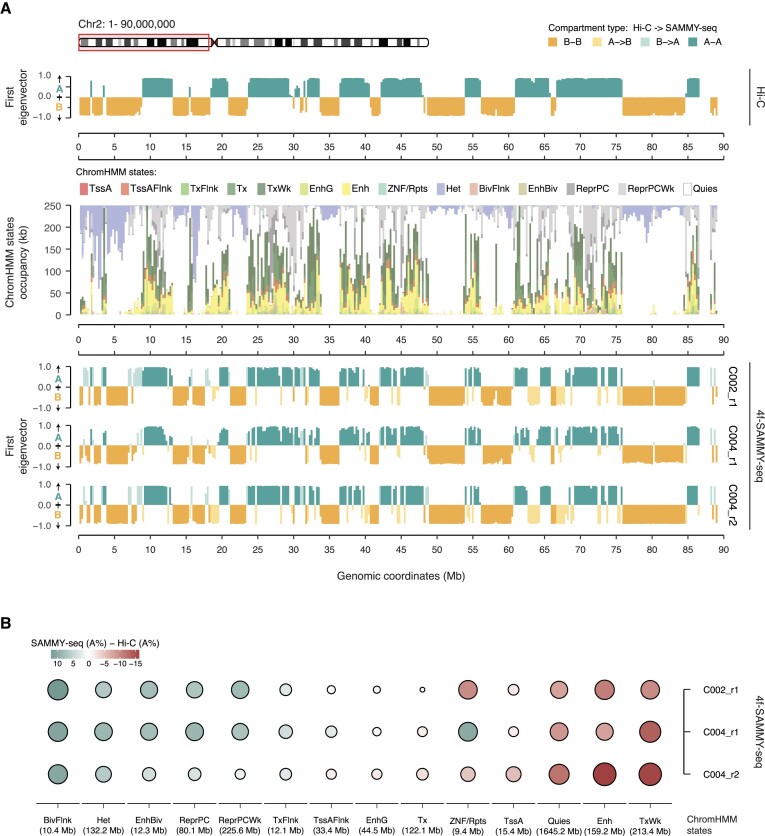
Chromatin three-dimensional (3D) organization inside the cell nucleus determines the separation of euchromatin and heterochromatin domains. Their segregation results in the definition of active and inactive chromatin compartments, whereby the local concentration of associated proteins, RNA and DNA results in the formation of distinct subnuclear structures. Thus, chromatin domains spatially confined in a specific 3D nuclear compartment are expected to share similar epigenetic features and biochemical properties, in terms of accessibility and solubility. Based on this rationale, we developed the 4f-SAMMY-seq to map euchromatin and heterochromatin based on their accessibility and solubility, starting from as little as 10 000 cells. Adopting a tailored bioinformatic data analysis approach we reconstruct also their 3D segregation in active and inactive chromatin compartments and sub-compartments, thus recapitulating the characteristic properties of distinct chromatin states. A key novelty of the new method is the capability to map both the linear segmentation of open and closed chromatin domains, as well as their compartmentalization in one single experiment.
染色质的三维(3D)组织决定了常染色质和异染色质区域的分离。它们的分离导致了活性和非活性染色质区室的定义,其中相关蛋白质、RNA 和 DNA 的局部浓度导致了不同的亚核结构的形成。因此,在特定的三维核区室中空间受限的染色质区域预计将具有相似的表观遗传特征和生化特性,就可及性和溶解度而言。基于这一原理,我们开发了 4f-SAMMY-seq 技术,根据可及性和溶解度来绘制常染色质和异染色质,起始样本量低至 10000 个细胞。通过采用定制的生物信息学数据分析方法,我们还重建了它们在活性和非活性染色质区室和亚区室中的 3D 分离,从而再现了不同染色质状态的特征性质。该新方法的一个关键新颖之处在于能够在一个单一实验中同时绘制开放和封闭染色质区域的线性分段以及它们的区室化。