
布瓦西坦的综述:在癫痫患者治疗中的临床前特征和临床获益。
Narrative Review of Brivaracetam: Preclinical Profile and Clinical Benefits in the Treatment of Patients with Epilepsy.
机构信息
Mid-Atlantic Epilepsy and Sleep Center, 6410 Rockledge Dr, Bethesda, MD, 20817, USA.
UCB Pharma, Agiou Dimitriou 63, 17456, Alimos, Greece.
出版信息
Adv Ther. 2024 Jul;41(7):2682-2699. doi: 10.1007/s12325-024-02876-z. Epub 2024 May 29.
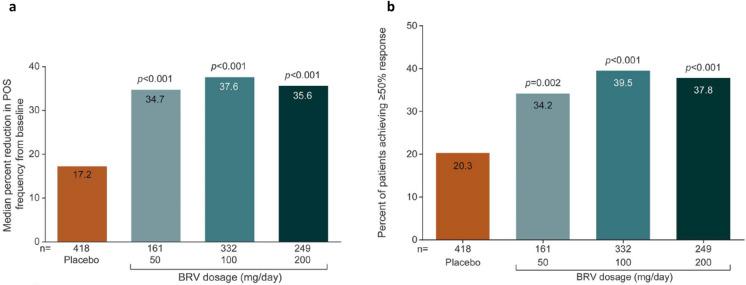
One third of patients with epilepsy will continue to have uncontrolled seizures despite treatment with antiseizure medications (ASMs). There is therefore a need to develop novel ASMs. Brivaracetam (BRV) is an ASM that was developed in a major drug discovery program aimed at identifying selective, high-affinity synaptic vesicle protein 2A (SV2A) ligands, the target molecule of levetiracetam. BRV binds to SV2A with 15- to 30-fold higher affinity and greater selectivity than levetiracetam. BRV has broad-spectrum antiseizure activity in animal models of epilepsy, a favorable pharmacokinetic profile, few clinically relevant drug-drug interactions, and rapid brain penetration. BRV is available in oral and intravenous formulations and can be initiated at target dose without titration. Efficacy and safety of adjunctive BRV (50-200 mg/day) treatment of focal-onset seizures was demonstrated in three pivotal phase III trials (NCT00490035/NCT00464269/NCT01261325), including in patients who had previously failed levetiracetam. Efficacy and safety of adjunctive BRV were also demonstrated in adult Asian patients with focal-onset seizures (NCT03083665). In several open-label trials (NCT00150800/NCT00175916/NCT01339559), long-term safety and tolerability of adjunctive BRV was established, with efficacy maintained for up to 14 years, with high retention rates. Evidence from daily clinical practice highlights BRV effectiveness and tolerability in specific epilepsy patient populations with high unmet needs: the elderly (≥ 65 years of age), children (< 16 years of age), patients with cognitive impairment, patients with psychiatric comorbid conditions, and patients with acquired epilepsy of specific etiologies (post-stroke epilepsy/brain tumor related epilepsy/traumatic brain injury-related epilepsy). Here, we review the preclinical profile and clinical benefits of BRV from pivotal trials and recently published evidence from daily clinical practice.
三分之一的癫痫患者尽管接受了抗癫痫药物 (ASM) 治疗,但仍会出现癫痫发作无法控制的情况。因此,需要开发新型 ASM。布瓦雷西坦 (BRV) 是一种 ASM,它是在一项旨在识别选择性、高亲和力突触囊泡蛋白 2A (SV2A) 配体的主要药物发现计划中开发的,SV2A 是左乙拉西坦的靶分子。BRV 与 SV2A 的结合亲和力比左乙拉西坦高 15-30 倍,选择性更强。BRV 在癫痫动物模型中具有广谱抗癫痫活性,药代动力学特性良好,与临床相关的药物相互作用较少,并且脑穿透迅速。BRV 有口服和静脉两种制剂,可在目标剂量下起始给药,无需滴定。三项关键的 III 期临床试验(NCT00490035/NCT00464269/NCT01261325)证实了 BRV(50-200mg/天)辅助治疗局灶性发作性癫痫的疗效和安全性,包括先前使用左乙拉西坦治疗失败的患者。BRV 辅助治疗成人亚洲局灶性发作性癫痫的疗效和安全性也在一项 III 期临床试验(NCT03083665)中得到证实。在几项开放标签试验(NCT00150800/NCT00175916/NCT01339559)中,BRV 的辅助治疗长期安全性和耐受性得到了确立,疗效可维持长达 14 年,且保留率高。来自日常临床实践的证据突出了 BRV 在具有高度未满足需求的特定癫痫患者人群中的有效性和耐受性:老年人(≥65 岁)、儿童(<16 岁)、认知障碍患者、合并精神疾病的患者,以及特定病因(中风后癫痫/脑肿瘤相关癫痫/创伤性脑损伤相关癫痫)获得性癫痫患者。在这里,我们回顾了关键试验中 BRV 的临床前特征和临床获益,并从最近的日常临床实践中发表的证据进行了综述。



 Zotero 插件