Chalifoux Nolan, Ko Tiffany, Slovis Julia, Spelde Audrey, Kilbaugh Todd, Mavroudis Constantine D
Department of Clinical Sciences and Advanced Medicine, School of Veterinary Medicine, University of Pennsylvania, Philadelphia, PA, 19104, USA.
Department of Anesthesiology and Critical Care Medicine, University of Pennsylvania, Philadelphia, PA, 19104, USA.
Neurocrit Care. 2024 Dec;41(3):1055-1072. doi: 10.1007/s12028-024-02002-5. Epub 2024 May 29.
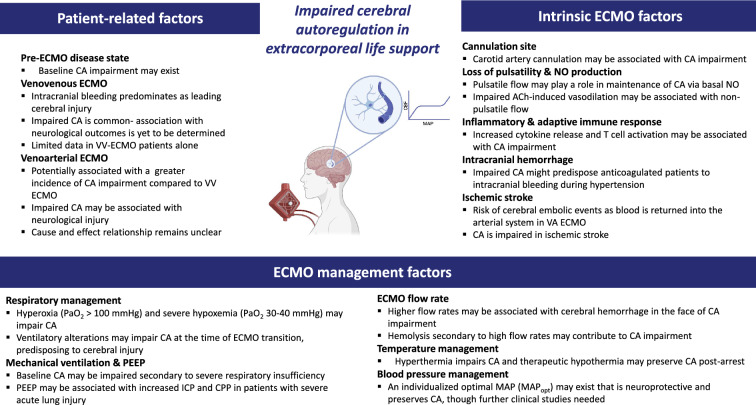
Despite improvements in survival after illnesses requiring extracorporeal life support, cerebral injury continues to hinder successful outcomes. Cerebral autoregulation (CA) is an innate protective mechanism that maintains constant cerebral blood flow in the face of varying systemic blood pressure. However, it is impaired in certain disease states and, potentially, following initiation of extracorporeal circulatory support. In this review, we first discuss patient-related factors pertaining to venovenous and venoarterial extracorporeal membrane oxygenation (ECMO) and their potential role in CA impairment. Next, we examine factors intrinsic to ECMO that may affect CA, such as cannulation, changes in pulsatility, the inflammatory and adaptive immune response, intracranial hemorrhage, and ischemic stroke, in addition to ECMO management factors, such as oxygenation, ventilation, flow rates, and blood pressure management. We highlight potential mechanisms that lead to disruption of CA in both pediatric and adult populations, the challenges of measuring CA in these patients, and potential associations with neurological outcome. Altogether, we discuss individualized CA monitoring as a potential target for improving neurological outcomes in extracorporeal life support.
尽管在需要体外生命支持的疾病后生存率有所提高,但脑损伤仍然阻碍着成功的治疗结果。脑自动调节(CA)是一种先天性保护机制,可在全身血压变化时维持恒定的脑血流量。然而,在某些疾病状态下以及体外循环支持启动后,它可能会受到损害。在这篇综述中,我们首先讨论与静脉-静脉和静脉-动脉体外膜肺氧合(ECMO)相关的患者因素及其在CA损害中的潜在作用。接下来,我们研究ECMO本身可能影响CA的因素,如插管、搏动性变化、炎症和适应性免疫反应、颅内出血和缺血性中风,以及ECMO管理因素,如氧合、通气、流速和血压管理。我们强调导致儿童和成人CA破坏的潜在机制、在这些患者中测量CA的挑战以及与神经学结果的潜在关联。总之,我们讨论将个体化CA监测作为改善体外生命支持中神经学结果的潜在目标。