
用ZIF-67衍生的Co/N掺杂多孔碳纳米立方体活化过一硫酸盐用于降解刚果红染料
Activation of peroxymonosulfate with ZIF-67-derived Co/N-doped porous carbon nanocubes for the degradation of Congo red dye.
作者信息
Khamis Aya, Mahmoud Aya S, El Naga Ahmed O Abo, Shaban Seham A, Youssef Nadia A
机构信息
Chemistry Department, Faculty of Women, Ain Shams University, Cairo, Egypt.
Catalysis Department, Refining Division, Egyptian Petroleum Research Institute, Nasr City, 11727, Cairo, Egypt.
出版信息
Sci Rep. 2024 May 29;14(1):12313. doi: 10.1038/s41598-024-62029-8.
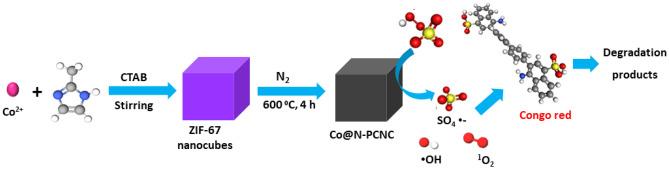
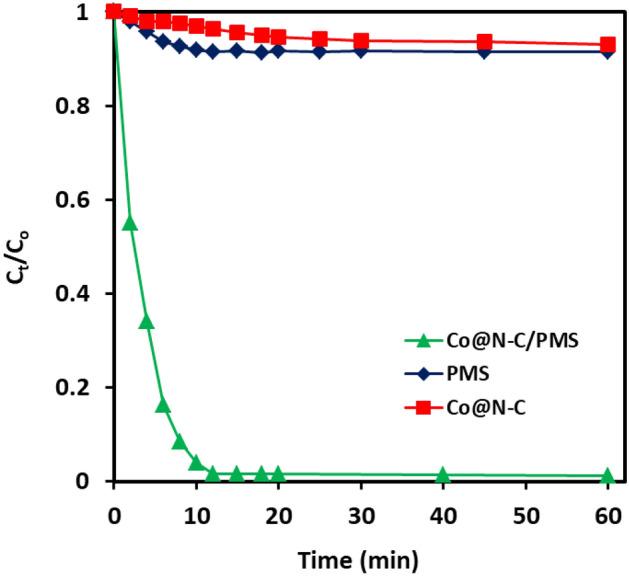
In this study, porous carbon nanocubes encapsulated magnetic metallic Co nanoparticles (denoted as Co@N-PCNC) was prepared via pyrolyzing ZIF-67 nanocubes precursor at 600 °C and characterized by various technologies. It was used to activate peroxymonosulfate (PMS) to degrade Congo red (CR) dye efficiently. Over 98.45% of 50 mg L CR was degraded using 0.033 mM PMS activated by 75 mg L Co@N-PCNC within 12 min. The free radical quenching experiments were performed to reveal the nature of the reactive oxygen species radicals generated throughout the catalytic oxidation of CR. The effects of common inorganic anions and the water matrix on CR removal were studied. Moreover, the results of the kinetic study revealed the suitability of the pseudo-first-order and Langmuir-Hinshelwood kinetic models for illustrating CR degradation using the Co@N-PCNC/PMS system. Ultimately, the Co@N-PCNC displayed good operational stability, and after five cycles, the CR removal rate can still maintain over 90% after 12 min.
在本研究中,通过在600℃下热解ZIF-67纳米立方体前驱体制备了包裹磁性金属钴纳米颗粒的多孔碳纳米立方体(记为Co@N-PCNC),并采用多种技术对其进行了表征。它被用于活化过一硫酸盐(PMS)以高效降解刚果红(CR)染料。使用75 mg L Co@N-PCNC活化的0.033 mM PMS,在12分钟内可降解50 mg L CR中的98.45%以上。进行了自由基猝灭实验,以揭示在CR催化氧化过程中产生的活性氧物种自由基的性质。研究了常见无机阴离子和水基质对CR去除的影响。此外,动力学研究结果表明,伪一级动力学模型和朗缪尔-欣谢尔伍德动力学模型适用于描述使用Co@N-PCNC/PMS体系降解CR的过程。最终,Co@N-PCNC表现出良好的操作稳定性,经过五个循环后,12分钟后CR去除率仍可保持在90%以上。





 Zotero 插件