China-Japan Union Hospital of Jilin University, Jilin University, Jilin, China.
Harvard T H Chan School of Public Health, Boston, USA.
Cardiovasc Diabetol. 2024 May 29;23(1):185. doi: 10.1186/s12933-024-02278-z.
Triglyceride and glucose (TyG) index, a surrogate marker of insulin resistance, has been validated as a predictor of cardiovascular disease. However, effects of TyG-related indices combined with obesity markers on cardiovascular diseases remained unknown. We aimed to investigate the associations between TyG index and modified TyG indices with new-onset cardiovascular disease and the time-dependent predictive capacity using a national representative cohort.
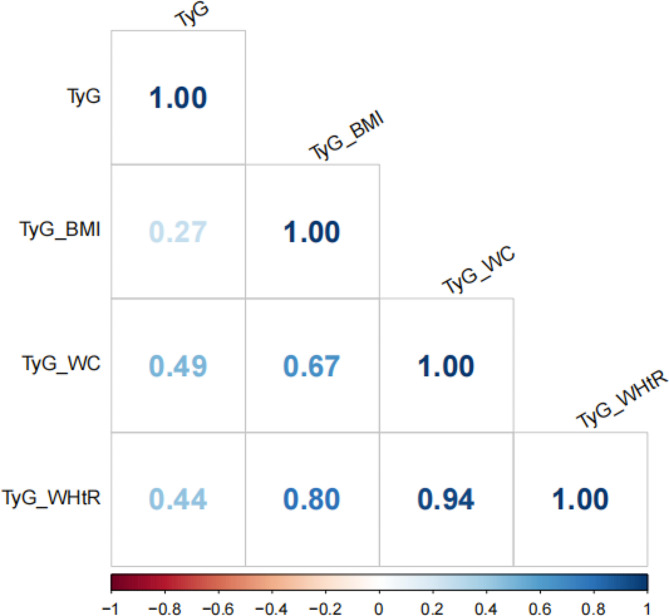
This study is a retrospective observational cohort study using data from China Health and Retirement Longitudinal Study (CHARLS) of 7 115 participants. The TyG index was calculated as Ln [fasting triglyceride (mg/dL) × fasting glucose (mg/dL)/2]. The modified TyG indices were developed combining TyG with body mass index (BMI), waist circumference (WC) and waist-to-height ratio (WHtR). We used adjusted Cox proportional hazards regression to analyze the association and predictive capacity based on hazard ratio (HR) and Harrell's C-index.
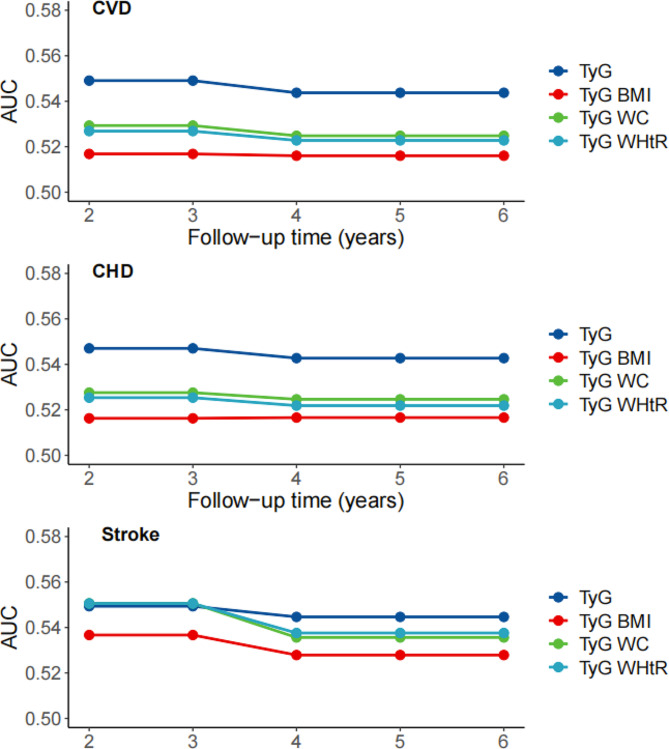
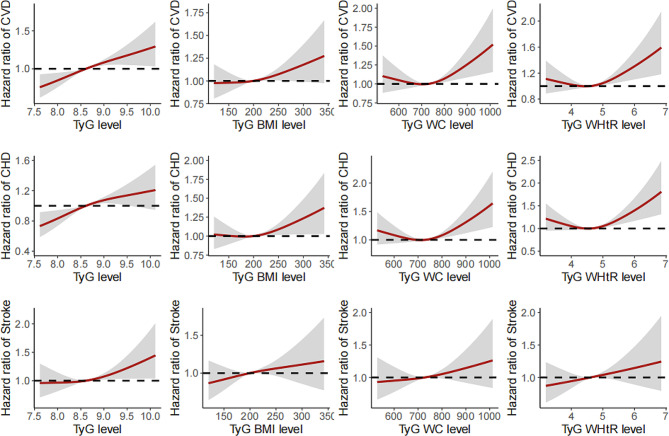
Over a 7-year follow-up period, 2136 participants developed cardiovascular disease, including 1633 cases of coronary heart disease and 719 cases of stroke. Compared with the lowest tertile group, the adjusted HR (95% CI) for new-onset cardiovascular disease in the highest tertile for TyG, TyG-BMI, TyG-WC, and TyG-WHtR were 1.215 (1.088-1.356), 1.073 (0.967-1.191), 1.078 (0.970-1.198), and 1.112 (1.002-1.235), respectively. The C-indices of TyG index for cardiovascular disease onset were higher than other modified TyG indices. Similar results were observed for coronary heart disease and stroke.
TyG and TyG-WhtR were significantly associated with new-onset cardiovascular diseases, and TyG outperformed the modified TyG indices to identify individuals at risk of incident cardiovascular event.
甘油三酯和葡萄糖(TyG)指数是胰岛素抵抗的替代标志物,已被验证可预测心血管疾病。然而,TyG 相关指数与肥胖标志物联合对心血管疾病的影响尚不清楚。我们旨在使用全国代表性队列研究调查 TyG 指数和改良 TyG 指数与新发心血管疾病之间的关联,以及时间依赖性预测能力。
这是一项使用中国健康与退休纵向研究(CHARLS)7115 名参与者数据的回顾性观察性队列研究。TyG 指数计算为 Ln[空腹甘油三酯(mg/dL)×空腹葡萄糖(mg/dL)/2]。改良 TyG 指数是通过将 TyG 与体重指数(BMI)、腰围(WC)和腰高比(WHtR)相结合而开发的。我们使用调整后的 Cox 比例风险回归分析基于危险比(HR)和 Harrell 的 C 指数的关联和预测能力。
在 7 年的随访期间,2136 名参与者发生了心血管疾病,包括 1633 例冠心病和 719 例中风。与最低三分位组相比,TyG、TyG-BMI、TyG-WC 和 TyG-WHtR 的最高三分位组新发心血管疾病的调整 HR(95%CI)分别为 1.215(1.088-1.356)、1.073(0.967-1.191)、1.078(0.970-1.198)和 1.112(1.002-1.235)。TyG 指数对心血管疾病发病的 C 指数高于其他改良 TyG 指数。对于冠心病和中风也观察到了类似的结果。
TyG 和 TyG-WhtR 与新发心血管疾病显著相关,TyG 优于改良 TyG 指数,可识别发生心血管事件的风险个体。