Department of Epidemiology, Beijing Neurosurgical Institute, Beijing Tiantan Hospital, Capital Medical University, Beijing, China.
China National Clinical Research Center for Neurological Diseases, Beijing Tiantan Hospital, Capital Medical University, Beijing, China.
Cardiovasc Diabetol. 2024 Jun 19;23(1):208. doi: 10.1186/s12933-024-02290-3.
Triglyceride glucose (TyG) index and its related parameters have been introduced as cost-effective surrogate indicators of insulin resistance, while prospective evidence of their effects on atherosclerotic cardiovascular disease (ASCVD) remained scattered and inconsistent. We aimed to evaluate the association of TyG and its related parameters with new-onset ASCVD, and the predictive capacity were further compared.
A total of 95,342 ASCVD-free participants were enrolled from the Kailuan study. TyG and its related parameters were defined by fasting blood glucose, triglyceride, body mass index (BMI), waist circumstance (WC) and waist-to-height ratio (WHtR). The primary outcome was incident ASCVD, comprising myocardial infarction (MI) and ischemic stroke (IS). Cox proportional hazard models and restricted cubic spline (RCS) analyses were adopted to investigate the association between each index and ASCVD. The C-index, integrated discrimination improvement (IDI), and net reclassification improvement (NRI) were used for comparison of their predictive value for ASCVD.
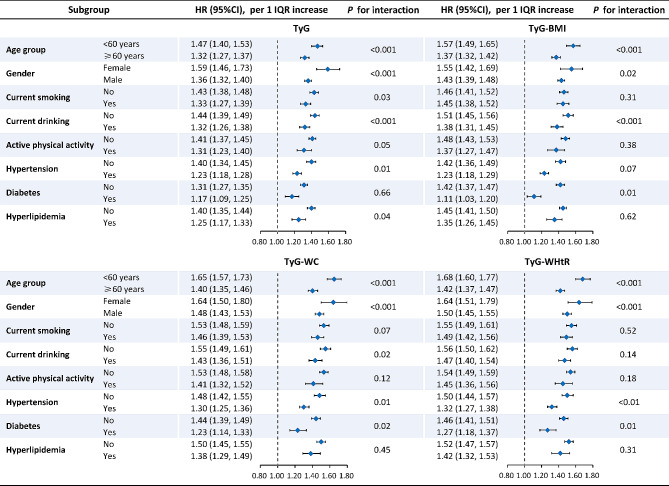
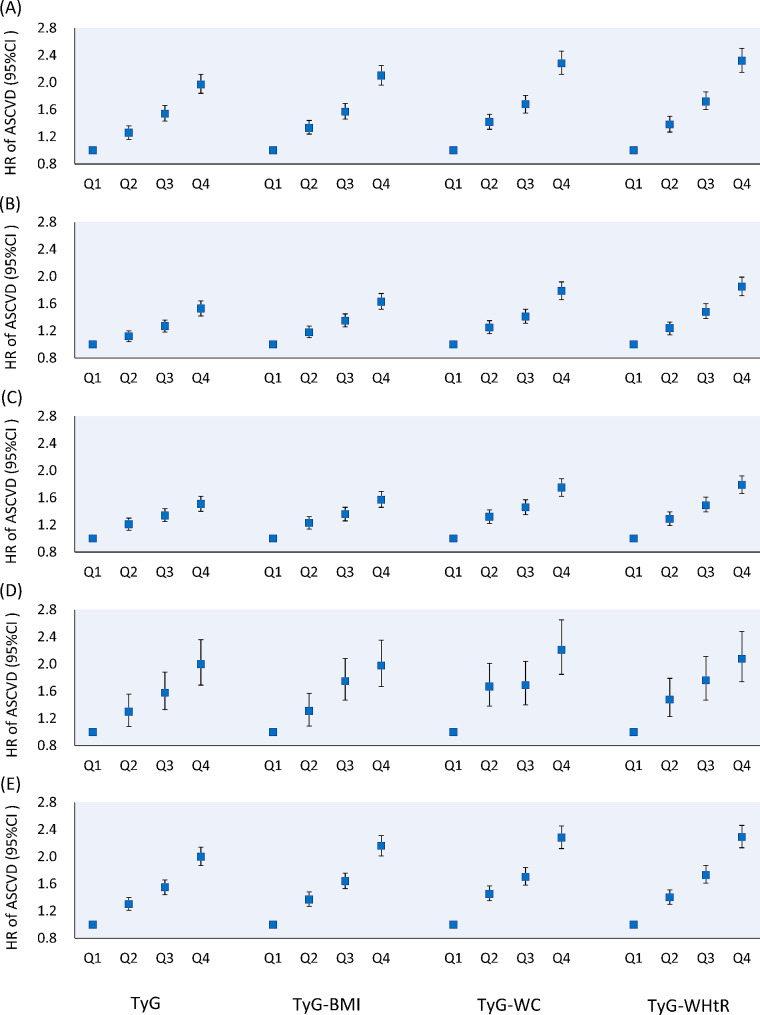
During a median follow-up of 15.0 years, 8,031 new cases of ASCVD were identified. The incidence rate of ASCVD increased along with elevated levels of each index, and the relationships were found to be nonlinear in the RCS analyses. The hazard ratio (HR) and 95% confidence interval (95% CI) for ASCVD was 1.39 (1.35, 1.43), 1.46 (1.41, 1.50), 1.50 (1.46, 1.55), and 1.52 (1.48, 1.57) per 1 IQR increase of baseline TyG, TyG-BMI, TyG-WC, and TyG-WHtR, respectively, and the association were more pronounced for females and younger individuals aged < 60 years (P<0.05). Using the updated mean or time-varying measurements instead of baseline indicators did not significantly alter the primary findings. Additionally, TyG-WC and TyG-WHtR showed better performance in predicting risk of ASCVD than TyG, with the IDI (95% CI) of 0.004 (0.001, 0.004) and 0.004 (0.001, 0.004) and the category-free NRI (95% CI) of 0.120 (0.025, 0.138) and 0.143 (0.032, 0.166), respectively. Similar findings were observed for MI and IS.
Both the TyG index and its related parameters were significantly and positively associated with ASCVD. TyG-WC and TyG-WHtR had better performance in predicting incident ASCVD than TyG, which might be more suitable indices for risk stratification and enhance the primary prevention of ASCVD.
甘油三酯-葡萄糖(TyG)指数及其相关参数已被作为胰岛素抵抗的具有成本效益的替代指标引入,但其对动脉粥样硬化性心血管疾病(ASCVD)的前瞻性证据仍然分散且不一致。我们旨在评估 TyG 及其相关参数与新发 ASCVD 的相关性,并进一步比较其预测能力。
共纳入 95342 例 ASCVD 无事件的参与者,来自开滦研究。TyG 及其相关参数通过空腹血糖、甘油三酯、体重指数(BMI)、腰围(WC)和腰高比(WHtR)来定义。主要结局为新发 ASCVD,包括心肌梗死(MI)和缺血性卒中(IS)。采用 Cox 比例风险模型和限制性立方样条(RCS)分析来探讨每个指标与 ASCVD 的相关性。采用 C 指数、综合判别改善(IDI)和净重新分类改善(NRI)来比较它们对 ASCVD 的预测价值。
在中位随访 15.0 年期间,共确定了 8031 例 ASCVD 新发病例。ASCVD 的发生率随着每个指标水平的升高而增加,并且在 RCS 分析中发现这些关系是非线性的。ASCVD 的风险比(HR)和 95%置信区间(95%CI)分别为 TyG 每增加 1 个 IQR 时为 1.39(1.35,1.43)、1.46(1.41,1.50)、1.50(1.46,1.55)和 1.52(1.48,1.57);TyG-BMI、TyG-WC 和 TyG-WHtR;并且这种关联在女性和年龄<60 岁的年轻个体中更为明显(P<0.05)。使用更新的平均值或时变测量值而不是基线指标不会显著改变主要发现。此外,TyG-WC 和 TyG-WHtR 在预测 ASCVD 风险方面的表现优于 TyG,IDI(95%CI)分别为 0.004(0.001,0.004)和 0.004(0.001,0.004),无分类 NRI(95%CI)分别为 0.120(0.025,0.138)和 0.143(0.032,0.166)。对于 MI 和 IS,也观察到了类似的发现。
TyG 指数及其相关参数均与 ASCVD 显著正相关。TyG-WC 和 TyG-WHtR 在预测新发 ASCVD 方面的表现优于 TyG,它们可能是更适合风险分层和增强 ASCVD 一级预防的指标。