Valldeperes Marta, Pascual-Rico Roberto, Fandos Paulino, Soriguer Escofet Ramón C, Pérez Jesús M, Cano-Manuel León Francisco J, Prieto Yerro Paloma, López-Olvera Jorge Ramón, Granados José Enrique
Wildlife Ecology & Health Group (WE&H), 08193 Bellaterra, Barcelona, Spain.
Servei d'Ecopatologia de Fauna Salvatge (SEFaS), Departament de Medicina i Cirurgia Animals, Universitat Autònoma de Barcelona (UAB), 08193 Bellaterra, Spain.
J Mammal. 2024 Feb 27;105(3):621-632. doi: 10.1093/jmammal/gyae013. eCollection 2024 Jun.
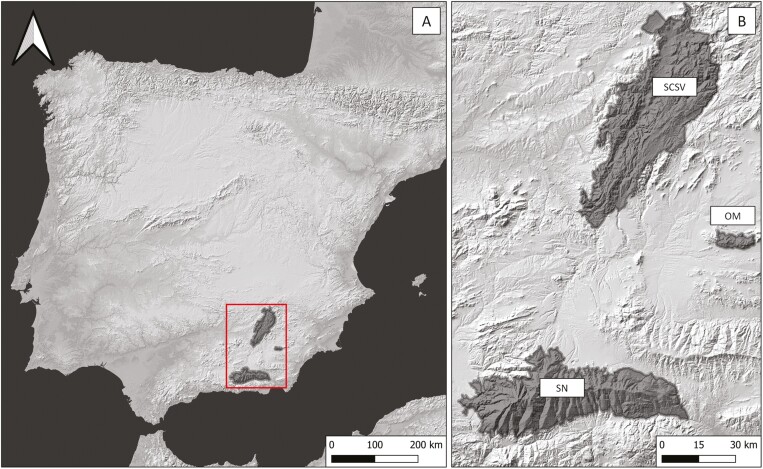
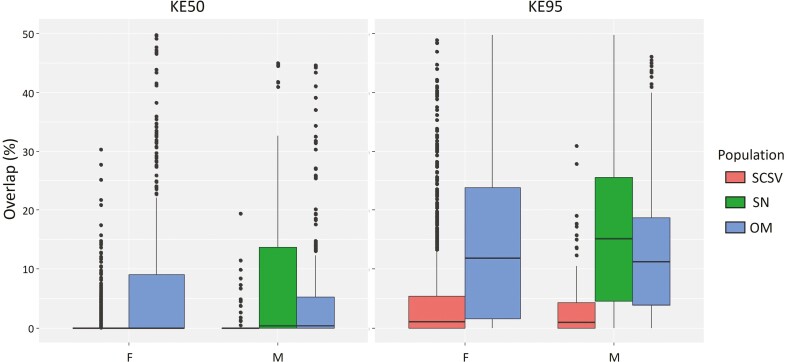
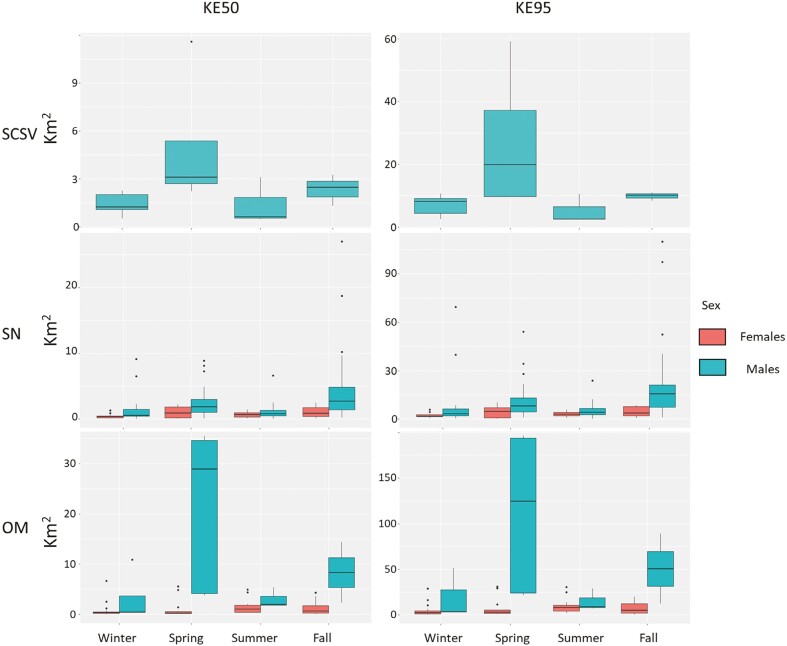
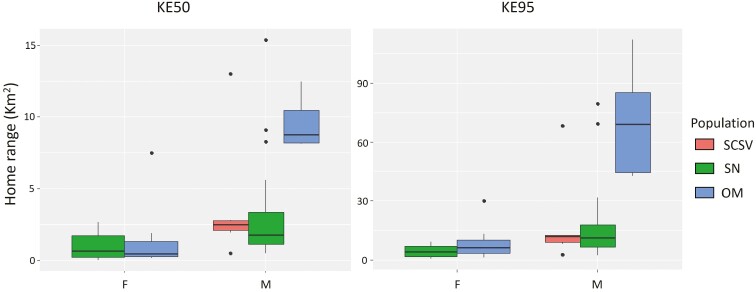
Home range and home range overlap can be used to describe use of space and movement of wildlife. During the last years, advancements in technology have greatly improved our understanding of animal movement, especially among large herbivores. Wild ungulate abundance and distribution have increased in temperate areas. Moreover, their diseases-including sarcoptic mange in the Iberian Ibex ()-have become a cause of concern for livestock, public health, and wildlife conservation. In this study, we first reviewed existing literature on the home range of species in the genus . We then analyzed data from 52 GPS-GSM-collared Iberian ibexes, of which 33 were healthy and 19 were affected by sarcoptic mange from 3 different populations in the southeastern Iberian Peninsula to analyze: (1) differences in size and characteristics of home ranges obtained by the 3 most commonly used methodologies-minimum convex polygon, kernel density estimation, and Brownian bridges movement models (BBMMs); and (2) the impact of endemic sarcoptic mange on Iberian Ibex home range. The literature review revealed that available information on spatial behavior of spp. was based only on 3 species, including the Iberian Ibex, estimated through a diversity of methods which made it difficult to compare results. We found positive correlations among the different home range estimation methods in the Iberian Ibex, with BBMMs proving to be the most accurate. This study is the first to use BBMMs for estimating home range in this species, and it revealed a marked seasonal behavior in spatial use, although sarcoptic mange smoothed such seasonal pattern. The seasonal overlaps obtained suggest that core areas of the Iberian Ibex change within wider home range areas, which are ecological parameters relevant to identifying key areas for species management and conservation.
家域及家域重叠可用于描述野生动物的空间利用和活动情况。在过去几年中,技术进步极大地增进了我们对动物活动的理解,尤其是大型食草动物的活动。温带地区野生有蹄类动物的数量和分布有所增加。此外,它们所患的疾病,包括伊比利亚野山羊()的疥螨病,已成为影响家畜、公共卫生和野生动物保护的一个问题。在本研究中,我们首先回顾了关于属物种家域的现有文献。然后,我们分析了来自伊比利亚半岛东南部3个不同种群的52只佩戴GPS - GSM项圈的伊比利亚野山羊的数据,其中33只为健康个体,19只感染了疥螨病,以分析:(1)通过3种最常用方法——最小凸多边形法、核密度估计法和布朗桥运动模型(BBMMs)获得的家域大小和特征的差异;(2)地方性疥螨病对伊比利亚野山羊家域的影响。文献综述表明,关于属物种空间行为的现有信息仅基于3个物种,包括伊比利亚野山羊,通过多种方法进行估计,这使得结果难以比较。我们发现伊比利亚野山羊不同家域估计方法之间存在正相关,其中BBMMs被证明是最准确的。本研究首次使用BBMMs来估计该物种的家域,并且揭示了空间利用中明显的季节性行为,尽管疥螨病使这种季节性模式变得平滑。获得的季节性重叠表明,伊比利亚野山羊的核心区域在更广阔的家域范围内发生变化,这些是与确定物种管理和保护关键区域相关的生态参数。