Choi JooHee, Thänert Robert, Reske Kimberly A, Nickel Katelin B, Olsen Margaret A, Hink Tiffany, Thänert Anna, Wallace Meghan A, Wang Bin, Cass Candice, Barlet Margaret H, Struttmann Emily L, Iqbal Zainab Hassan, Sax Steven R, Fraser Victoria J, Baker Arthur W, Foy Katherine R, Williams Brett, Xu Ben, Capocci-Tolomeo Pam, Lautenbach Ebbing, Burnham Carey-Ann D, Dubberke Erik R, Dantas Gautam, Kwon Jennie H
The Edison Family Center for Genome Sciences and Systems Biology, Washington University School of Medicine, St. Louis, MO, USA.
Department of Pathology and Immunology, Division of Laboratory and Genomic Medicine, Washington University School of Medicine, St. Louis, MO, USA.
EClinicalMedicine. 2024 Apr 26;71:102490. doi: 10.1016/j.eclinm.2024.102490. eCollection 2024 May.
Urinary tract infections (UTI) affect approximately 250 million people annually worldwide. Patients often experience a cycle of antimicrobial treatment and recurrent UTI (rUTI) that is thought to be facilitated by a gut reservoir of uropathogenic (UPEC).
125 patients with UTI caused by an antibiotic-resistant organism (ARO) were enrolled from July 2016 to May 2019 in a longitudinal, multi-center cohort study. Multivariate statistical models were used to assess the relationship between uropathogen colonization and recurrent UTI (rUTI), controlling for clinical characteristics. 644 stool samples and 895 UPEC isolates were interrogated for taxonomic composition, antimicrobial resistance genes, and phenotypic resistance. Cohort UTI gut microbiome profiles were compared against published healthy and UTI reference microbiomes, as well as assessed within-cohort for timepoint- and recurrence-specific differences.
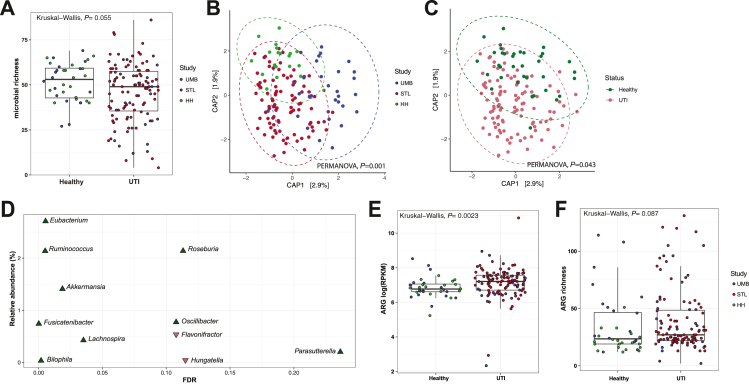
Risk of rUTI was not independently associated with clinical characteristics. The UTI gut microbiome was distinct from healthy reference microbiomes in both taxonomic composition and antimicrobial resistance gene (ARG) burden, with 11 differentially abundant taxa at the genus level. rUTI and non-rUTI gut microbiomes in the cohort did not generally differ, but gut microbiomes from urinary tract colonized patients were elevated in abundance 7-14 days post-antimicrobial treatment. Corresponding UPEC gut isolates from urinary tract colonizing lineages showed elevated phenotypic resistance against 11 of 23 tested drugs compared to non-colonizing lineages.
The gut microbiome is implicated in UPEC urinary tract colonization during rUTI, serving as an ARG-enriched reservoir for UPEC. UPEC can asymptomatically colonize the gut and urinary tract, and post-antimicrobial blooms of gut among urinary tract colonized patients suggest that cross-habitat migration of UPEC is an important mechanism of rUTI. Thus, treatment duration and UPEC populations in both the urinary and gastrointestinal tract should be considered in treating rUTI and developing novel therapeutics.
This work was supported in part by awards from the U.S. Centers for Disease Control and Prevention Epicenter Prevention Program (grant U54CK000482; principal investigator, V.J.F.); to J.H.K. from the Longer Life Foundation (an RGA/Washington University partnership), the National Center for Advancing Translational Sciences (grants KL2TR002346 and UL1TR002345), and the National Institute of Allergy and Infectious Diseases (NIAID) (grant K23A1137321) of the National Institutes of Health (NIH); and to G.D. from NIAID (grant R01AI123394) and the Eunice Kennedy Shriver National Institute of Child Health and Human Development (grant R01HD092414) of NIH. R.T.'s research was funded by the Deutsche Forschungsgemeinschaft (DFG; German Research Foundation; grant 402733540). REDCap is Supported by Clinical and Translational Science Award (CTSA) Grant UL1 TR002345 and Siteman Comprehensive Cancer Center and NCI Cancer Center Support Grant P30 CA091842. The content is solely the responsibility of the authors and does not necessarily represent the official views of the funding agencies.
全球每年约有2.5亿人受到尿路感染(UTI)的影响。患者常经历抗菌治疗和复发性尿路感染(rUTI)的循环,这被认为是由尿路致病性大肠杆菌(UPEC)的肠道储存库促成的。
2016年7月至2019年5月,一项纵向多中心队列研究纳入了125例由抗生素耐药菌(ARO)引起的UTI患者。使用多变量统计模型评估尿路病原体定植与复发性尿路感染(rUTI)之间的关系,并对临床特征进行控制。对644份粪便样本和895株UPEC分离株进行分类组成、抗菌耐药基因和表型耐药性检测。将队列UTI肠道微生物群谱与已发表的健康和UTI参考微生物群进行比较,并在队列中评估时间点和复发特异性差异。
rUTI的风险与临床特征无独立相关性。UTI肠道微生物群在分类组成和抗菌耐药基因(ARG)负担方面均与健康参考微生物群不同,在属水平上有11个差异丰富的分类群。队列中的rUTI和非rUTI肠道微生物群一般无差异,但抗菌治疗后7 - 14天,尿路定植患者的肠道微生物群丰度升高。与非定植谱系相比,来自尿路定植谱系的相应UPEC肠道分离株对23种测试药物中的11种表现出更高的表型耐药性。
肠道微生物群与rUTI期间UPEC尿路定植有关,是UPEC富含ARG的储存库。UPEC可无症状地定植于肠道和尿路,尿路定植患者肠道中抗菌治疗后的菌群增殖表明UPEC的跨栖息地迁移是rUTI的重要机制。因此,在治疗rUTI和开发新疗法时,应考虑治疗持续时间以及尿路和胃肠道中的UPEC数量。
这项工作部分得到了美国疾病控制与预防中心震中预防计划(拨款U54CK000482;首席研究员,V.J.F.)的资助;J.H.K.获得了长寿基金会(RGA/华盛顿大学合作项目)、美国国立卫生研究院(NIH)国家推进转化科学中心(拨款KL2TR002346和UL1TR002345)以及国家过敏和传染病研究所(NIAID)(拨款K23A1137321)的资助;G.D.获得了NIAID(拨款R01AI123394)和NIH的尤妮斯·肯尼迪·施赖弗国家儿童健康与人类发展研究所(拨款R01HD092414)的资助。R.T.的研究由德国研究基金会(DFG;拨款402733540)资助。REDCap由临床和转化科学奖(CTSA)拨款UL1 TR002345以及西曼综合癌症中心和NCI癌症中心支持拨款P30 CA091842资助。内容仅由作者负责,不一定代表资助机构的官方观点。