Martinez-Lopez Nicolas, Estevan Isaac, Candia-Cabrera Paulina, Aguilar-Farias Nicolas, Carcamo-Oyarzun Jaime
CIAM Physical Literacy Research Centre, Faculty of Education, Social Science, and Humanities, Universidad de La Frontera, Temuco, Chile.
Programa de Doctorado en Didácticas Especificas, Didáctica de la Educación Física, University of Valencia, Valencia, Spain.
Front Psychol. 2024 May 10;15:1371766. doi: 10.3389/fpsyg.2024.1371766. eCollection 2024.
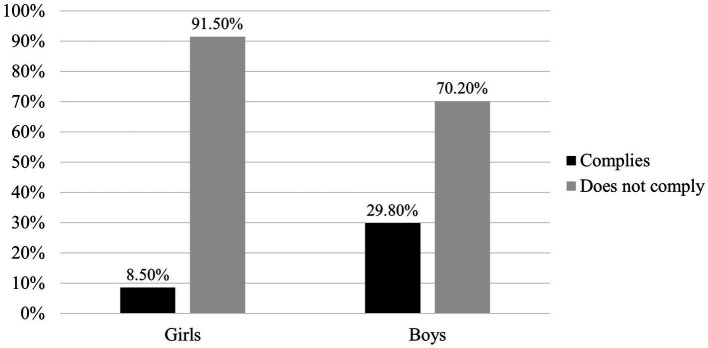
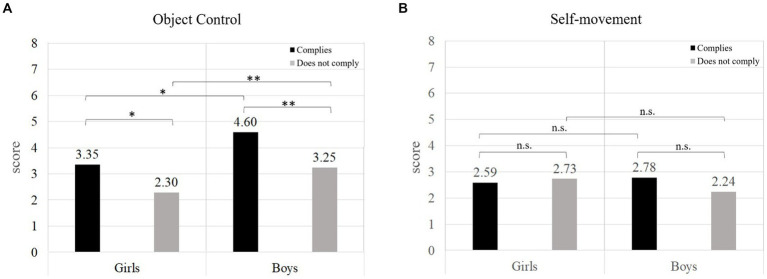
The development of motor competence is thought to be a crucial precursor to raising the trajectory of PA throughout a person's life. The objectives of this study are to determine motor competence and the daily time of moderate and vigorous physical activity of students in 5th and 6th grade elementary in Chile, and to establish whether there are differences in motor competence according to sex and compliance with physical activity recommendations. 368 schoolchildren ( = 11.10 years; 54.3% girls) participated. To assess motor competence, the MOBAK 5-6 test was used. Physical activity was measured using ActiGraph wGT3X-BT® accelerometers. Boys ( = 3.65, SD = 2.14) showed better performance than girls ( = 2.39, SD = 1.80) in Object Control ( ≤ 0.001, PS = 0.67). For Self-Movement, the girls ( = 2.72, SD = 2.14) performed better than the boys ( = 2.40, SD = 1.86); however, there were no significant differences between the two sexes ( = 0.257). Boys ( = 48.4, SD = 22.8) presented more daily minutes of moderate and vigorous physical activity than girls ( = 35.9, SD = 16.9), with statistically significant differences ( ≤ 0.001, PS = 0.67). About MC according to compliance with the physical activity recommendations, only in Object Control there is a statistically significant difference ( ≤ 0.001; PS = 0.29) between the students who comply with the recommendations ( = 4.28, SD = 2.12) and those who do not achieve the recommended minutes ( = 2.67, SD = 1.29). By contrast, an analysis of Self-Movement found no significant difference (complies: = 2.73, SD = 1.97; does not comply: = 2.54, SD = 2.04; = 0.408) between the two groups. It is necessary to generate instances that develop motor competence in all its dimensions to promote higher levels of moderate to vigorous physical activity.
运动能力的发展被认为是提升一个人一生体育活动轨迹的关键前提。本研究的目的是确定智利小学五、六年级学生的运动能力以及中度和剧烈身体活动的每日时长,并确定运动能力在性别方面是否存在差异以及是否符合体育活动建议。368名学童(平均年龄 = 11.10岁;54.3%为女生)参与了研究。为评估运动能力,使用了MOBAK 5 - 6测试。身体活动通过ActiGraph wGT3X - BT®加速度计进行测量。在物体控制方面,男孩(平均分 = 3.65,标准差 = 2.14)表现优于女孩(平均分 = 2.39,标准差 = 1.80)(p≤0.001,效应量 = 0.67)。在自我移动方面,女孩(平均分 = 2.72,标准差 = 2.14)表现优于男孩(平均分 = 2.40,标准差 = 1.86);然而,两性之间没有显著差异(p = 0.257)。男孩(平均时长 = 48.4分钟,标准差 = 22.8)的中度和剧烈身体活动每日时长比女孩(平均时长 = 35.9分钟,标准差 = 16.9)更多,存在统计学显著差异(p≤0.001,效应量 = 0.67)。关于根据是否符合体育活动建议的运动能力情况,仅在物体控制方面,符合建议的学生(平均分 = 4.28,标准差 = 2.12)和未达到建议时长的学生(平均分 = 2.67,标准差 = 1.29)之间存在统计学显著差异(p≤0.001;效应量 = 0.29)。相比之下,对自我移动的分析发现两组之间没有显著差异(符合:平均分 = 2.73,标准差 = 1.97;不符合:平均分 = 2.54,标准差 = 2.04;p = 0.408)。有必要创造各种机会,从各个维度发展运动能力,以促进更高水平的中度至剧烈身体活动。