Aghaei Atefeh, Qiao Shan, Chi Tam Cheuk, Yuan Guangzhe, Li Xiaoming
Department of Health Promotion, Education and Behavior, Arnold School of Public Health, University of South Carolina, Columbia, SC, USA.
South Carolina SmartState Center of Healthcare Quality, Columbia, SC, USA.
Heliyon. 2024 May 17;10(10):e31328. doi: 10.1016/j.heliyon.2024.e31328. eCollection 2024 May 30.
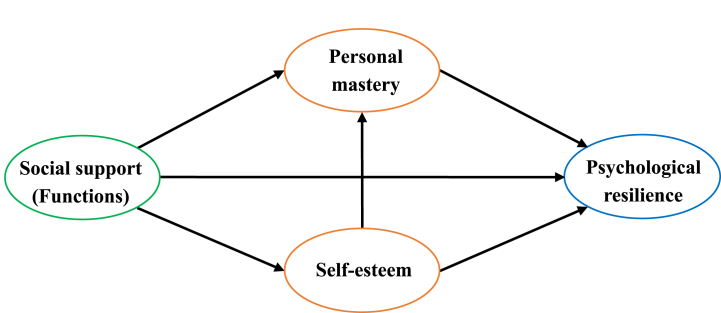
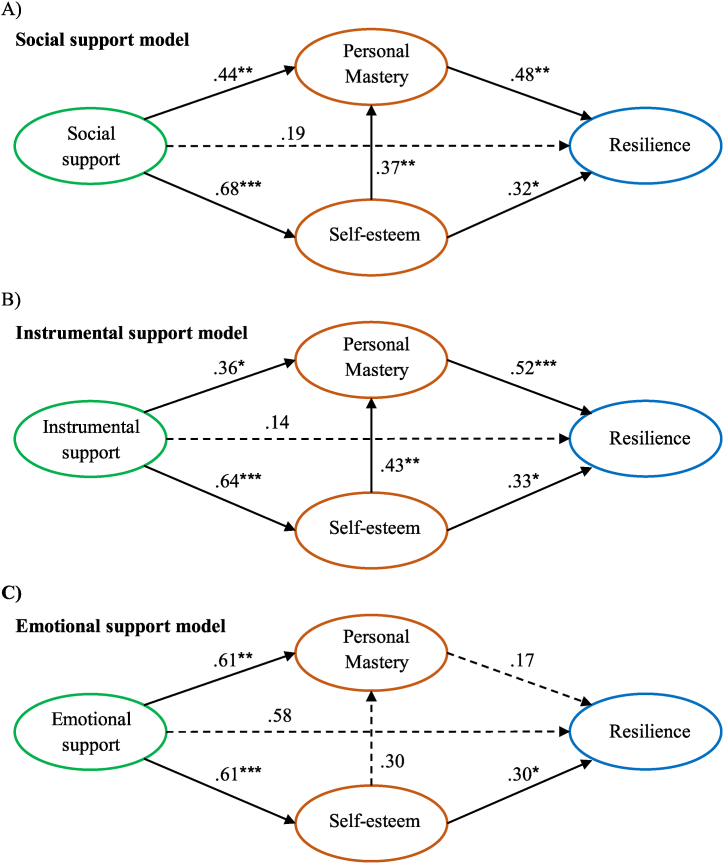
Although the COVID-19 mortality rate is declining, the number of individuals dealing with persistent COVID-19 symptoms is increasing worldwide, making long COVID a global public health concern. People with long COVID (long haulers) often deal with physical and mental stressors. Long haulers' psychological resilience could play a key role in coping with these stressors in intercorrelation with psychosocial resources. The current study aims to test a hypothesized relationship between social support and its functions (i.e., instrumental and emotional) and the resilience of long haulers through serial mediation by personal mastery and self-esteem. A cross-sectional and self-administered online survey was conducted among 460 individuals with long COVID recruited from COVID-19 Facebook support groups in the United States. Analyzing data indicated a positive correlation between social support and the resilience of long haulers. Structural equation modeling suggested that self-esteem and personal mastery fully mediated the association between social (instrumental) support and resilience. Personal mastery also mediated the association between self-esteem and resilience in social (instrumental) support models. However, in the emotional support model, the indirect effect was non-significant for the mediation by personal mastery and self-esteem. Findings suggest that social support, mainly instrumental support, may protect long haulers by promoting their resilience through self-esteem and personal mastery. This study emphasizes the importance of including social support services in designing programs for COVID-19 long haulers.
尽管新冠病毒的死亡率在下降,但全球范围内出现持续性新冠症状的人数却在增加,这使得新冠长期症状成为一个全球公共卫生问题。患有新冠长期症状的人(长期患者)经常面临身体和心理压力源。长期患者的心理韧性可能在与心理社会资源相互关联中应对这些压力源方面发挥关键作用。当前研究旨在通过个人掌控和自尊的系列中介作用,检验社会支持及其功能(即工具性支持和情感性支持)与长期患者韧性之间的假设关系。对从美国新冠病毒脸书支持群组招募的460名新冠长期患者进行了一项横断面且由参与者自行管理的在线调查。数据分析表明社会支持与长期患者的韧性之间存在正相关。结构方程模型表明自尊和个人掌控完全中介了社会(工具性)支持与韧性之间的关联。在社会(工具性)支持模型中,个人掌控也中介了自尊与韧性之间的关联。然而,在情感性支持模型中,个人掌控和自尊进行中介的间接效应不显著。研究结果表明,社会支持,主要是工具性支持,可能通过自尊和个人掌控提升韧性来保护长期患者。本研究强调了在为新冠长期患者设计项目时纳入社会支持服务的重要性。