South Carolina SmartState Center for Healthcare Quality, Arnold School of Public Health, University of South Carolina, Columbia, SC, United States of America.
Department of Health Promotion, Education and Behavior, Arnold School of Public Health, University of South Carolina, Columbia, SC, United States of America.
PLoS One. 2023 Aug 3;18(8):e0289413. doi: 10.1371/journal.pone.0289413. eCollection 2023.
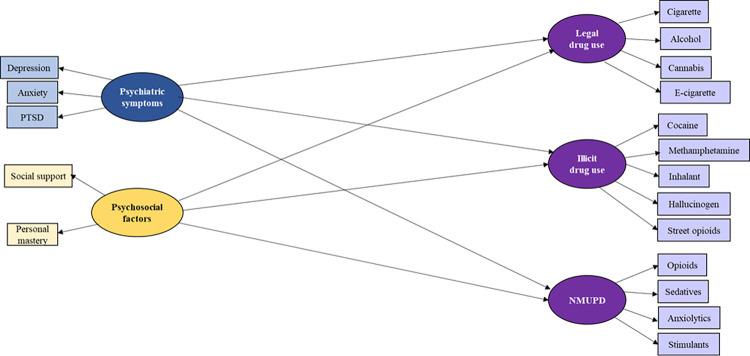
Substance use has become a critical health concern during the COVID-19 pandemic, and emerging attention has been paid to people with the persistent symptoms of COVID-19 (COVID-19 long haulers) due to their high vulnerability. However, scant research has investigated their substance use and relevant psychosocial factors. The current study was to (1) examine substance use behaviors (i.e., legal drug use, illicit drug use, and non-medical use of prescription drugs); and (2) assessed their associations with psychiatric symptoms (i.e., depression, anxiety, and post-traumatic stress disorder) and psychosocial factors (i.e., personal mastery and social support) among COVID-19 long haulers.
In January-March 2022, 460 COVID-19 long haulers (50% female), with an average age of 32, completed online surveys regarding their demographics, substance use, psychiatric symptoms, and psychosocial factors.
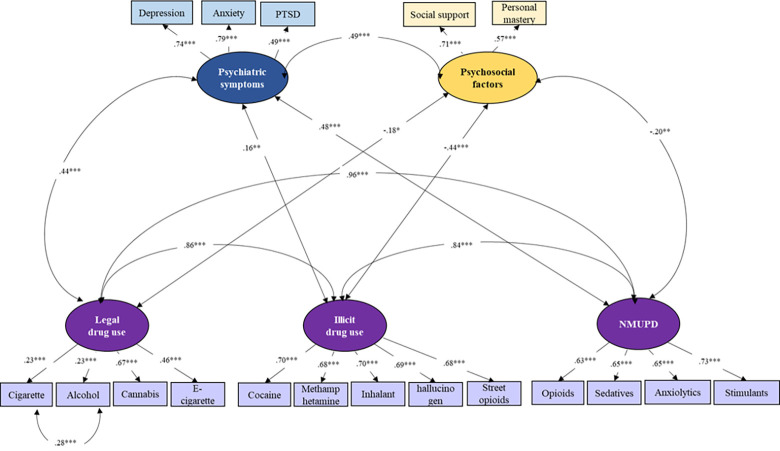
In the past three months, the most commonly used or non-medically used substances were tobacco (82%) for legal drugs, cocaine (53%) for illicit drugs, and prescription opioids (67%) for prescription drugs. Structural equation modeling suggested that psychiatric symptoms were positively associated with substance use behaviors (βs = 0.38 to .68, ps < 0.001), while psychosocial factors were negatively associated with substance use behaviors (βs = -0.61 to -0.43, ps < 0.001).
Substance use is common in COVID-19 long haulers and psychiatric symptoms are the risk factors. Personal mastery and social support appear to offer protection offsetting the psychiatric influences. Substance use prevention and mental health services for COVID-19 long haulers should attend to personal mastery and social support.
在 COVID-19 大流行期间,物质使用已成为一个严重的健康问题,由于 COVID-19 长期患者(COVID-19 长期患者)的高脆弱性,人们对他们的物质使用情况和相关的社会心理因素越来越关注。然而,几乎没有研究调查过他们的物质使用情况和相关的社会心理因素。本研究旨在:(1)调查物质使用行为(即合法药物使用、非法药物使用和非医疗处方药物使用);(2)评估这些行为与 COVID-19 长期患者的精神症状(即抑郁、焦虑和创伤后应激障碍)和社会心理因素(即个人掌握和社会支持)之间的关系。
在 2022 年 1 月至 3 月期间,460 名 COVID-19 长期患者(50%为女性)完成了关于人口统计学、物质使用、精神症状和社会心理因素的在线调查,平均年龄为 32 岁。
在过去三个月中,最常使用或非医疗使用的物质是合法药物中的烟草(82%)、非法药物中的可卡因(53%)和处方药物中的阿片类药物(67%)。结构方程模型表明,精神症状与物质使用行为呈正相关(βs=0.38 至 0.68,p<0.001),而社会心理因素与物质使用行为呈负相关(βs=-0.61 至-0.43,p<0.001)。
物质使用在 COVID-19 长期患者中很常见,精神症状是危险因素。个人掌握和社会支持似乎提供了保护,抵消了精神影响。COVID-19 长期患者的物质使用预防和心理健康服务应该关注个人掌握和社会支持。