Department of Plant Pathology, Dr. Rajendra Prasad Central Agricultural University, Pusa, Bihar, India.
Department of Entomology, Dr. Rajendra Prasad Central Agricultural University, Pusa, Bihar, India.
Sci Rep. 2024 May 31;14(1):12500. doi: 10.1038/s41598-024-60039-0.
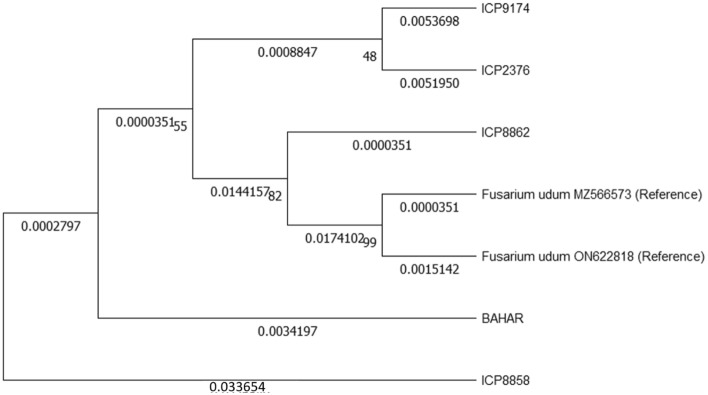
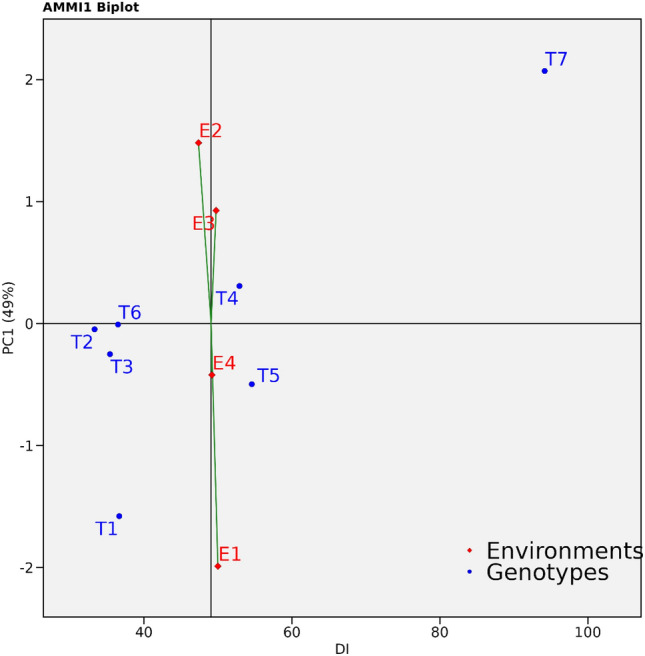
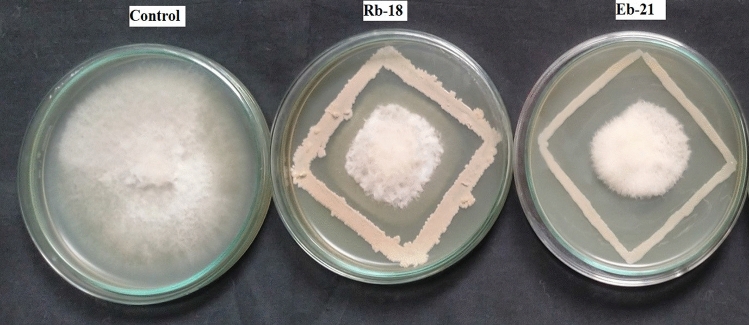
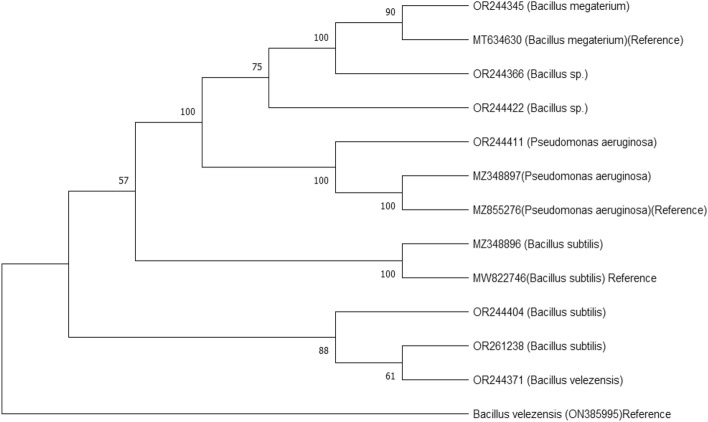
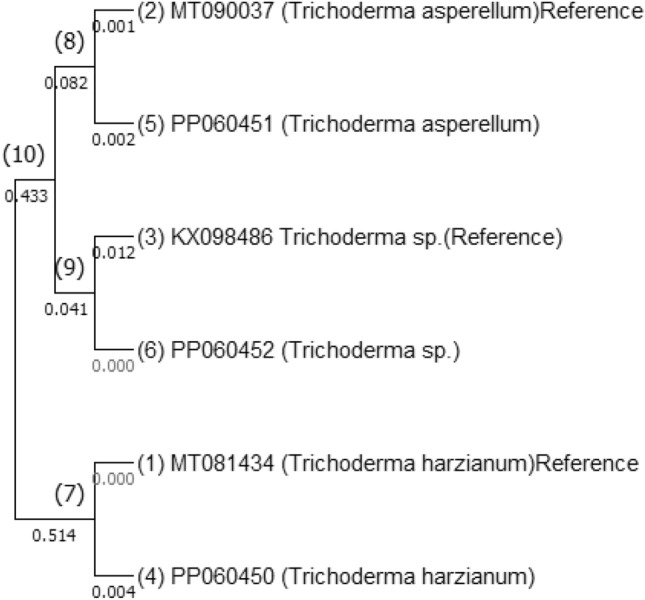
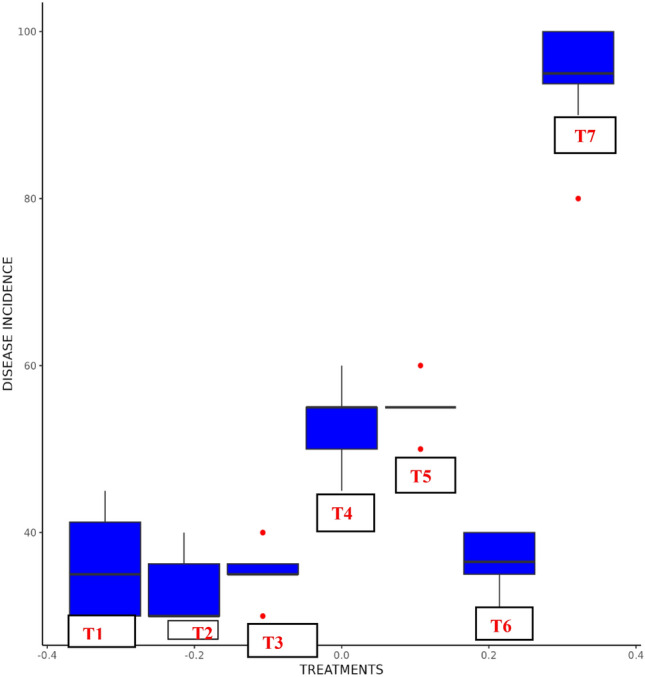
Fusarium wilt, caused by (Fusarium udum Butler), is a significant threat to pigeonpea crops worldwide, leading to substantial yield losses. Traditional approaches like fungicides and resistant cultivars are not practical due to the persistent and evolving nature of the pathogen. Therefore, native biocontrol agents are considered to be more sustainable solution, as they adapt well to local soil and climatic conditions. In this study, five isolates of F. udum infecting pigeonpea were isolated from various cultivars and characterized morphologically and molecularly. The isolate from the ICP 8858 cultivar displayed the highest virulence of 90%. Besides, 100 endophytic bacteria, 100 rhizosphere bacteria and three Trichoderma spp. were isolated and tested against F. udum isolated from ICP 8858 under in vitro conditions. Out of the 200 bacteria tested, nine showed highest inhibition, including Rb-4 (Bacillus sp.), Rb-11 (B. subtilis), Rb-14 (B. megaterium), Rb-18 (B. subtilis), Rb-19 (B. velezensis), Eb-8 (Bacillus sp.), Eb-11 (B. subtilis), Eb-13 (P. aeruginosa), and Eb-21 (P. aeruginosa). Similarly, Trichoderma spp. were identified as T. harzianum, T. asperellum and Trichoderma sp. Notably, Rb-18 (B. subtilis) and Eb-21 (P. aeruginosa) exhibited promising characteristics such as the production of hydrogen cyanide (HCN), cellulase, siderophores, ammonia and nutrient solubilization. Furthermore, treating pigeonpea seedlings with these beneficial microorganisms led to increased levels of key enzymes (POD, PPO, and PAL) associated with resistance to Fusarium wilt, compared to untreated controls. In field trials conducted for four seasons, the application of these potential biocontrol agents as seed treatments on the susceptible ICP2376 cultivar led to the lowest disease incidence. Specifically, treatments T2 (33.33) (P. aeruginosa) and T3 (35.41) (T. harzianium) exhibited the lowest disease incidence, followed by T6 (36.5) (Carbendizim), T1 (36.66) (B. subtilis), T4 (52.91) (T. asperellum) and T5 (53.33) (Trichoderma sp.). Results of this study revealed that, P. aeruginosa (Eb-21), B. subtilis (Rb-18) and T. harzianum can be used for plant growth promotion and management of Fusarium wilt of pigeonpea.
枯萎病,由(尖孢镰刀菌乌敦亚种)引起,是对全世界兵豆作物的重大威胁,导致大量减产。由于病原体的持续和演变性质,传统的方法,如杀菌剂和抗性品种,并不实用。因此,本地生物防治剂被认为是更可持续的解决方案,因为它们能很好地适应当地的土壤和气候条件。在这项研究中,从不同品种中分离出了 5 株感染兵豆的尖孢镰刀菌,并从形态学和分子学上进行了鉴定。从 ICP 8858 品种中分离出的菌株表现出最高的毒力,为 90%。此外,从 ICP 8858 中分离出的尖孢镰刀菌在体外条件下,对 100 株内生细菌、100 株根际细菌和 3 株木霉进行了分离和测试。在测试的 200 株细菌中,有 9 株表现出最高的抑制作用,包括 Rb-4(芽孢杆菌)、Rb-11(枯草芽孢杆菌)、Rb-14(巨大芽孢杆菌)、Rb-18(枯草芽孢杆菌)、Rb-19(贝莱斯芽孢杆菌)、Eb-8(芽孢杆菌)、Eb-11(枯草芽孢杆菌)、Eb-13(铜绿假单胞菌)和 Eb-21(铜绿假单胞菌)。同样,木霉被鉴定为哈茨木霉、asperellum 和木霉。值得注意的是,Rb-18(枯草芽孢杆菌)和 Eb-21(铜绿假单胞菌)表现出产生氰化氢(HCN)、纤维素酶、铁载体、氨和养分溶解等有希望的特性。此外,用这些有益微生物处理兵豆幼苗,与未处理的对照相比,与抗枯萎病相关的关键酶(POD、PPO 和 PAL)水平升高。在四个季节进行的田间试验中,将这些潜在的生物防治剂作为种子处理剂应用于易感的 ICP2376 品种,导致最低的疾病发病率。具体而言,处理 T2(33.33)(铜绿假单胞菌)和 T3(35.41)(哈茨木霉)表现出最低的疾病发病率,其次是 T6(36.5)(苯醚甲环唑)、T1(36.66)(枯草芽孢杆菌)、T4(52.91)(asperellum)和 T5(53.33)(木霉)。这项研究的结果表明,铜绿假单胞菌(Eb-21)、枯草芽孢杆菌(Rb-18)和哈茨木霉可以用于促进植物生长和管理兵豆枯萎病。