Department of Mycology and Plant Pathology, Institute of Agricultural Sciences, Banaras Hindu University, Varanasi, 221005, India.
ICAR-Indian Institute of Pulses Research, Kanpur, 208024, India.
Sci Rep. 2019 Oct 4;9(1):14344. doi: 10.1038/s41598-019-50696-x.
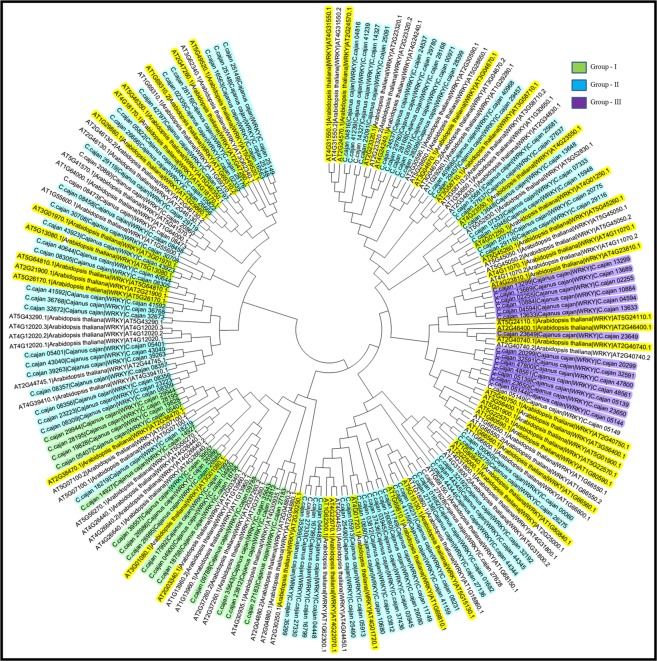
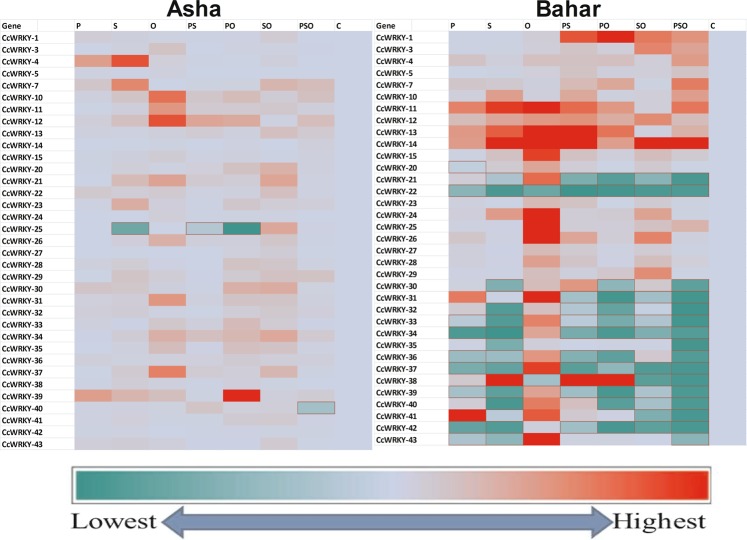
The WRKY gene family has never been identified in pigeonpea (Cajanus cajan). Therefore, objective of the present study was to identify the WRKY gene family in pigeonpea and characterize the Fusarium udum stress-responsive WRKY genes under normal, NaCl-stressed and Pseudomonas fluorescens OKC (a plant growth-promoting bacterial strain) treated conditions. The aim was to characterize the Fusarium udum stress-responsive WRKY genes under some commonly occurring field conditions. We identified 97 genes in the WRKY family of pigeonpea, using computational prediction method. The gene family was then classified into three groups through phylogenetic analysis of the homologous genes from the representative plant species. Among the 97 identified WRKY genes 35 were further classified as pathogen stress responsive genes. Functional validation of the 35 WRKY genes was done through generating transcriptional profiles of the genes from root tissues of pigeonpea plants under the influence of P. fluorescens OKC after 24 h of stress application (biotic: Fusarium udum, abiotic: NaCl). The entire experiment was conducted in two pigeonpea cultivars Asha (resistant to F. udum) and Bahar (susceptible to F. udum) and the results were concluded on the basis of transcriptional regulation of the WRKY genes in both the pigeonpea cultivars. The results revealed that among the 35 tentatively identified biotic stress responsive CcWRKY genes, 26 were highly F. udum responsive, 17 were better NaCl responsive compared to F. udum and 11 were dual responsive to both F. udum and NaCl. Application of OKC was able to enhance transcript accumulation of the individual CcWRKY genes to both the stresses when applied individually but not in combined challenge of the two stresses. The results thus indicated that CcWRKY genes play a vital role in the defense signaling against F. udum and some of the F. udum responsive CcWRKYs (at least 11 in pigeonpea) are also responsive to abiotic stresses such as NaCl. Further, plant beneficial microbes such as P. fluorescens OKC also help pegionpea to defend itself against the two stresses (F. udum and NaCl) through enhanced expression of the stress responsive CcWRKY genes when the stresses are applied individually.
WRKY 基因家族在兵豆(Cajanus cajan)中从未被鉴定过。因此,本研究的目的是鉴定兵豆中的 WRKY 基因家族,并在正常条件、NaCl 胁迫和 Pseudomonas fluorescens OKC(一种植物生长促进细菌菌株)处理条件下,对 Fusarium udum 胁迫响应的 WRKY 基因进行特征描述。其目的是在一些常见的田间条件下,对 Fusarium udum 胁迫响应的 WRKY 基因进行特征描述。我们使用计算预测方法,在兵豆的 WRKY 基因家族中鉴定出 97 个基因。然后,通过对代表植物物种的同源基因进行系统发育分析,将基因家族分为三组。在鉴定出的 97 个 WRKY 基因中,有 35 个被进一步归类为病原体胁迫响应基因。通过在施加胁迫 24 小时后,从受 P. fluorescens OKC 影响的兵豆植株根部组织中生成基因的转录谱,对 35 个 WRKY 基因进行功能验证(生物胁迫:Fusarium udum,非生物胁迫:NaCl)。整个实验在两个兵豆品种 Asha(对 F. udum 具有抗性)和 Bahar(对 F. udum 具有易感性)中进行,并根据两个品种中 WRKY 基因的转录调控得出结论。结果表明,在 35 个推测的生物胁迫响应 CcWRKY 基因中,有 26 个对 F. udum 高度响应,17 个对 NaCl 比 F. udum 更响应,11 个对 F. udum 和 NaCl 均有双重响应。当单独施加 OKC 时,它能够增强各个 CcWRKY 基因对两种胁迫的转录积累,但在两种胁迫的联合挑战中则不然。因此,结果表明 CcWRKY 基因在防御 Fusarium udum 信号中起着至关重要的作用,并且在兵豆中至少有 11 个 F. udum 响应的 CcWRKY 基因也对非生物胁迫(如 NaCl)有响应。此外,有益的植物微生物,如 P. fluorescens OKC,也通过增强胁迫响应的 CcWRKY 基因的表达,帮助兵豆在单独施加胁迫时抵抗两种胁迫(F. udum 和 NaCl)。