
土木香内酯通过靶向抑制信号转导和转录激活因子3(STAT3)的激活及下调干细胞标志物,增强黑色素瘤对丝裂原活化蛋白激酶(MAPK)通路抑制剂的敏感性。
Alantolactone enhances the sensitivity of melanoma to MAPK pathway inhibitors by targeting inhibition of STAT3 activation and down-regulating stem cell markers.
作者信息
Zhao Kun, Zhao Qi, Dai Xinzhi, Wen Xue, Luo Xing, Duan Yi, Yang Zhihui, Dai Qiong
机构信息
Department of Respiratory and Critical Care Medicine, Xinqiao Hospital, The Army Medical University, Chongqing, 400037, China.
Department of Pathology, The Affiliated Hospital of Southwest Medical University, No. 25 Taiping Street, Jiangyang District, Luzhou, Sichuan Province, 646000, China.
出版信息
Cancer Cell Int. 2024 May 31;24(1):191. doi: 10.1186/s12935-024-03371-9.
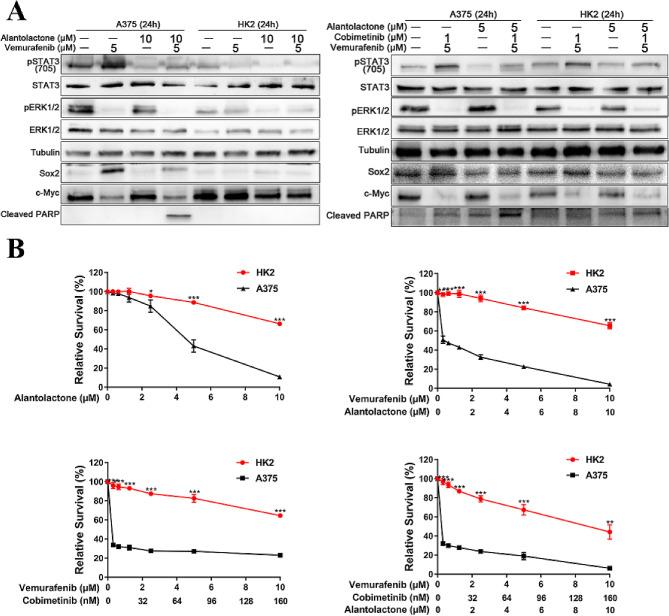
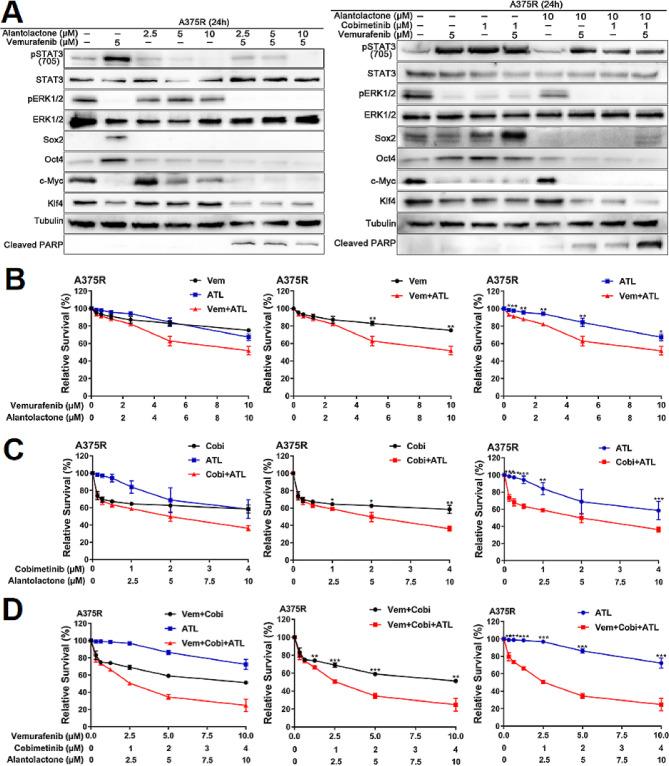
Mitogen-activated protein kinase inhibitors (MAPKi) were the first line drugs for advanced melanoma patients with BRAF mutation. Targeted therapies have significant therapeutic effects; however, drug resistance hinders their long-term efficacy. Therefore, the development of new therapeutic strategies against MAPKi resistance is critical. Our previous results showed that MAPKi promote feedback activation of STAT3 signaling in BRAF-mutated cancer cells. Studies have shown that alantolactone inhibited the activation of STAT3 in a variety of tumor cells. Our results confirmed that alantolactone suppressed cell proliferation and promoted apoptosis by inhibiting STAT3 feedback activation induced by MAPKi and downregulating the expression of downstream Oct4 and Sox2. The inhibitory effect of alantolactone combined with a MAPKi on melanoma cells was significantly stronger than that on normal cells. In vivo and in vitro experiments showed that combination treatment was effective against drug-resistant melanomas. Our research indicates a potential novel combination therapy (alantolactone and MAPKi) for patients with BRAF-mutated melanoma.
丝裂原活化蛋白激酶抑制剂(MAPKi)是携带BRAF突变的晚期黑色素瘤患者的一线用药。靶向治疗具有显著的治疗效果;然而,耐药性阻碍了其长期疗效。因此,开发针对MAPKi耐药的新治疗策略至关重要。我们之前的结果表明,MAPKi促进BRAF突变癌细胞中STAT3信号的反馈激活。研究表明,土木香内酯在多种肿瘤细胞中抑制STAT3的激活。我们的结果证实,土木香内酯通过抑制MAPKi诱导的STAT3反馈激活并下调下游Oct4和Sox2的表达来抑制细胞增殖并促进细胞凋亡。土木香内酯与MAPKi联合对黑色素瘤细胞的抑制作用明显强于对正常细胞的抑制作用。体内和体外实验表明,联合治疗对耐药黑色素瘤有效。我们的研究表明,对于携带BRAF突变的黑色素瘤患者,一种潜在的新型联合治疗方法(土木香内酯和MAPKi)。




 Zotero 插件