Jin Lin, Zhang Lijun, Yan Chunxiao, Liu Mengxin, Dean Douglas C, Liu Yongqing
Department of Ophthalmology, The Third People's Hospital of Dalian, Dalian Medical University, Dalian, 116033, China.
James Brown Cancer Center, University of Louisville School of Medicine, Louisville, KY, 40202, USA.
Eye Vis (Lond). 2024 Jun 1;11(1):20. doi: 10.1186/s40662-024-00387-0.
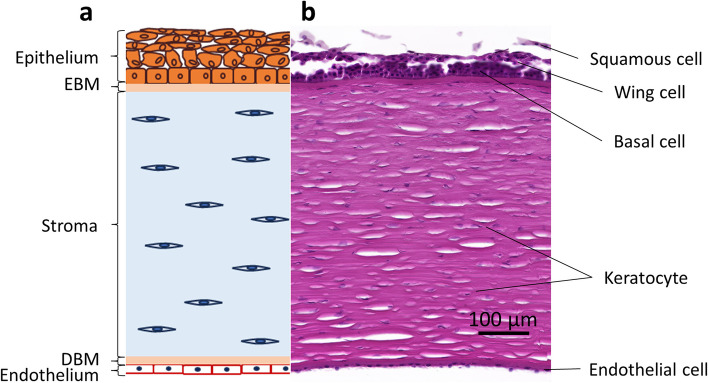
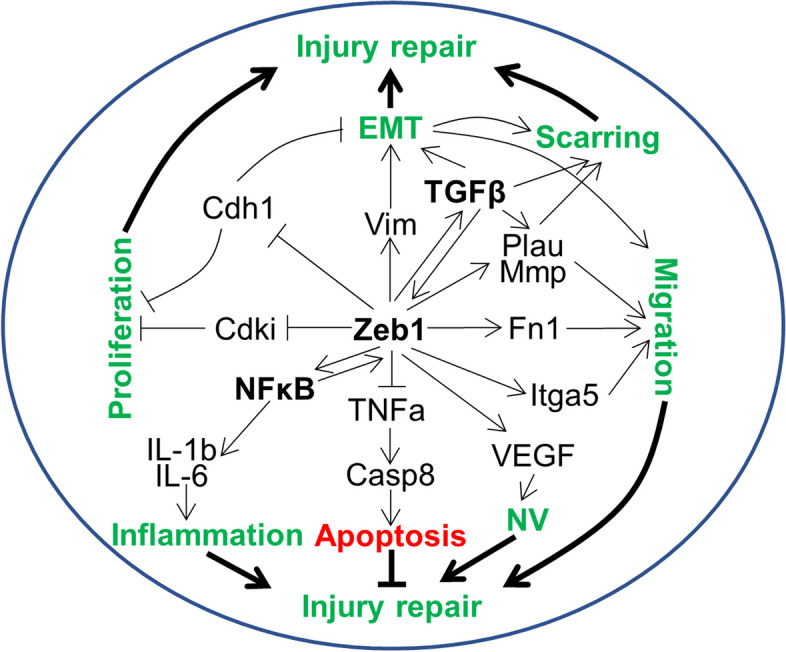
The cornea, consisting of three cellular and two non-cellular layers, is the outermost part of the eyeball and frequently injured by external physical, chemical, and microbial insults. The epithelial-to-mesenchymal transition (EMT) plays a crucial role in the repair of corneal injuries. Zinc finger E-box binding homeobox 1 (ZEB1), an important transcription factor involved in EMT, is expressed in the corneal tissues. It regulates cell activities like migration, transformation, and proliferation, and thereby affects tissue inflammation, fibrosis, tumor metastasis, and necrosis by mediating various major signaling pathways, including transforming growth factor (TGF)-β. Dysfunction of ZEB1 would impair corneal tissue repair leading to epithelial healing delay, interstitial fibrosis, neovascularization, and squamous cell metaplasia. Understanding the mechanism underlying ZEB1 regulation of corneal injury repair will help us to formulate a therapeutic approach to enhance corneal injury repair.
角膜由三层细胞层和两层非细胞层组成,是眼球的最外层,经常受到外部物理、化学和微生物损伤。上皮-间充质转化(EMT)在角膜损伤修复中起关键作用。锌指E盒结合同源框1(ZEB1)是一种参与EMT的重要转录因子,在角膜组织中表达。它调节细胞迁移、转化和增殖等活动,从而通过介导包括转化生长因子(TGF)-β在内的各种主要信号通路,影响组织炎症、纤维化、肿瘤转移和坏死。ZEB1功能障碍会损害角膜组织修复,导致上皮愈合延迟、间质纤维化、新生血管形成和鳞状细胞化生。了解ZEB1调节角膜损伤修复的机制将有助于我们制定增强角膜损伤修复的治疗方法。