Oncobiona Group, Navarrabiomed-Instituto de Investigación Sanitaria de Navarra (IdiSNA), Pamplona, Spain.
Department of Medical Oncology, Hospital Universitario de Navarra (HUN), Pamplona, Spain.
BMC Cancer. 2024 Jun 1;24(1):668. doi: 10.1186/s12885-024-12454-9.
Gastrointestinal cancers represent one of the most prevalent diseases worldwide. Strikingly, the incidence of Early Onset Gastrointestinal Cancer (EOGIC) has been rising during the last decades and changes in lifestyle and environmental exposure seem to play a role. EOGIC has been defined as a different entity compared to on-average gastrointestinal cancer, with distinct clinical and molecular characteristics. Inherent to the particularities of younger age, there is an unmet need for a tailored approach for the management of these patients. The TEOGIC proposes a comprehensive study to characterize EOGIC patients in the northern of Spain.
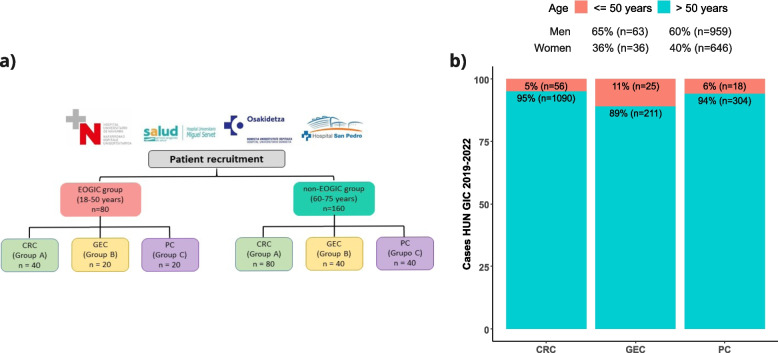
Patients with histologically confirmed new diagnosis of colorectal, gastroesophageal and pancreatic adenocarcinoma will be considered for two cohorts: EOGIC (≤ 50 years old) and non-EOGIC (60-75 years old), with a ratio of 1:2. Two hundred and forty patients will be recruited in 4 Public Hospitals from northern Spain. After receiving unified informed consent, demographic and clinical data of the patients will be collected in a REDCap database. Lifestyle related data will be obtained in questionnaires assessing diet, physical activity and the general quality of life of the patients before diagnosis. Biological samples prior to any onco-specific treatment will be obtained for the analyses of circulating inflammatory proteins, gut microbiota, and the proteome of the tumor microenvironment. Histologic characteristics and routine biomarkers will be also collected. Thereafter, data will be integrated and analyzed to assess tumor specific, pan-tumor and sex-associated differential characteristics of EOGIC.
The underlying risk factors and differential characteristics of EOGIC remain poorly studied, particularly in our geographical area. Although limited by the exploratory nature and the small sample size estimated to be recruited, TEOGIC represents the first attempt to comprehensively characterize these young patients, and thus attend to their special needs. Findings derived from this study could contribute to raise awareness and preventive behaviors in the population. In parallel, molecular studies could lead to the identification of potential novel non-invasive biomarkers and therapeutic targets that would help in the development of the tailored clinical management of these patients, focusing on screening programs for early diagnosis and precision medicine.
胃肠道癌是全球最常见的疾病之一。令人震惊的是,早发性胃肠道癌(EOGIC)的发病率在过去几十年中一直在上升,生活方式和环境暴露的变化似乎起到了作用。EOGIC 与一般胃肠道癌不同,具有独特的临床和分子特征。由于年龄较小的特殊性,这些患者的管理需要一种量身定制的方法。TEOGIC 提出了一项全面的研究,以描述西班牙北部的 EOGIC 患者。
将组织学证实患有新诊断的结直肠、胃食管和胰腺腺癌的患者纳入两个队列:EOGIC(≤50 岁)和非 EOGIC(60-75 岁),比例为 1:2。将从西班牙北部的 4 家公立医院招募 240 名患者。在收到统一的知情同意书后,将在 REDCap 数据库中收集患者的人口统计学和临床数据。通过评估患者诊断前饮食、体育活动和总体生活质量的问卷,获得与生活方式相关的数据。在进行任何肿瘤特异性治疗之前,将获得生物样本,用于分析循环炎症蛋白、肠道微生物群和肿瘤微环境的蛋白质组。还将收集组织学特征和常规生物标志物。然后,将整合和分析数据,以评估 EOGIC 的肿瘤特异性、泛肿瘤和性别相关的差异特征。
EOGIC 的潜在风险因素和差异特征仍研究不足,特别是在我们的地理区域。尽管由于估计招募的探索性性质和样本量较小而受到限制,但 TEOGIC 代表了全面描述这些年轻患者的首次尝试,从而满足了他们的特殊需求。从这项研究中得出的发现可以有助于提高人们对该人群的认识和预防行为。同时,分子研究可能会导致发现潜在的新型非侵入性生物标志物和治疗靶点,这将有助于为这些患者量身定制的临床管理的发展,重点是早期诊断和精准医学的筛查计划。