Carroll Kaitlin L, Frugé Andrew D, Heslin Martin J, Lipke Elizabeth A, Greene Michael W
Department of Nutrition, Dietetics and Hospitality Management, Auburn University, Auburn, AL, United States.
Mitchell Cancer Institute, University of South Alabama, Mobile, AL, United States.
Front Nutr. 2022 Jun 9;9:896330. doi: 10.3389/fnut.2022.896330. eCollection 2022.
Colorectal cancer in adults 50 years old and younger is increasing in incidence worldwide. Diet may be a modifiable risk factor. The objective of this study was to examine evidence regarding the association between diet and the risk of developing early-onset colorectal cancer (EOCRC) and early-onset colorectal adenomas in young adults.
PUBMED, Web of Science, and Embase were systematically searched for studies examining dietary intake as a risk factor for EOCRC and early-onset colorectal adenomas. Results were synthesized narratively due to the heterogeneity of the studies.
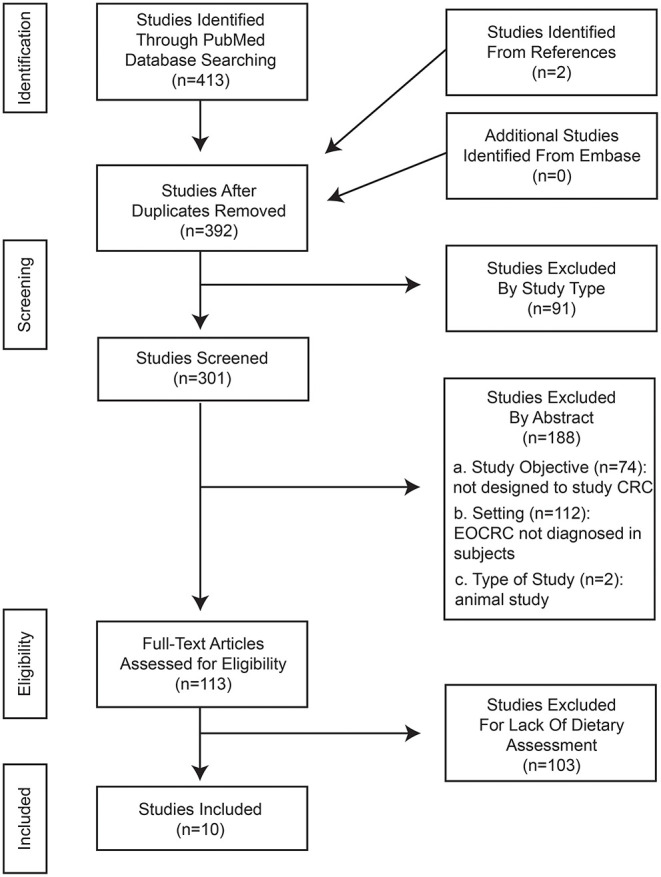
Of the 415 studies identified, ten met the inclusion criteria. Of these ten studies, four provided data on dietary risk factors for early-onset colorectal adenomas and six provided data on dietary risk factors for EOCRC. The four studies that measured colorectal adenoma occurrence reported an increased incidence with high sugar sweetened beverage intake, a higher pro-inflammatory diet, a higher Western diet score and higher sulfur microbial diet score. A protective effect against early-onset colorectal adenomas was observed in those who had a higher Prudent diet score or higher adherence to other health dietary approaches (Dietary Approaches to Stop Hypertension, Alternative Healthy Eating Index-2010, or the alternative Mediterranean diet). Those who consumed large amounts of deep-fried foods, refined foods, followed a high fat diet, consumed large amounts of sugary drinks and desserts, and had low folate and fiber consumption had a significantly higher occurrence of EOCRC. A protective effect against EOCRC was observed for those who consumed more fruits and vegetables, high amounts of micronutrients and those who adhered to a vegetarian diet.
The results of this study reveal various dietary habits may be risk factors or protective against early-onset colorectal cancer and adenomas. Future research should focus on large prospective cohort studies with long-term follow-up to confirm published results and further examine whether differences in diet quality are associated with EOCRC risk.
全球范围内,50岁及以下成年人的结直肠癌发病率正在上升。饮食可能是一个可改变的风险因素。本研究的目的是检验有关饮食与年轻人早发性结直肠癌(EOCRC)及早发性结直肠腺瘤发生风险之间关联的证据。
系统检索了PUBMED、科学网和Embase数据库,以查找将饮食摄入作为EOCRC和早发性结直肠腺瘤风险因素的研究。由于研究的异质性,对结果进行了叙述性综合分析。
在确定的415项研究中,有10项符合纳入标准。在这10项研究中,4项提供了早发性结直肠腺瘤饮食风险因素的数据,6项提供了EOCRC饮食风险因素的数据。4项测量结直肠腺瘤发生率的研究报告称,高糖甜味饮料摄入量增加、促炎饮食程度更高、西方饮食评分更高以及硫微生物饮食评分更高会导致发病率上升。在谨慎饮食评分较高或对其他健康饮食方法(终止高血压饮食法、2010年替代健康饮食指数或替代地中海饮食)依从性较高的人群中,观察到对早发性结直肠腺瘤有保护作用。大量食用油炸食品、精制食品、遵循高脂肪饮食、大量饮用含糖饮料和食用甜点以及叶酸和纤维摄入量低的人群,EOCRC的发生率显著更高。食用更多水果和蔬菜、大量摄入微量营养素以及坚持素食的人群对EOCRC有保护作用。
本研究结果表明,各种饮食习惯可能是早发性结直肠癌和腺瘤的风险因素或具有保护作用。未来的研究应侧重于进行长期随访的大型前瞻性队列研究,以证实已发表的结果,并进一步研究饮食质量差异是否与EOCRC风险相关。